


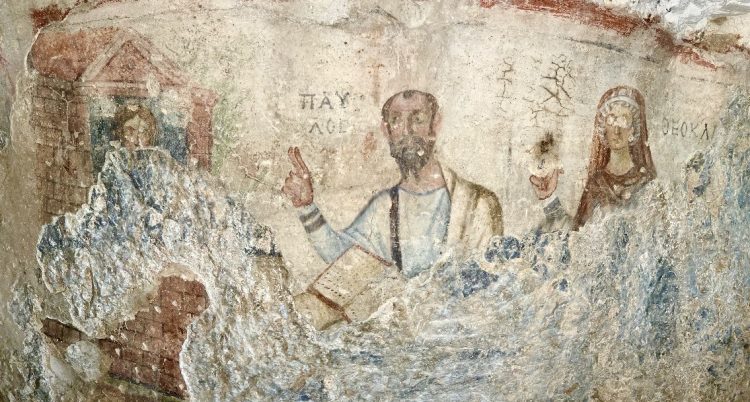

After the first missionary journey, Paul did not return to Asia Minor immediately. He spent some time in Antioch, debating the conditions under which Gentile converts should be admitted to the Christian community. The famous Council of Jerusalem, around 49 AD, settled the question. Gentiles could be admitted to full Christian fellowship without circumcision and without full observance of the Jewish law. Paul’s missionary strategy was vindicated.
Then he went back. The second missionary journey, in 49 to 52 AD, took him through Asia Minor again, and then on to Greece, returning briefly through Asia Minor on the way back to Antioch. Then almost immediately he set out on the third missionary journey, in 53 to 56 AD, which included his major three-year stay in Ephesus. By the time he finally left Ephesus around 56 AD, he had been working in Asia Minor, on and off, for almost a decade.
In this article I want to walk you through the whole arc of Paul’s second period in Asia Minor or Paul’s Second Visit to Asia Minor and Ephesian Years. The second missionary journey through the highlands. The redirect from Asia. The vision at Troas. The brief Ephesus visit on the way home. The third missionary journey. The long Ephesian ministry. The riot of the silversmiths. The departure.
This is, in volume, the most consequential period of Paul’s career. Most of the seven churches of the Apocalypse were founded during these years. Many of his most famous letters were written during these years. The shape of European and Mediterranean Christianity, for the next two thousand years, was determined in large part by what Paul did in Asia Minor between 49 and 56 AD.
The Second Journey Begins
The second journey started, as the first had, from Antioch in Syria. But this time, Paul did not travel with Barnabas. The disagreement over John Mark, which I described in the previous article, had separated the two old friends. Barnabas took John Mark and sailed to Cyprus. Paul took Silas, a Greek-speaking Roman citizen from Jerusalem, and went overland to Asia Minor.
The land route was a deliberate choice. Paul wanted to visit the churches he had founded on the first journey. He walked north from Antioch, through Cilicia, then up over the Taurus mountains via the great pass called the Cilician Gates, then westward along the southern Anatolian highlands. He revisited Derbe, Lystra, Iconium, Antioch in Pisidia. In each city, he encouraged the small Christian communities. He delivered the decisions of the Jerusalem Council. He confirmed the practical implications of Gentile inclusion.


At Lystra, the city where he had been stoned, Paul met a young man named Timothy. Timothy’s mother was a Jewish Christian. His father was a Greek. He had been raised in the faith from childhood. Paul recognized in him the qualities of a future leader. Timothy joined the missionary team. He would become, in the years to come, one of Paul’s closest co-workers and the recipient of two of the most pastoral letters in the New Testament.
The Strange Redirects
After completing the visits to the first-journey churches, the team continued westward into the region called Phrygia. Their plan, almost certainly, was to enter the great Roman province of Asia, that is to say, the western coastal region with its major cities — Ephesus, Smyrna, Pergamon, the future seven churches.
But, in one of the strangest small details of Acts, the Holy Spirit prevented them.
Now when they had gone throughout Phrygia and the region of Galatia, and were forbidden of the Holy Ghost to preach the word in Asia, after they were come to Mysia, they assayed to go into Bithynia: but the Spirit suffered them not. And they passing by Mysia came down to Troas. *

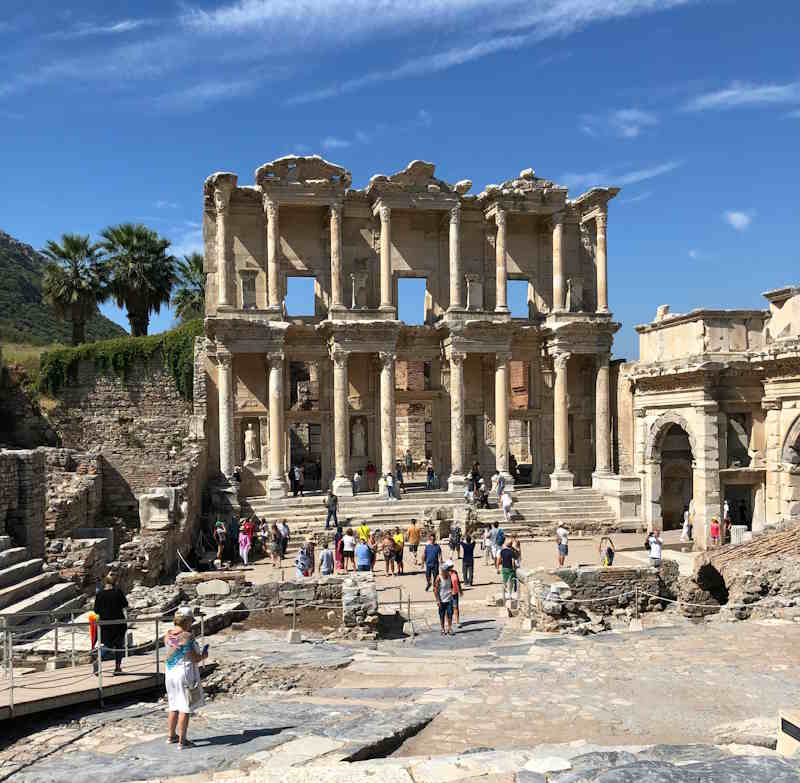


The text does not explain how the Spirit prevented them. It might have been a vision. It might have been a sense of internal blockage in prayer. It might have been external obstacles — illness, weather, political events — which they read as divine guidance. We do not know. What we know is that Paul tried to go into Asia, was somehow redirected, tried to go into Bithynia in the north, was again redirected, and ended up at the small port town of Troas on the northwest coast.
I have always found this detail revealing. Paul, who is so often presented as the bold confident apostle, was in fact, in this period, a confused traveller. He had clear plans. The plans were not working. Each time he tried a new direction, something stopped him. He kept moving, looking for an open door. The eventual destination — Macedonia and Greece — was not in his original plan. It was, in some sense, imposed on him by the closure of the alternatives.
The Vision at Troas


At Troas, Paul had the famous vision. A man of Macedonia stood and asked him, Come over into Macedonia, and help us. The next morning, the team understood. They sailed across the Aegean to Greece. The next two years would be spent in Macedonia, Greece, Athens, and Corinth, founding the European churches — Philippi, Thessalonica, Berea, Athens, Corinth.
This is when Paul became, in some sense, the apostle to Europe. Not to Asia. Not to inland Anatolia. Europe. The shift had been resisted, then accepted. Paul went where the Spirit redirected him.
I will not retell the Greek part of the story here. The article is about Asia Minor, not Greece. What matters for our purposes is that, after about two years in Greece, Paul travelled back eastward, sailing from Corinth to Ephesus, briefly visiting the city, and then sailing back to Caesarea and Antioch.
The Brief Ephesus Stop
The brief Ephesus stop on the second journey is mentioned in Acts chapter 18. Paul stayed only a few days. He preached in the synagogue. The local Jews asked him to stay longer. He refused, saying he had to go to Jerusalem for the Jewish feast, but promising to return.
I will return again unto you, if God will. *
He left two of his companions in Ephesus, however. Aquila and Priscilla, the husband-and-wife couple who had become his close co-workers in Corinth, stayed behind in Ephesus to prepare the ground. They opened a small textile workshop. They formed a house church. They began the careful preparation that would, three years later, support Paul’s return.

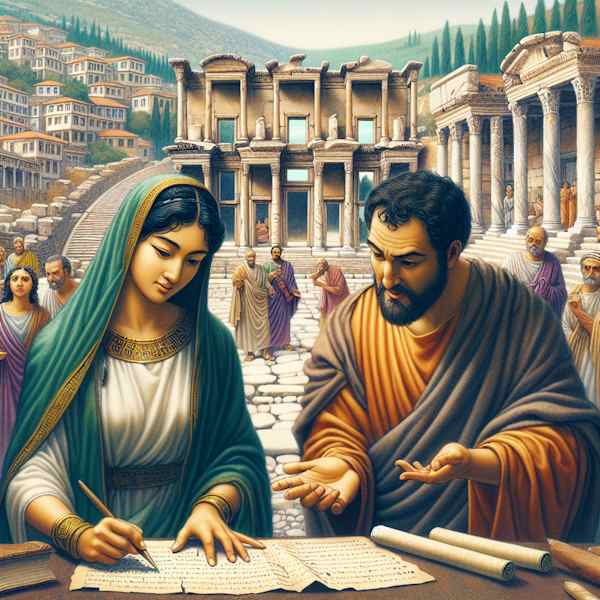
This pattern of advance team missionary work is interesting. Paul did not just walk into a new city alone. He sent friends ahead. He left friends behind. He built networks. The Christian community of Ephesus, when Paul finally returned in 53 AD, was not starting from zero. It had been quietly preparing for several years.
The Third Journey: The Return
After the brief stop in Antioch in Syria, Paul almost immediately set out on the third journey. He went overland, again, through Cilicia, over the Taurus mountains, and across the Anatolian highlands. Again he visited the churches of the first journey. Again he encouraged the local communities. By the autumn of 53 AD, he had reached Ephesus.


He stayed for almost three years.
This is the longest single ministry of Paul’s career. The most concentrated. The most productive. The most consequential. Almost everything that happened in Ephesus during these years was significant.
The First Days at Ephesus
When Paul arrived, the Ephesian church had been functioning for about three years under Aquila and Priscilla and a few other local leaders. The first significant event Paul had to deal with was the case of the twelve disciples.

These were twelve men, probably converts of Apollos or of the Baptist movement which had spread eastward from Palestine, who knew of Jesus but had only received the baptism of John the Baptist. They had not received the Holy Spirit in the Christian sense. Paul recognized that they were, in some way, only partially Christian. He explained the gospel more fully to them. They were rebaptized in the name of Jesus. They received the Holy Spirit. They became part of the Ephesian Christian community.
The episode is small but instructive. The early Christian movement was not, in this period, a single uniform organism. There were multiple streams of related but distinct teaching. The disciples of John the Baptist, the disciples of Apollos, the disciples of Paul, the disciples of the original Jerusalem apostles, all overlapped and intersected. Part of Paul’s work in Ephesus was to integrate these various streams into a single coherent Christian community.
The Hall of Tyrannus
Paul began his teaching, as usual, in the synagogue. After three months, the synagogue rejected him. He moved his teaching to a public lecture hall belonging to a man called Tyrannus. We do not know who Tyrannus was. Probably a local rhetorician or philosophy teacher whose hall could be rented during off hours.
Acts says that Paul taught daily at the hall of Tyrannus for the space of two years. Some manuscripts add the detail from the fifth hour to the tenth hour, that is, from 11 AM to 4 PM. The midday hours. The siesta hours. The hours when the lecture hall was empty because the local people were resting from the heat.


This is a small but very practical detail. Paul taught when others were resting. He used the hot dead hours of the Anatolian afternoon. The arrangement was probably cheaper, since the hall would have been less in demand. It also fit with the daily rhythm of working people who could come to listen during their own midday break.
The two years of daily teaching produced enormous results. Acts says that all that dwelt in Asia heard the word of the Lord, both Jews and Greeks. The seven churches of the Apocalypse were probably almost all founded in this period, by Paul’s disciples working from the Ephesian school. Smyrna, Pergamon, Sardis, Thyatira, Philadelphia, Laodicea, plus the smaller communities of Colossae and Hierapolis — all of them probably trace their first generation of Christians to this Ephesian period.
The Burning of the Magic Books
Ephesus in the first century was famous for its magic. The city had a reputation across the empire for magical formulas, amulets, and written spells. Even the philosopher Plutarch mentions the Ephesia Grammata, the Ephesian writings, as a brand name in the magic industry.
During Paul’s stay, two strange and very vivid stories happened in this magic-rich environment.

The first was the affair of the seven sons of Sceva. These were Jewish exorcists who tried to copy Paul’s methods. They went around the city saying, I exorcise you by the Jesus whom Paul preaches. According to Acts, an evil spirit answered them with one of the most ironic lines in the New Testament. Jesus I know, and Paul I know, but who are you? The possessed man jumped on them, beat them up, and they ran out of the house naked and wounded.
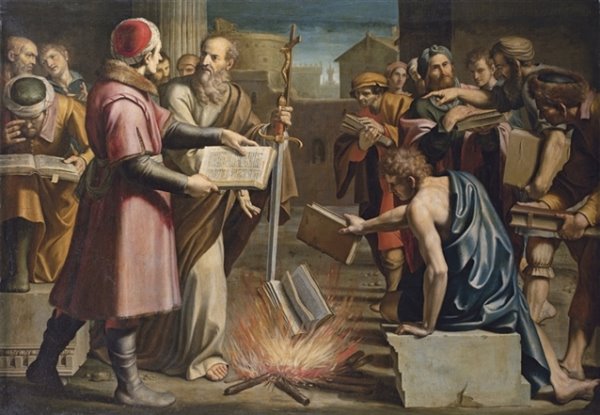
The story spread quickly. And then the second strange event happened. Many people who had been practicing magic in Ephesus brought out their books of spells and burned them publicly. Acts gives us the value — fifty thousand pieces of silver. This is a huge amount, the equivalent of fifty thousand days’ wages of a working man. The bonfire of expensive scrolls in the middle of one of the great cities of the Roman world was a turning point.
The Riot of the Silversmiths
But not everyone in Ephesus was happy. The most dramatic biblical event in our city is the famous riot in Acts chapter 19. I have written about it in several earlier articles in this series, so I will be brief here.
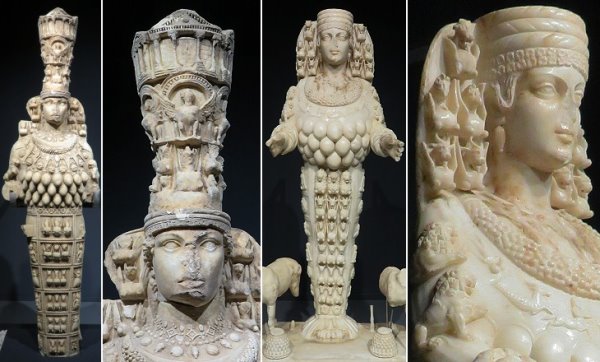
The Temple of Artemis was the centre of the regional economy. Around it, an entire industry of small silver Artemis statuettes was produced for the pilgrim trade. A silversmith named Demetrius, watching Paul’s success, realized that if Christianity continued to spread, the Artemis trade would collapse. He gathered his colleagues. He gave a speech which is one of the most honest moments in the Bible. Our craft is in danger to be set at nought, and the temple of the great goddess Diana will be despised.

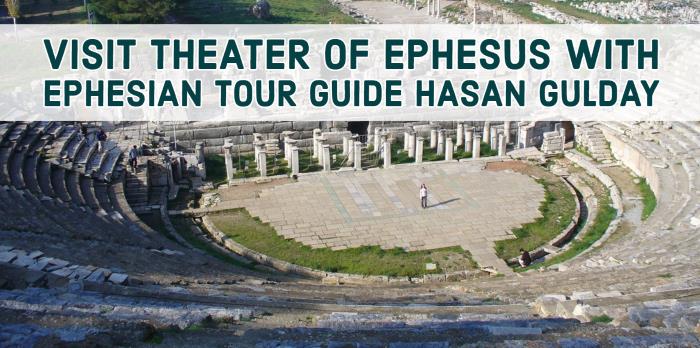
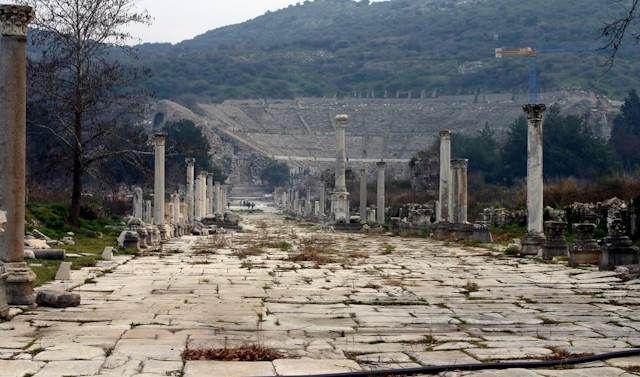
The crowd became furious. They poured into the Great Theatre, the same theatre with twenty-five thousand seats which my guests can still walk into today. They dragged two of Paul’s companions, Gaius and Aristarchus, with them. For almost two hours they shouted one single sentence at the top of their voices. Megale he Artemis Ephesion! Great is Artemis of the Ephesians!
The riot was finally calmed by the city clerk, the grammateus, who reminded the crowd that they could be charged by the Romans for an unauthorized assembly. The crowd dispersed. Paul, whose friends had wisely persuaded him not to enter the theatre in person, left Ephesus shortly afterwards, never to return as a free man.
What Paul Wrote in Ephesus
During his three years at Ephesus, Paul wrote at least two of his major letters. The first letter to the Corinthians was written from Ephesus, around 54 or 55 AD. The letter to the Galatians was probably also written here, although the dating is disputed. The lost previous letter to the Corinthians, mentioned in 1 Corinthians 5, was definitely written from Ephesus. The lost severe letter mentioned in 2 Corinthians may also have been written here.

So Ephesus was not just a missionary base. It was also a writing centre. Paul, in those years, was producing some of the most important Christian theological documents ever composed. The community around him — Aquila, Priscilla, Timothy, Titus, the local elders, the disciples — formed a kind of Pauline writing workshop. They debated. They edited. They sent letters to other churches. They received letters back. The intellectual life of Christian Ephesus, in the mid-50s AD, was unusually intense.
The Departure
Around 56 AD, Paul left Ephesus. The riot had probably accelerated his decision, but the decision had been made before. He sailed first to Macedonia. From there to Greece. From there back through Asia Minor on his way to Jerusalem with the great collection for the poor of the Jerusalem church.
On this final passage through Asia Minor, Paul stopped briefly at the small port of Miletus, about fifty kilometres south of Ephesus. He sent for the elders of the Ephesian church to come to meet him there. The famous farewell speech that follows, recorded in Acts chapter 20, is one of the most moving passages in the New Testament.

Take heed therefore unto yourselves, and to all the flock, over the which the Holy Ghost hath made you overseers, to feed the church of God, which he hath purchased with his own blood. For I know this, that after my departing shall grievous wolves enter in among you, not sparing the flock. *
Paul knew, by this point, that he would probably never return to Ephesus. He was going to Jerusalem. He suspected that imprisonment was waiting there. The farewell to the Ephesian elders was, for him, the closing of his Asian career.
The text says that they all wept sore, and fell on Paul’s neck, and kissed him. The most painful detail is the next sentence. Sorrowing most of all for the words which he spake, that they should see his face no more.
This is the moment when Paul’s long Ephesian ministry ended. With weeping. With kisses. With a clear understanding, on both sides, that this was the last meeting. The road was about to lead Paul away from Asia Minor for good.
One Closing Image

I will leave you with one image instead of the standard pitch.
The harbour of ancient Miletus is, today, mostly silt. The river Maeander has filled in the bay over the centuries. The original docks where Paul’s ship was tied up are now somewhere under farmland, several kilometres inland from the modern coastline. The site is open to visitors, but most people who come to it are looking at the impressive Roman theatre or the temple of Apollo, not at the modest small harbour where the farewell happened.
I have stood, several times, at the place where the harbour used to be. Late afternoon, with the small wildflowers growing in the cracks between the stones, with the distant noise of farm tractors in the surrounding fields. The wind is usually moving, gently, from the southwest, the same direction Paul’s ship would have sailed. The light is the same kind of soft Aegean light that he would have seen.
Here, on this old harbour, an old missionary said goodbye to his closest disciples. They wept. They kissed him. They went back to their city. He sailed away.
The Asian career was over. The Roman career was about to begin.
Come and let’s visit the very same locations where Paul spent his three years doing god’s work. Contact me learn more on these places and to hire a professional, Biblical tour guide in Turkey.
See you soon, Hasan Gülday