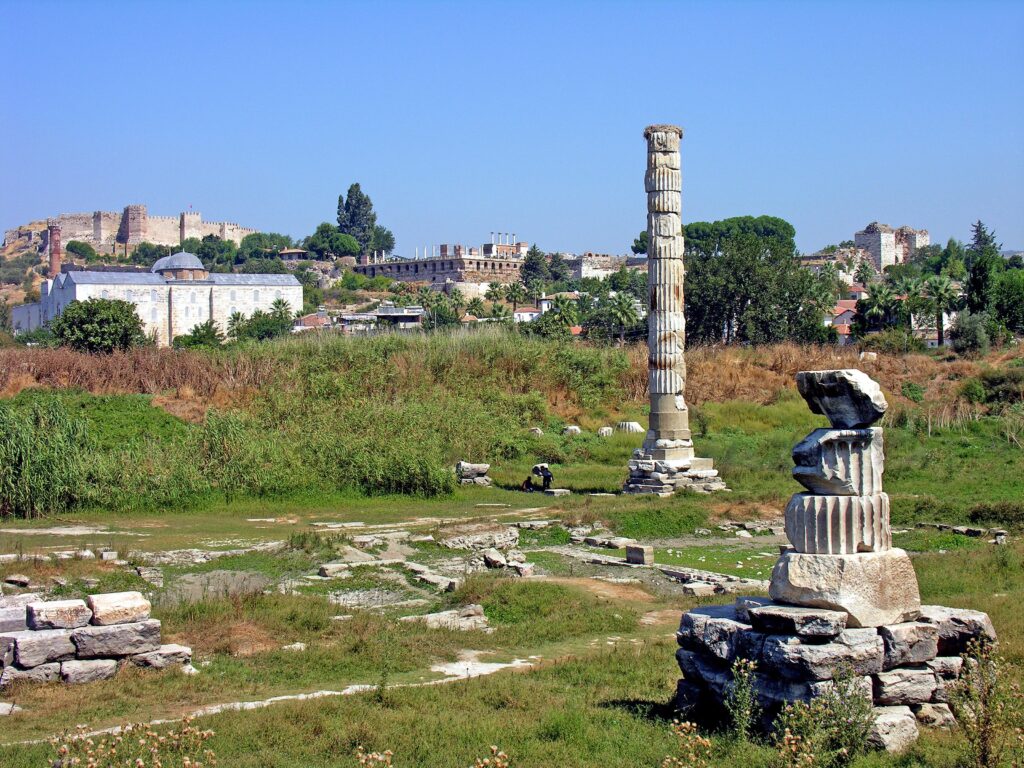
Temple of Artemis in Ephesus is one of the Seven Wonders of the Ancient World. Another name of the Temple of Artemis in Ephesus is the Temple of Diana. The Temple of Artemis has been used as a religious place, where it has been visited by kings, artists, merchants, and tourists for centuries, offering their beliefs to the goddess.
| Where | Selçuk, near the Ephesus Ancient City, in Izmir Province |
|---|---|
| Built | About 550 BC, and rebuilt after the fire of 356 BC |
| Famous as | One of the Seven Wonders of the Ancient World |
| Goddess | Artemis, called Diana by the Romans. Many people keep May 6th as her birthday |
| Left today | Foundations, marble blocks and one rebuilt column |
Location of Artemis Temple

Temple is located near the ancient city of Ephesus in the Selçuk district of Izmir. There is not much left behind from the Artemis temple. Temple was built in 550 BC for Artemis, the goddess of fertility by the King of Lydia Kroisos. Today two magnificent statues of the temple are preserved in the Selçuk Museum.
Destruction and Reconstruction of the Artemis Temple
Original Temple was burned by a person named Herostratus on July 21, 356 BC, the day of Alexander the Great’s birth. With the spread of Christianity in Ephesus by St. Paul, the belief in pagan goddess Artemis (Diana) began to weaken. The temple of Artemis was destroyed by the Goths in 362, but the Ephesians rebuilt the temple. The temple of Artemis was completely destroyed by St. John Chrysostom since Christianity was completely accepted in Ephesus in the 4th century.
Discovery of Artemis Temple

Excavations started in 1863 by the archeologist John Turtle Wood under the sponsorship of the British Museum, and the foundations of the Temple of Artemis were discovered in 1869 after a 6-meter deep excavation. Columns and sculptures found as a result of excavations are currently preserved in the British Museum. There is currently only one column left at the original location of the temple. There is nothing left standing from the Temple of Artemis in Ephesus Ancient City so there is no exact information about its real look. The only information about the temple is what was written by the historian Plynus. The historian Plynus explains that the Temple of Artemis had a rectangular architecture of 115 meters in length and 55 meters in width and it was made entirely of marble. Stating that the height consists of 18 meters high, 127 columns with ionic reliefs.
What Is Left of the Temple of Artemis Today?
Today the Temple of Artemis in Ephesus is a low, grassy hollow just outside Selçuk, a few meters below the fields around it, with its foundations, scattered marble blocks and one column put together from pieces found on the site.
Water has always been the problem here. After the temple was torn down, the whole area lay for centuries in the way of several streams, and their mud covered the ruins layer by layer, up to 4 meters in some places. In 2017 the excavation holes were full of rainwater and the site looked like a swamp.
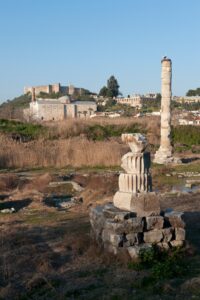
In 2021 the Ministry of Culture and Tourism finished a landscaping project around the ruins, so that visitors can walk around them more easily. By the way, the storks on top of the column are not there for the photo. They come back to their nest every spring.
Life on the Temple Site in the Middle Ages
The site was not empty in the Middle Ages. In Seljuk and early Ottoman times, from the 12th to the 15th century, houses stood on top of the mud all over the old sanctuary. It was the edge of Ayasuluk, the Turkish town of the Isa Bey Mosque.
Excavators found a Seljuk farmhouse about two meters under the ground, a lot of glazed pottery and the tools of a potter’s workshop, like molds and three-legged kiln stands. A hoard of coins hidden around 1370 shows how rich was the trade of Ayasuluk in those days. Later there was a Turkish cemetery here, and after the 15th century land was probably used for farming.
Byzantine Twins Buried at the Artemision
One of the saddest finds of the sanctuary came from its odeon, a small music hall built in the 1st century AD about 175 meters southwest of the temple. In 2010 archaeologists found a tiny grave in an old latrine channel of the building, with two babies who were born too early, at about 33 and 34 weeks.
The babies were buried together and they were probably twins. Their family built a small box grave for them from reused roof tiles, bricks and stone slabs. It dates between AD 692 and 887, long after the last prayers to Artemis, and it shows that somebody buried these children with great care.
Did Hagia Sophia Take Columns from the Temple of Artemis?
You may hear that some columns of Hagia Sophia in Istanbul were taken from this temple. It is a legend of the late Middle Ages and there is no truth in it. The stones of the temple were really reused, but mostly nearby, and they probably went into the fortress walls on Ayasuluk Hill till the 7th and 8th centuries.
Why Do Old Books Call It the Temple of Diana?
Because Roman writers used the Latin name of the goddess. After Ephesus came under Roman rule in 129 BC, the Romans matched the local Artemis with their own Diana, and Latin books speak of the Temple of Diana at Ephesus.
The goddess of Ephesus was local form of Artemis, a goddess of fertility with her own look, quite different from the huntress with a bow that most people picture. Her priests and her sanctuary belonged to Ephesus, whatever name the visitors used.
A small warning for your searches: Rome had its own Temple of Diana on the Aventine Hill, and Roman ruins in Nîmes in France, Mérida in Spain and Évora in Portugal are also called a Temple of Diana. None of them is the temple of Ephesus.
Temple of Artemis Facts and Figures
Here are the Temple of Artemis facts my guests ask about most, in one table. The temple stood on marshy ground on purpose, it took a very long time to build, and its builders mixed the marble with cedar and cypress wood.
| Fact | Detail |
|---|---|
| Building time | It is said that it took about 120 years, with help from all the cities of Asia |
| Foundations | Layers of pounded charcoal and sheep fleeces under the marble, laid on marshy ground so that earthquakes would not shake the temple |
| Columns | 36 of the 127 columns were carved with figures at the bottom, and old writers say every column was the gift of a king |
| Wood in a marble temple | Cedar for the roof beams and the ceilings, cypress for the doors, which were said to last 400 years |
| Rebuildings | By the 1st century AD Roman writers already counted seven, and the Ephesians rebuilt it once more after the Goths |
The marble temple of King Croesus is believed to be first Greek temple built fully of marble. When I stand with my guests at the single column, I ask them to picture 127 of them and a roof of cedar high above the swamp. Then the water around the ruins makes sense: the builders wanted soft ground under one of the biggest buildings of their world.
Frequently Asked Questions
Is the Temple of Artemis in the Bible?
Yes, in Acts 19. The silversmith Demetrius made silver shrines of Artemis, and a crowd shouted “Great is Artemis of the Ephesians!” in the Great Theater. Some older Bibles call her Diana.
How many times was the Temple of Artemis rebuilt?
Many times. A flood destroyed early temple in the 7th century BC, and the great marble temple of about 550 BC replaced it. After the fire of 356 BC the Ephesians rebuilt it, larger than before.
Is the Temple of Artemis the same as the Parthenon?
No, they are two different temples. The Parthenon stands in Athens and was built for Athena. The Temple of Artemis stood in Ephesus and was much bigger.
Is the Temple of Diana the same as the Temple of Artemis?
Yes, at Ephesus they are one temple. Artemis is the Greek name of the goddess and Diana is the Roman name, so the Seven Wonders temple is known by both names. Only the Ephesus one was a Seven Wonder.
What was the Temple of Artemis made of?
Marble, from the steps to the roof tiles, and that was new for a Greek temple. Only the roof beams and the ceilings were wood, and the Ephesians chose cedar because it lasts. The doors were made of cypress.
Why was the Temple of Artemis built on marshy ground?
Because of earthquakes. The builders believed that soft, wet ground would not pass the shaking on to the temple. To stop it from sinking, they laid pounded charcoal and sheep fleeces under the foundations. The same wet ground is the reason the site is full of water today.
How long did the Temple of Artemis stand?
The marble temple of King Croesus stood about 200 years, from around 550 BC to the fire of 356 BC. The temple built after the fire stood even longer, for many centuries, till the Goths came and the old religion ended in the 4th century.
Tour Guide for Artemis Temple in Ephesus
You can always write to me to ask and learn more about the Temple of Artemis in Ephesus. You can book a professional licensed Ephesus tour guide to Ephesus Temple of Artemis. See you soon, Hasan Gülday


4 comments