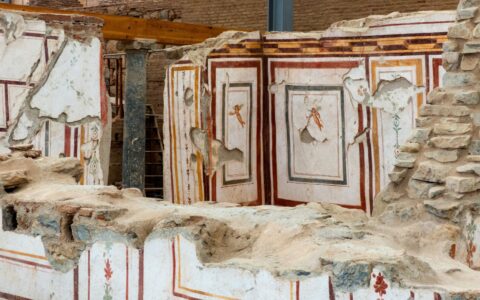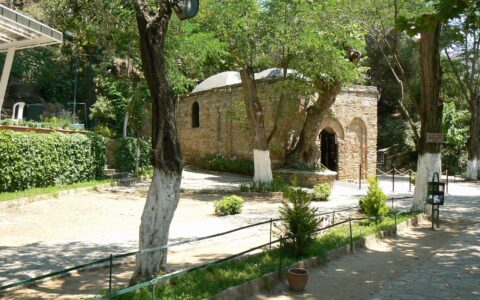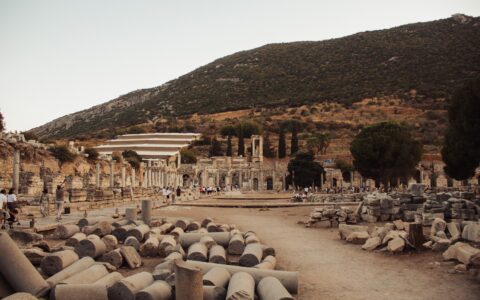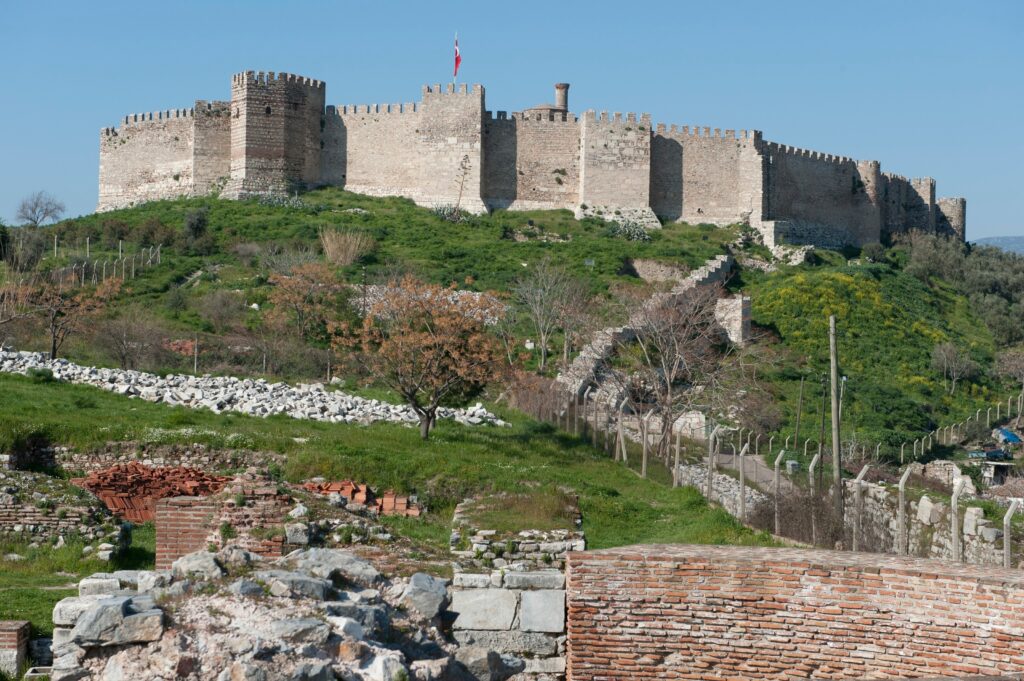
Ayasuluk Hill, also known as Ayasuluk Höyük, is an ancient mound located in İzmir Province, Turkey. It holds a special place within the Ephesus UNESCO World Heritage Site and boasts a rich historical legacy. Towering over the heart of Ephesus Ancient City, Ayasuluk Hill serves as a gateway to the city’s enigmatic past and breathtaking panoramas. As a tour guide, let me take you on a journey through time as we explore this remarkable site.
| Where | Selçuk, İzmir Province |
|---|---|
| Also called | Ayasuluk Höyük |
| On the hill | The Ayasuluk Fortress on top, the Basilica of Saint John on the slope |
| Periods | Prehistoric times to the Ottoman era |
| Part of | The Ephesus UNESCO World Heritage Site, since 2015 |

The earliest traces of human settlement on Ayasuluk Hill date back to the Hittite era of the 2nd millennium BC, when it was known as Apasa. Even before the start of the Helladic period around 1050 BC, there is evidence of Mycenaean presence in the area. Ayasuluk Hill is believed to be the original location of Ephesus before the city moved a few kilometers away. Over time, Ephesus shifted from its coastal position to this elevated hill.
Ayasuluk Hill boasts the distinction of being Ephesus’s first settlement. Archaeological evidence suggests the hill was inhabited as far back as the Hittite period (roughly 1600 BC – 1180 BC). During the Hellenistic period (323 BC – 31 BC), Ephesus flourished as a major port city, leaving its mark on history. Over time, the city shifted its location, but by the Byzantine Era (330 AD – 1453 AD), Ephesians returned to city’s birthplace which was Ayasuluk Hill.
Excavations on Ayasuluk Hill
Excavations on Ayasuluk Hill have found a Mycenaean grave from around 1400 BC, pottery of the Early Iron Age, an early spring sanctuary and graves of the Classical, Hellenistic and Byzantine periods. So the hill was a home, a holy place and a cemetery for thousands of years.
The Mycenaean grave was found on the south side of the hill, nearby the Gate of Persecution of the Basilica of Saint John. Mycenaean pots were laying inside it. In 2021 a small Mycenaean figurine came out of the ground on the hill too. So the people living here were in touch with the Mycenaean world long before the Ionian Greeks arrived.
The Early Iron Age, the dark centuries after the end of the Bronze Age, is the least known part of the story of Ephesus. Pottery of this time has been found on Ayasuluk Hill, and the same kind of pottery turns up at the Temple of Artemis on the plain below. So it is believed that the first people who worshipped there lived up on the hill. It is still not clear if they were old local families or the Ionian newcomers who came with Androklos in the legend.
On steep north side of the hill there was probably an early spring sanctuary too. The rock face there is covered with a thick crust of lime and small stalactites, left by a strong spring that once ran over it. Niches cut into the rock and a stone base, which was later turned into a sarcophagus, probably mark the place of the old shrine.
Sanctuaries at springs were known in Anatolia since the time of the Hittites, so this holy place may be very old. The spring probably dried up by the Early Iron Age, when the hill had lost its trees. By the way, a chamber tomb is cut into the same rock wall.
Graves and Ancient DNA of Ayasuluk Hill
In 2022 the Ephesus Museum started a rescue excavation south of the Ayasuluk Fortress, in the Atatürk neighborhood of Selçuk, and found 26 graves in an area of about 180 square meters. They belong to the Classical, Hellenistic and Byzantine periods, so this slope was used as a cemetery again and again.
The graves show seven different ways of burial:
- simple graves dug into the earth
- burials inside amphoras, the big clay jars
- empty amphora graves for people whose bodies were not there
- graves under roof tiles set like a small gable roof
- graves under roof tiles leaning to one side
- two clay sarcophagi of the Klazomenai type, named after the old city nearby Urla
- a clay grave shaped like a cylinder
Rich and poor families used the same cemetery. Some people had a fine Klazomenai sarcophagus and others only a hole in the earth, but all of them were laid to rest on Ayasuluk Hill.
The people of the hill have even given us their DNA. Three skeletons from the 4th century BC were found at the foot of the walls on the hill during the excavations of 2007 and 2008. All three carry the same maternal line, the haplogroup T2b of European origin. The right thigh bone of one of them shows a wound from a sharp object, which was probably the cause of death.
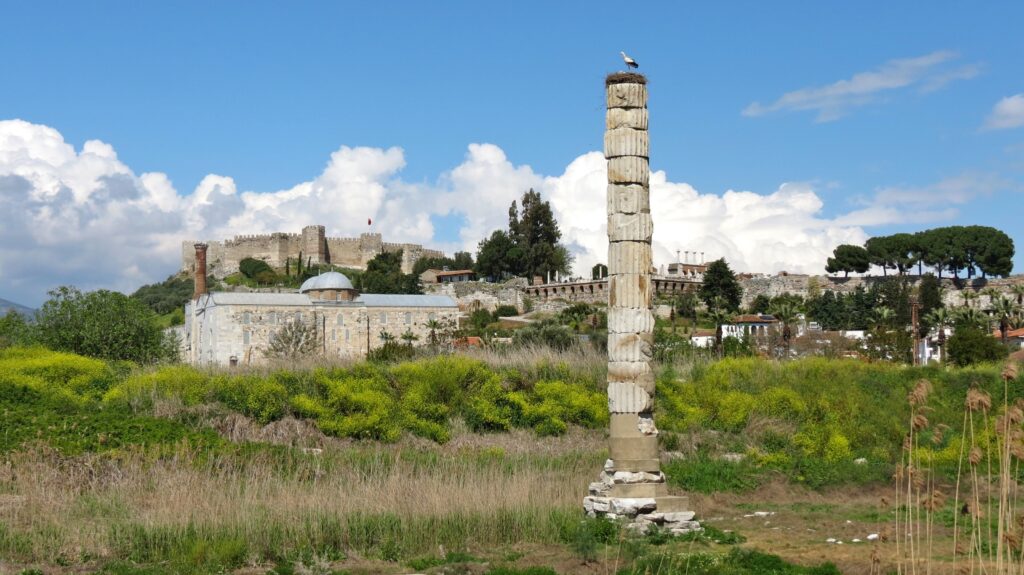
Today the top of Ayasuluk Hill belongs to the Ayasuluk Fortress, and the fortress is open to visitors. I recommend my guests to walk up after the Basilica of Saint John. From up there you see the Temple of Artemis, the Isa Bey Mosque and the plain where most of these stories happened.
Frequently Asked Questions
What was Apasa?
Apasa was the capital of the kingdom of Arzawa in Hittite times. It is believed to be the settlement on Ayasuluk Hill, and the later name Ephesus is probably related to it. More in my post On Ephesus History.
What does Ayasuluk mean?
Ayasuluk comes from Hagios Theologos, medieval Greek for Holy Theologian, which was the title of Saint John. In Turkish the hill is Ayasuluk Tepesi, and tepe means hill. See my post on Saint John the Evangelist.
Where is Ayasuluk Hill?
Ayasuluk Hill rises over the town of Selçuk in İzmir Province, near the ruins of Ephesus. The Basilica of Saint John is laying on its slope, and the Ayasuluk Fortress, which is open to visitors, stands on top.

Hire An Ephesian Tour Guide
Ayasuluk Hill serves as an unforgettable prelude to your Ephesus visit. After soaking in the city’s panoramic view from the hilltop, you can lose yourself in the ancient city’s enigmatic streets, listening to the echoes of the past. The enchanting atmosphere of Ephesus, coupled with the historical fabric of Ayasuluk Hill, promises a unique experience. Contact me to learn more about Ephesus and to hire professional tour guide for Ephesus ancient city. See you soon, Hasan Gülday!