Tetragonos Agora in Ephesus – Commercial Market in Ephesus
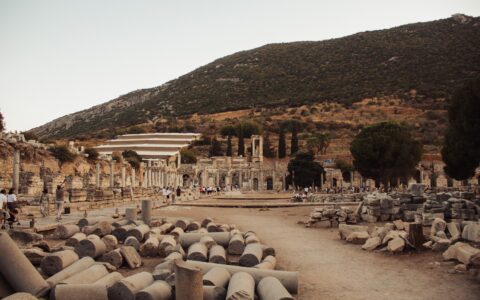
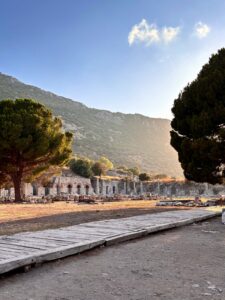
Tetragonos Agora in Ephesus was the place where commercial facilities and goods were located. Tetragonos Agora can be considered commercial center of Ephesus. Commercial Agora of Ephesus was first established in the 3rd century BC and took its final shape during the Roman Emperor Augustus’ era. However, after a great earthquake in the fourth century AD, the commercial agora of Ephesus was damaged and could not be used for a long time. A new agora was established in the northern part of the old one in the 6th century AD by recycling ruins of the old one.

3 sides of the Ephesus State Agora are surrounded by columns. It is known that in the agora there are offices for civil servants, but also religious and political meetings took place here too. There is a temple dedicated to the Egyptian God Isis in the middle of the agora. There was a significant number of Egyptians living in Ephesus. The section connecting newly established agora to the old one today serves as the police station center of the Ephesus Gendarmerie. Agora measures 157 meters by 157 meters being a nearly perfect square.
Shops of the Tetragonos Agora
About 100 rooms stood behind the colonnades of the Tetragonos Agora. Most of them were shops and workshops but some were used as meeting places of guilds and associations. Some shops had a mezzanine, a small upper floor for storing goods or for an office. In front part of the shop the owner kept his table, his shelves and his weights.
Traders also sold goods in the open square, under tents and on wooden stalls. Keeping such a crowded place clean was not easy, and several inscriptions found here ask the people to take care of the agora. Weights were checked by market officials called agoranomoi, and some lead weights carry their names. Greek weights made in Ephesus carried a bee, the symbol of the city.
By the way, the Ephesus Museum in Selçuk has more than 300 ancient weights, the richest collection of ancient Ionia. They go from Greek lead weights till Byzantine glass weights of the 5th to 7th centuries with monograms on them.
Agora South Gate

The Agora South Gate was built in the 2nd century BC, financed by Mazeus and Mithridates, two former slaves who were liberated by the Roman Emperor. The legislation and official declarations about the market place were hung on the gate informing shop owners. It was completely destroyed as a result of an earthquake that occurred in the thirteenth century and was restored during the restoration works of Ephesus.
Hall of Nero and the Tomb of Dionysius
The Hall of Nero, also called the Neronian Hall, was a long Doric hall on the east side of the agora, above Marble Street. It was about 150 meters long with two aisles, and its inscription dedicated it to Artemis of Ephesus, Emperor Nero, his mother Agrippina and the people of Ephesus, so it dates from the time of Nero, who ruled from 54 to 68 AD. Its western half stood on top of the shop rooms of the agora’s east side.
The floor of the hall was about 1.7 meters higher than Marble Street, and from the street you only saw a closed wall with a small door at the north end. In late Roman times the north end was raised for about 1 meter more for ceremonies. The hall may have been a court of law, but nobody knows for sure.
Under the stairs that went up to the hall from the south, close to the South Gate, is the tomb of Dionysius, a famous orator from Miletus. He was buried here around the middle of the 2nd century AD and his freedman Claudius Eutychus built the tomb. A bronze statue of Dionysius stood above its door. Being buried in the heart of the city was a great honor, just like Celsus under his library nearby.
Commercial Agora of Ephesus is an eye-catching part of Ephesus Ancient city in Turkey. I love to spend some free time in this agora, having some great photo opportunities. You can always contact me to learn more about Ephesus Commercial Agora. Contact me if you need to hire a professional licensed Turkish tour guide to take you to Ephesus Commercial Agora. See you soon, Hasan Gülday.