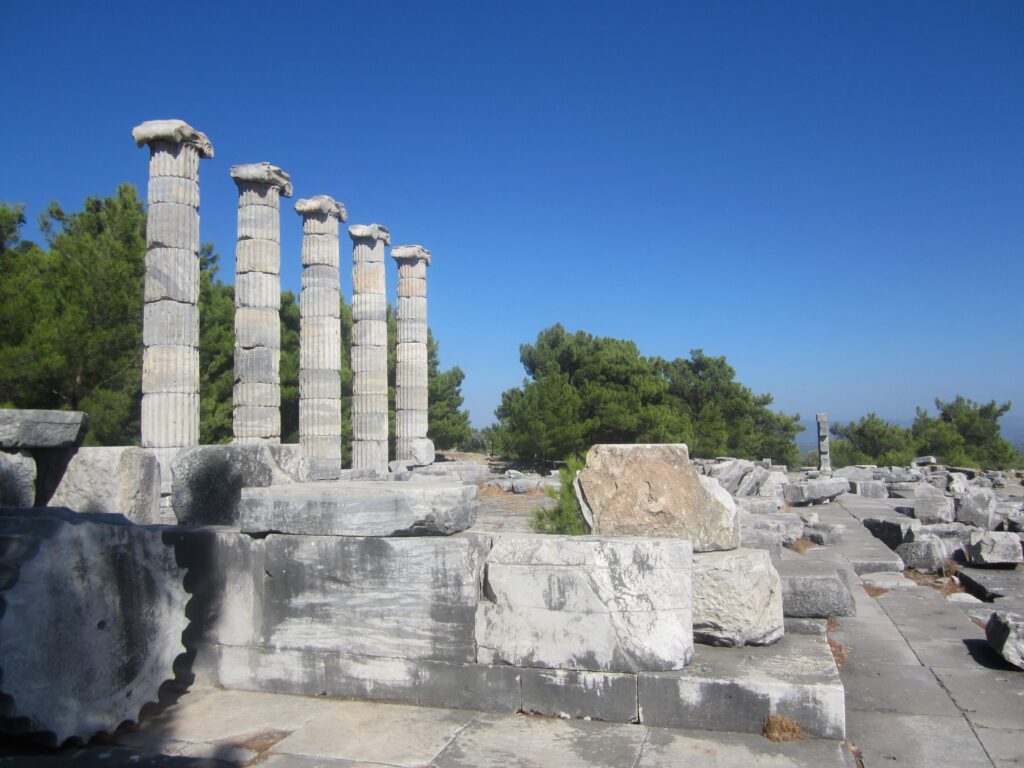
The Ionian League was an alliance of twelve Greek cities in Ionia, on the west coast of Anatolia and on the islands of Chios and Samos. It took shape around the middle of the 7th century BC. The cities met at a shared sanctuary, the Panionion on Mount Mycale.
| Also called | Panionic League |
|---|---|
| Members | Twelve Greek cities of Ionia; Smyrna joined later |
| Founded | Around the middle of the 7th century BC |
| Center | The Panionion on Mount Mycale, near Güzelçamlı |
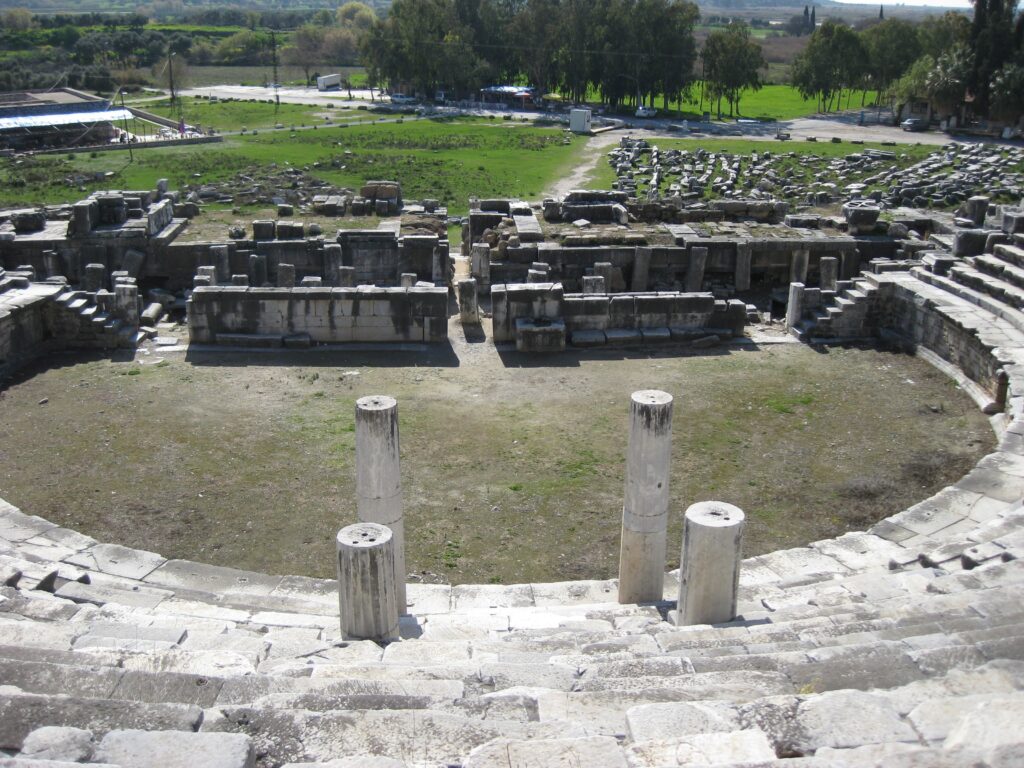
Ionia is definitely the best preserved and the most detailed historic part of Anatolia. 12 Ionian cities are Phocaea, Erythrae, Clazomenae, Teos, Lebedus, Colophon, Ephesus, Priene, Myus, and Miletus on Anatolian mainland and also two of the Greek islands of today’s Chios and Samos. They had complete unity in culture and religion, but Ionians lacked unity in politics. Ionians are pioneers of free-thinking and positive sciences. The foundation of philosophy, mathematics, and medical sciences were laid in Ionia. Ionians were very well-developed in palace and temple building and many of those can be still visited today. There were several reasons which made Ionia a center of culture more than two and a half thousand years ago. Which were;
- They were at the crossroads of important trade routes coming from Asia.
- They were in contact with many civilizations of the east and the west thanks to trade.
- Ionian cities were enriched by the colonies they established.
- They gave great importance to free thought and protected it.
- The lack of religious pressure on science and philosophy.
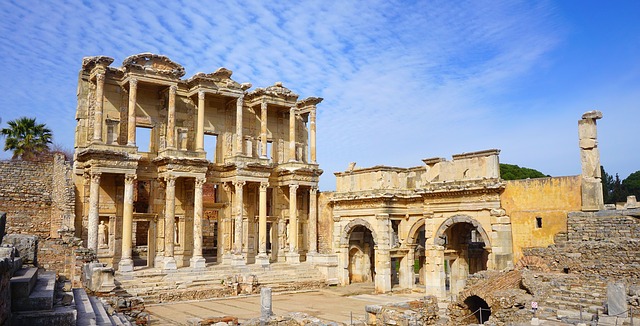
Their religion was polytheistic and their most important god was Zeus. They had most of their colonies in the Mediterranean and the Black Sea. They raised important people of science and philosophy. Some of them were Tales and Pythagoras in Mathematics, Herodotus in History, Diogenes in Philosophy, Hippocrates in medicine. They used the Phoenician alphabet and Ionians created their works in this still readable alphabet. The most important Ionian author was Homer who wrote Iliad and Odyssey.
The Ionian League had a real address, and it can still be visited: the Panionion, the federal sanctuary on the north slope of Mount Mycale above the village of Güzelçamlı, about half an hour south of Kuşadası, where I live. Herodotus records that the twelve cities gathered there for the festival of Poseidon Helikonios. What surprises the people I take there is how modest it is — a terrace, some rock-cut steps, a low rise in a field beside the road. Visitors looking for a temple drive past it every day.
Panionia Festival of the Ionian League
The Panionia was the religious festival and games of the Ionian League at the Panionion. In the early 4th century BC, when wars around Mount Mycale made the sanctuary unsafe, the Ionians moved the festival for a while to a safe place near Ephesus.
The people of Priene, on the other side of the mountain, looked after the sanctuary and led the sacrifices to Poseidon. There is a dramatic story about the time of the move. Ionians were told by the oracle of Delphi to take copies of the old altars of Poseidon from Helike, a city on the Gulf of Corinth in Greece, where the god had a famous temple.
They sent men to ask for the statue of Poseidon, or at least a model of his temple, but the people of Helike refused. In the winter of 373 BC an earthquake and a big wave swallowed Helike, and the city disappeared under the sea. The Greeks believed it was the anger of Poseidon.
In the time of Alexander the Great the festival went back to the Panionion, and it continued under the Romans too, but it never became as important as before. The rock-cut seats on the hill are believed to be the council house of the League, from the 4th century BC when the League and its festival came back to life.
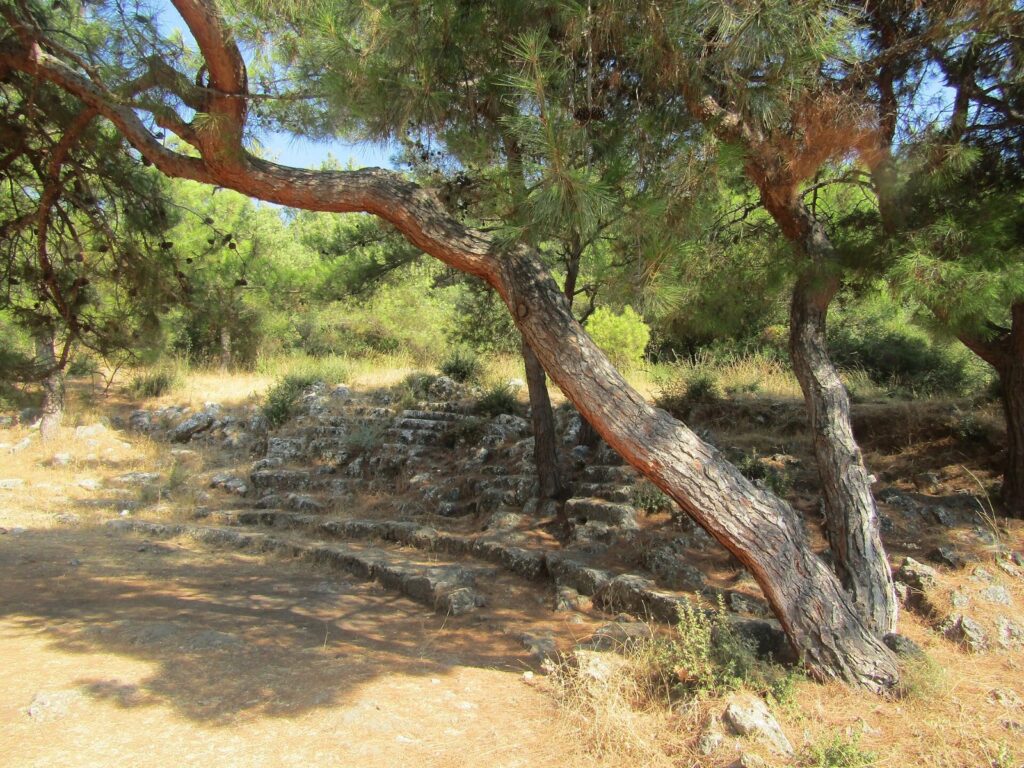
The hill is on the way to the Dilek Peninsula National Park, so I recommend my guests to stop there for a short visit before the beaches of the park. Sitting on these stones, it is easy to imagine the delegates of the twelve cities talking about war and peace.
The Panionion, Sanctuary of Poseidon Helikonios
The Panionion, Panionium in Latin, was the sanctuary of Poseidon Helikonios and the shared holy place of the twelve Ionian cities, on the north slope of Mount Mycale, which we call Samsun Dağı in Turkey. No temple was ever found there. On the top of the hill stood a long altar of about 17 by 4 meters inside a low wall, and the sacrifices were made in the open air, facing the sea.
Poseidon Helikonios was the Poseidon of Helike in Greece, the old home of the Ionians before they sailed to Anatolia, so the cult was also a memory of home. Young men of the cities led a bull to the altar, and when the bull bellowed under the knife, the Ionians took it as a good sign from the god. The priest was always a man of Priene.
Between the altar hill and the council seats there is a big cave, and nobody knows for sure what it was used for. By the way, local people call the hill Otomatik Tepe, the machine gun hill, a strange name for the holiest spot of Ionia. 😀
Two Panionion Sites on Mount Mycale
There are two places on Mount Mycale which may be the Panionion. The first is the hill above Güzelçamlı with the altar and the council seats, known since the 1950s. The second is a ridge called Çatallar Tepe, about 750 meters high inside the mountain, where a survey found in 2004 a walled town of the 7th century BC and an Ionic temple of the 6th century BC.
It is believed this high town was Melie, the Carian town that the Ionians took and shared out in their first common action, and that the temple next to it was the first Panionion. When the League came back to life in the 4th century BC, the Ionians probably built the new meeting place lower down, nearby the road and the sea, where you visit it today. The high site has no road and no signs, so it is a walk for mountain lovers, not a stop for a tour.
How to Reach the Panionion from Kuşadası
From Kuşadası take the coast road south through Davutlar toward Güzelçamlı and the national park. The low hill of the Panionion is beside the road at the entrance of Güzelçamlı, a few minutes before the gate of the park. There is no ticket office and no fee, you park on the roadside and walk up. Minibuses between Kuşadası and Güzelçamlı pass right by it too.
Half an hour is enough for the seats and the altar hill. I like to combine it with Priene on the other side of the mountain, the city that kept the sanctuary, or with a swim at the beaches of the park in Summer. More ideas for this side of the mountain are in my post on places of interest in Aydın.
Frequently Asked Questions
Who were the members of the Ionian League?
Twelve Greek cities, ten on the mainland coast and the two islands of Chios and Samos. Smyrna started as an Aeolian city next door and joined later as the thirteenth member.
Who were the Ionians?
The Ionians were one of the main Greek tribes and spoke the Ionic dialect. By tradition they sailed from mainland Greece to the west coast of Anatolia. Their thinkers are in my post on ancient philosophers of Anatolia.
Did the Ionian League still exist under the Romans?
Yes, it lasted through the Hellenistic and Roman periods till the 3rd century AD. Under Romans it even issued its own coins with the emperor’s portrait. More in my post on Roman Ephesus vs Hellenistic Ephesus.
Where is the Panionion?
On the north slope of Mount Mycale at Güzelçamlı, a short drive south of Kuşadası on the road to the Dilek Peninsula National Park. Look for a low hill with rock-cut seats beside the road. A second candidate, found in 2004, lies high up the mountain at Çatallar Tepe.
Why did the Ionians meet at the Panionion?
Because it was holy ground that belonged to all twelve cities and to none of them alone, in the middle of the Ionian coast and easy to reach by sea. Here the cities sacrificed to Poseidon together, held the games of the Panionia and talked about common problems, like the Lydian and Persian kings on their borders.
It is a pleasure for me to take my guests around the Ionian cities today. Tours are always fun and full of information when we visit ancient cities like Ephesus, Priene, and Miletus. Touring these ancient cities is possible nearly every day of the year thanks to the warm climate of western Turkey. Most of the cities of the Ionian league are well excavated and ready to be explored. You can always contact me to ask a question about the Ionian league and also to book a professional licensed Turkish tour guide who is specialized in Ionian cities. See you soon, Hasan Gülday.


1 comment