Due to the geographical structure and climatic characteristics of our Turkey, a large amount of various products are grown in our amazing country. Some products such as watermelon and wheat can be grown easily in many areas of Turkey.

Watermelon is grown in average in all parts of our country. However, the places where watermelon is grown in the highest amount are Diyarbakır in the Southeastern Anatolia region, Adana in the Mediterranean region, and Ankara and Çankırı in our Central Anatolia region.
Annual production of 4 million tons of watermelons are made in Turkey. Per capita watermelon consumption is around 50 kg. Adana is the province with the most watermelon production. Approximately 25% of watermelon production is made in Adana. The watermelon production of approximately 900 thousand square meters in area in Turkey is made.

What Kind of Watermelons Are Grown In Turkey?
Watermelon is planted in the spring after the danger of frost is gone. The soil is plowed deep. In each hole opened, 3 – 4 seeds are planted mostly at a depth of 2 – 5 cm. After the seeds germinate, the first hoeing is made. In addition, sweet watermelon is grown in dry conditions. Adult watermelons resonate, their dried stem easily breaks off, they are light. Watermelons are named for the quality, shape and the place where they grow:

Yepyeni hayat karpuzu: It is planted in large amounts in the Marmara part. It is light green, thin-skinned, dark red, crispy, sweet and fleshy. The seeds are white and small.
Alacalı karpuz: There are even dark spots on the light green rind. Crust is crispy. Its flesh is pink-red and its seeds black.
Black watermelon: It is also called black watermelon because it has a thick, dark green rind, a lot of sugar and a taste, and the middle part of its flesh looks like ice. The seeds are tiny and red. There are also black ones.

Gülle karpuzu: It is a late growing winter variety. It is dark green and shaped like a rose.
Washington watermelon: An early grown sweet, thin rind version of watermelon.
Diyarbakır watermelon: Variegated green, with a large amount of thick skin, round and in the shape of a shoulder, it is large, which can weigh 20 – 30 kg. There are also those who come with 50 – 60 kg. It is not counted with too much sugar, its meat is also pulp.

The Largest Watermelon in Turkey Exceeded 52 Kilos!
Adil Aydın, who grows watermelon near the Diyarbakır-Batman highway, came to his land in the early hours of the morning with field workers to collect the crop. Aydın could not hide his joy in the sight of the scenery he saw. Aydın weighed all the watermelons to find the heaviest product. Aydın experienced a second joy when he saw the weight of the last brought watermelon. The watermelon weighing 52 kilos and 300 grams was taken from Adil Aydın’s field, weighed with the help of two people, and then put in his personal car and kept under protection. *
Turkish Melons
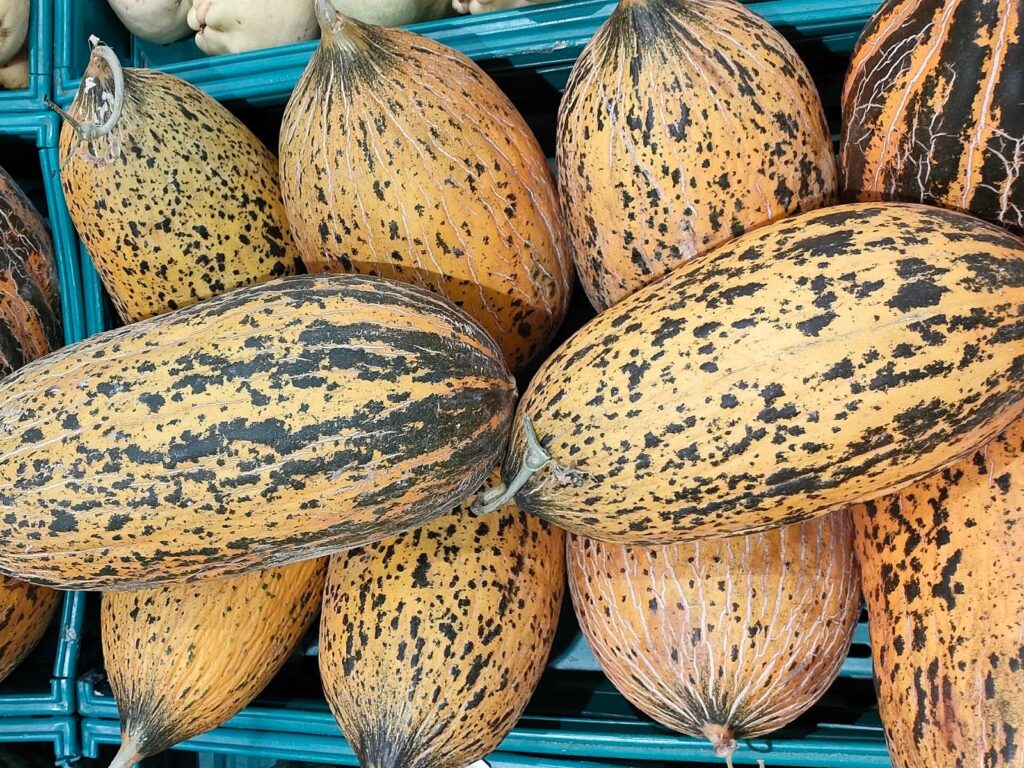
A melon in Turkey is called kavun, and Turkish melons come in two main groups. Early summer melons are sweet and fragrant, with a netted skin and yellow or orange flesh. Winter melons have a thick skin and firm flesh, and they keep for months.
- Ananas: an early melon, usually 1 to 3 kilos, with a netted skin and very sweet flesh.
- Kırkağaç: the famous winter melon of Manisa province, with yellow skin and dark green stripes. Its name is protected as a geographical indication.
- Hasanbey: a winter melon with a smooth skin and firm flesh.
- Yuva: another winter melon, with wrinkled skin that keeps well.
Frequently Asked Questions
When is melon season in Turkey?
Melon season in Turkey starts in early summer with the early melons. Winter melons come later, and the Kırkağaç harvest starts around mid-August and runs into early autumn.
How long do Turkish melons keep?
Winter melons such as Kırkağaç and Hasanbey keep for two to four months. In Kırkağaç the melons are tied by the stem and hung in cool stores, so fresh ones can still be found around January.

Get A Tour Guide in Turkey
You can taste these great watermelons of all types if you visit Turkey from late spring to early autumn. I love gastronomic adventures in Turkey. Contact me to book a professional licensed Turkish tour guide in Turkey. See you soon, Hasan Gülday.