Androclos is the legendary founder of Ephesus. He was the son of the legendary king Kodros of Athens. The oracles at Delphi told him that he would be guided by a fish and a pig to find where will he build his own city. Around 1000 BC, he discovered the area across the Aegean Sea where Ephesus is today and decided to build a city here, which was a decision followed by a specific incident.
Add Tours Around Turkey as a preferred source on Google
| Who | Androclos, son of the legendary King Kodros of Athens |
|---|---|
| Also spelled | Androclus, Androklos |
| Founded | Ephesus, around 1000 BC, in the legend |
| Legend | A fish and a wild boar, as the oracle at Delphi had told him |
| Monument | The Heroon on Curetes Street, believed to be his |
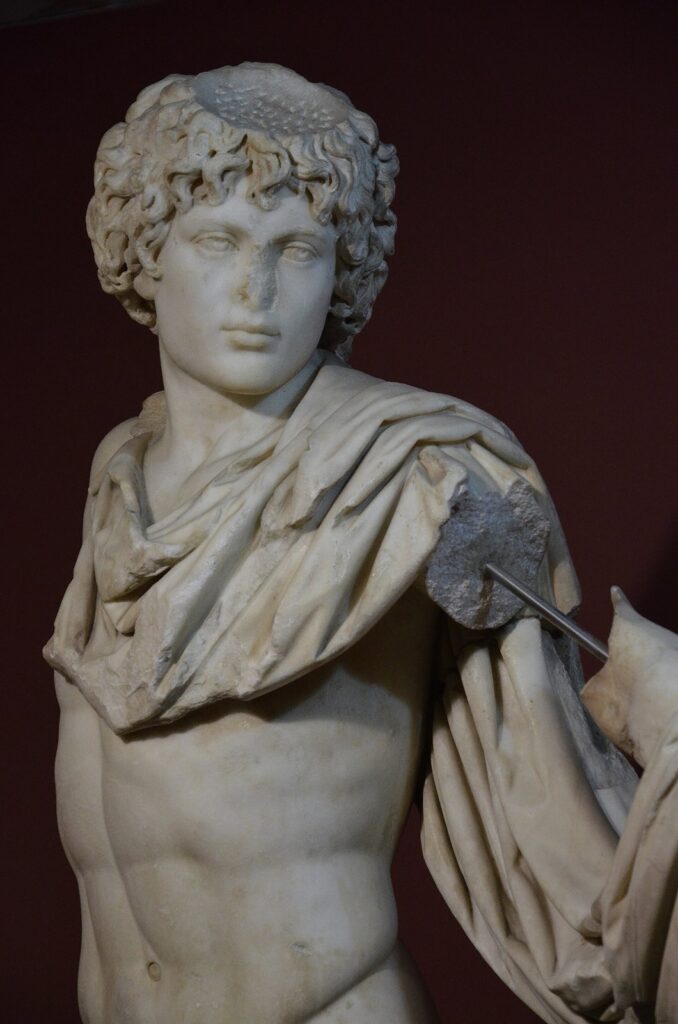
Androclos previously consulted the oracles at Delphi about where to build his city. The oracles told him that a fish and a pig would guide him. One day, while Androclos and his men were cooking on the beach, a fish fell out of the pan and drop into the dry grass. The grass caught fire and a wild boar jumped out and ran away. Androclos chased the boar and killed it, fulfilling the oracles’ prophecy.
The Ephesians even showed the place where this happened. It was at the spring called Hypelaios, near the harbor which they called the sacred harbor. The boar ran up the rocky mountain above it, and it was killed with spears on the spot where a temple of Athena stood in later times.
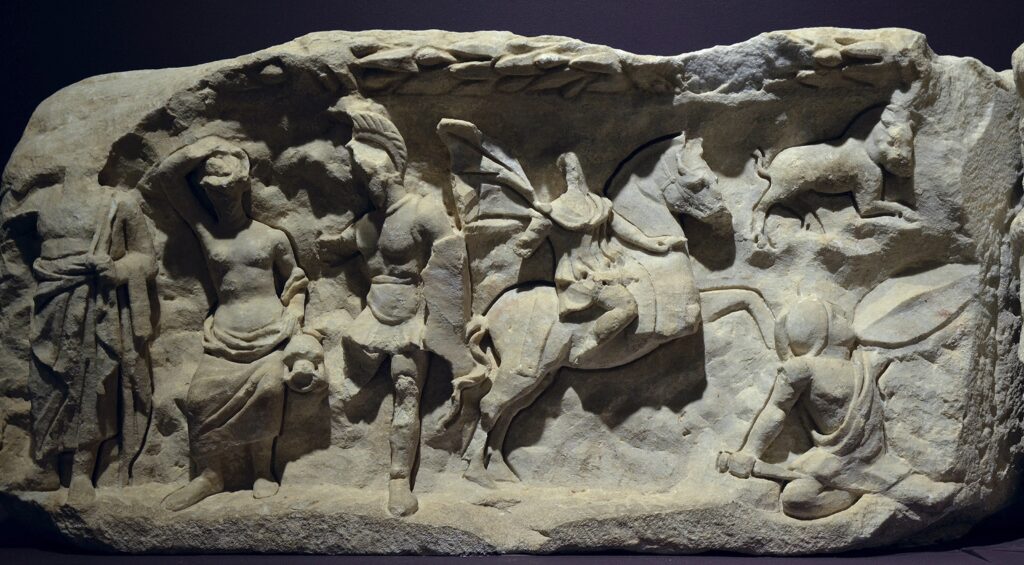
The Ephesians loved this hunt so much that they carved it on a relief of the Temple of Hadrian on Curetes Street. There Androclos rides his horse and attacks the wild boar. The original panel is in the Ephesus Museum in Selçuk, and on the temple you see a copy.
Heroon of Androclos on Curetes Street
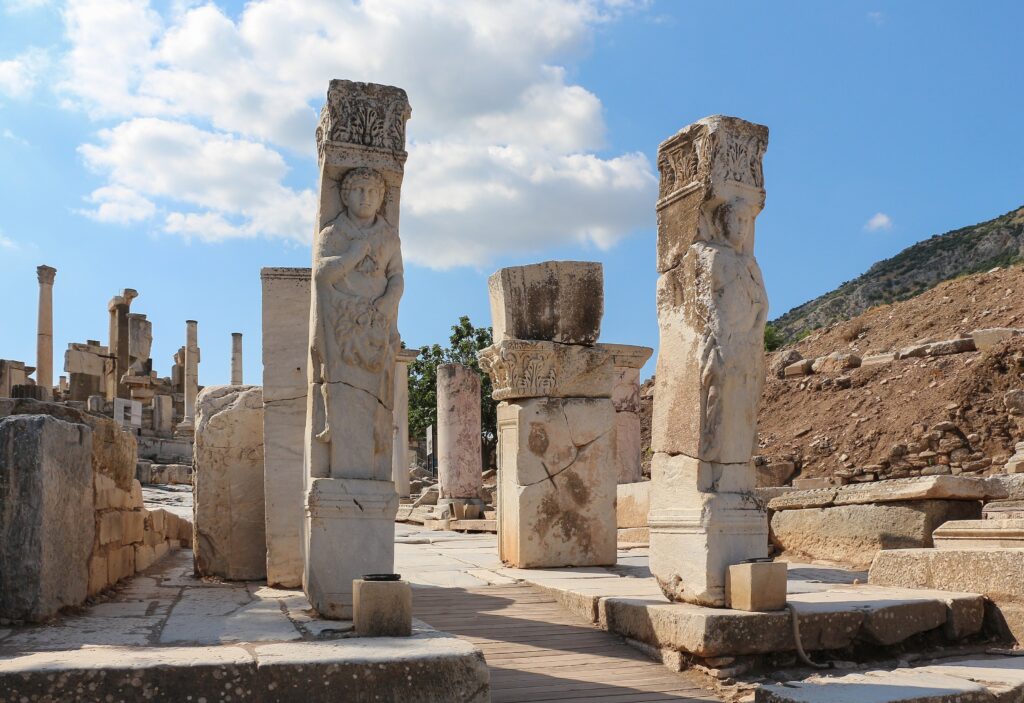
The Heroon of Androclos is a monument of the 2nd century BC at the lower end of Curetes Street, near the Gate of Hadrian, and it is believed to be the hero shrine of the founder of Ephesus. Today its remains look like a small pool beside the street.
It was a building in the shape of a U, with Doric columns on the ground floor and an open Ionic floor above. On its relief a horseman rides into a battle, with a fallen man below. A dedication to Androclos as the founder was found nearby too. Later a water basin was added in front of it and it became a fountain, so for a long time people called it Byzantine Fountain.
Why a battle? The old story says Androclos did not die in his bed. He went to help the people of Priene against the Carians and he was killed in the fight, although the Greeks won. The Ephesians carried his body to home and buried him.
More than a thousand years later, in the 2nd century AD, visitors were still shown his tomb on the road to the Magnesian Gate, which is the Upper Gate where most tours of Ephesus start today. A statue of an armed man stood on it. Is the heroon on Curetes Street the same place? Nobody knows for sure.
Frequently Asked Questions
Was Androclos a real person?
Nobody can say for sure. The Ephesians honored him as their founder, showed his tomb and made statues of him, but his story is a legend. More in my post on Founding Legends of Ephesus Ancient City.
Who was Kodros, the father of Androclos?
Kodros was last semi-legendary king of Athens. By tradition he gave his life to save the city from the Dorian invasion, and his son Androclos then left Athens to look for a new home across the sea.
Was Androclos a king?
Yes, in the legend. He led the Ionian settlers as their king and is said to have taken the island of Samos from the Samians. The Ionian cities are in my post Introduction into The Ionian League.
The story of Androclos is an important part of the historical and cultural identity of Ephesus, and is therefore often commemorated in the artifacts and museums of the ancient city. Come and visit Ephesus with me. Discover many more stories of Ephesus during your privately guided Ephesus tour. See you soon, Hasan Gülday!