Before or after your tour of Ephesus, you’ll enjoy reading these eight stories in an amazing new book about Ephesus by Finlay McQuade. They are all historically authentic, true to history when the history is known, plausible when the history is not known.
Life and Death in Ephesus is a short story collection by Finlay McQuade. Its eight stories follow one city across its long history, from the burning of the Temple of Artemis to the Council of Ephesus in 431, and many of the places in them are still there to visit.
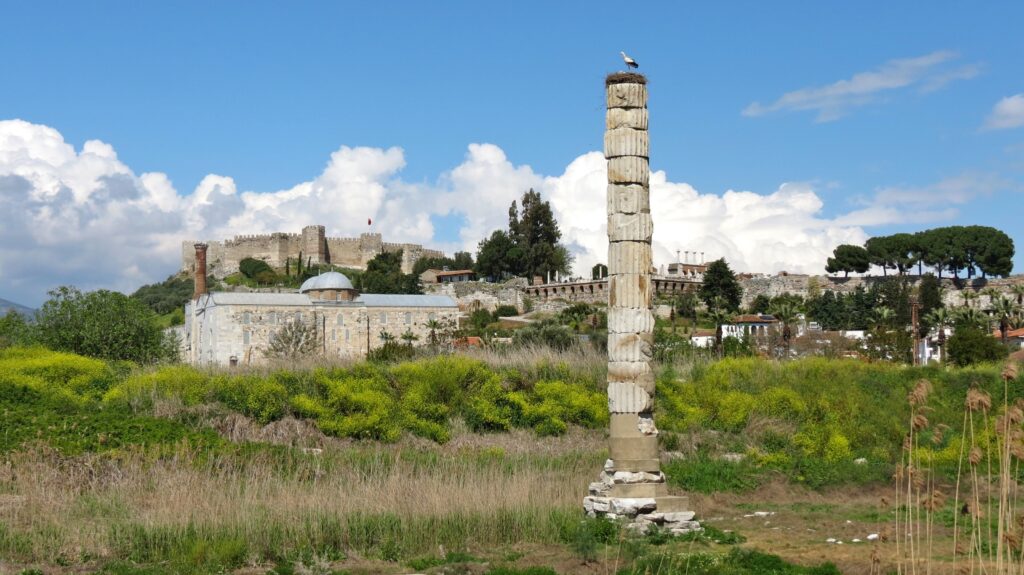
Finlay McQuade was a teacher of teachers at Boğaziçi University in Istanbul. When he retired from teaching, he lived for eight years in the town of Selçuk, where the ruins of Ephesus were quite literally on his doorstep. He lived across the street from the Basilica of St. John, built by Justinian I in the 6th century to house the Apostle’s grave. Down the hill was the Isa Bey Mosque, built by Seljuk Turks in the 14th century. And at the bottom of the hill, the few remaining stones and column drums of the Temple of Artemis were sinking unmajestically into a swampy puddle. Thus, surrounded by history, he did the research and wrote these stories.

They tell about—
- The destruction of the Temple of Artemis in 356 BCE
- The flood that shifted the city to its present location
- Mark Antony’s seduction of Arsinoe, Cleopatra’s sister
- Apostle Paul’s conflict and expulsion by rival faith healers and silversmiths
- A young man’s conversion to Christianity, his imprisonment, and execution
- The theft of a priceless book from the Celsus Library
- The Seven Sleepers, who slept for 400 years (or so they claimed)
- Nestorian heresy at the Council of Ephesus in 431 CE
A thousand years of history in one city!
Places From Finlay McQuade’s Stories You Can Visit
Most of them can still be seen. The ruins of Ephesus still hold the library, the theater and the church of the council, and the Cave of the Seven Sleepers is just outside the city. Let’s have a look at them one by one.
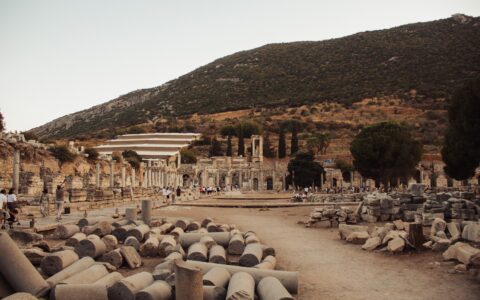
The Library of Celsus was built to honor Celsus, who is buried beneath it. Its two-story front was put back together in the 1970s, and a short walk along Marble Street takes you to the Great Theater.
Acts 19 tells how a crowd stirred up by the silversmiths filled that theater, shouting for Artemis. From the top rows you can see Harbor Street running toward the place where the sea used to be.
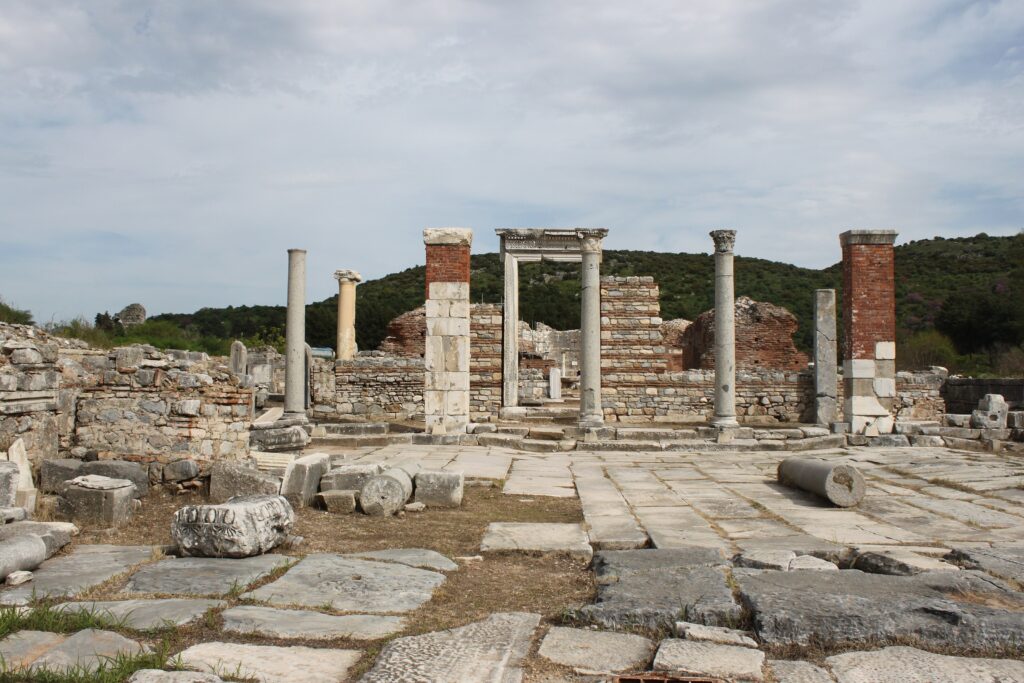
The Church of Mary, also called the Double Church, is where the Council of Ephesus met in 431. Only walls and columns are left, but you can still follow plan of the building.
The Cave of the Seven Sleepers lies on the slope of Panayır Mountain, with a ruined church and rock-cut tombs on the hillside. I wrote the legend down in my post on the Seven Sleepers. It is a small site, but with the story in your head it feels bigger.
Frequently Asked Questions
Who burned down the Temple of Artemis in 356 BC?
The story goes that a man named Herostratus set the Temple of Artemis on fire to become famous. The Ephesians tried to erase his name, then rebuilt the temple even larger.
Why is the site of the Temple of Artemis so wet?
The temple stood on low, marshy ground, and water still collects around its foundations. Some say the builders chose marsh on purpose, as protection against earthquakes.