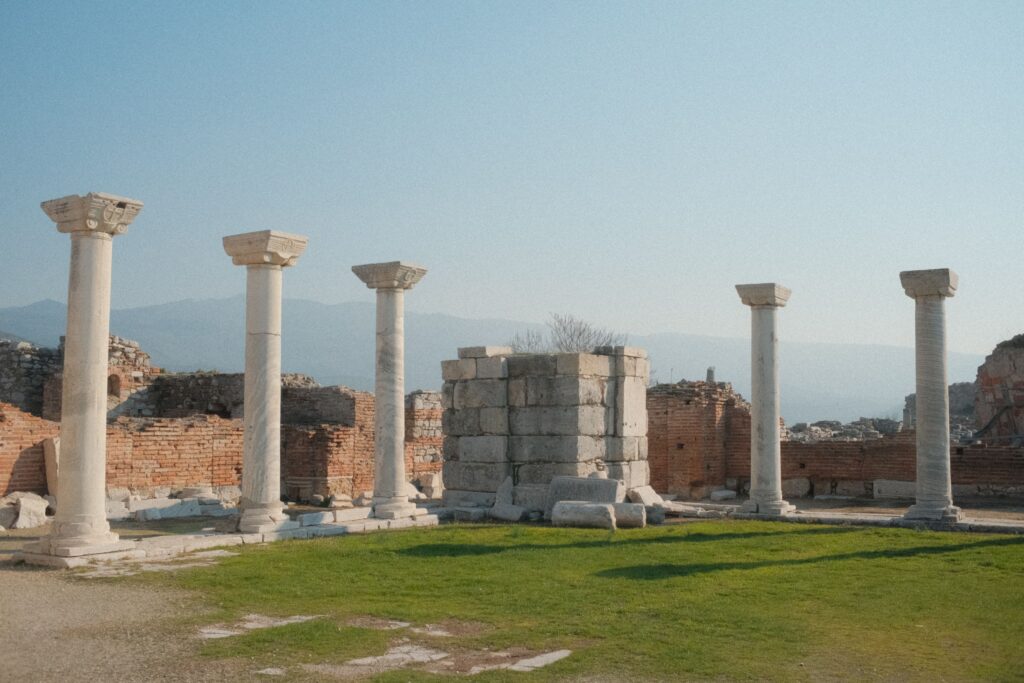
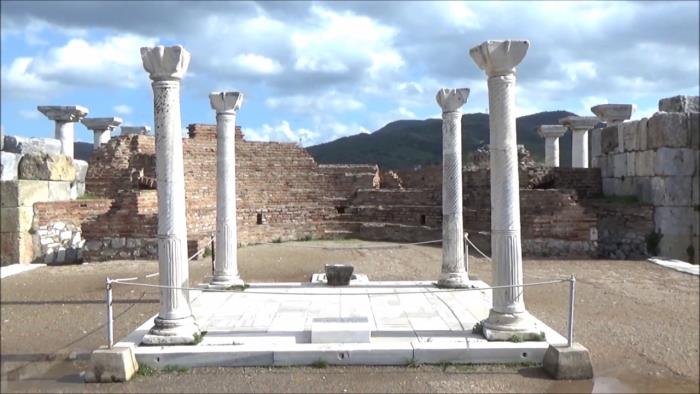
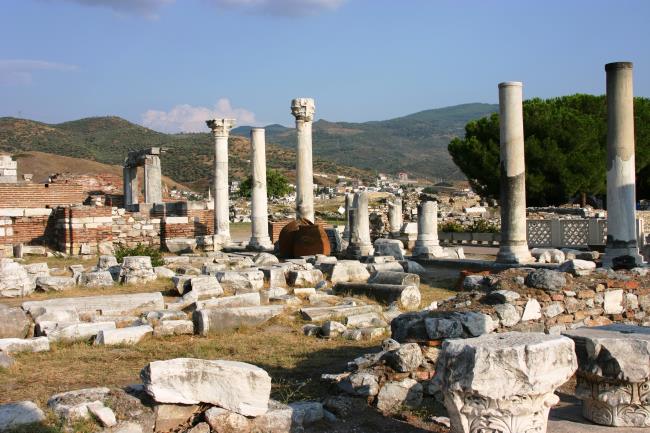
The Basilica of Saint John is the great church which Emperor Justinian built in the 6th century over the traditional tomb of Saint John the Evangelist. Its ruins lie on Ayasuluk Hill in Selçuk, the town next to Ephesus Ancient City, right below the Ayasuluk Fortress and next to the Isa Bey Mosque. Four marble columns stand around the place of the tomb today.
Saint John came to Ephesus after he was given the work of spreading words of Christ to Anatolia. He spent several years in Ephesus performing many miraculous acts.
Do you want to learn more? Then see Saint John the Evangelist in Ephesus and Saint John the Evangelist in Asia Minor
His success in converting thousands into Christianity and his fame shadowing the goddess Artemis of Ephesus worried the god emperor Domitian of the Roman Empire. Saint John was first captured to be taken to Rome, and then he was exiled to Samos Island of the Aegean Sea. He spent most of his remaining life on Samos. He came back to Ephesus after emperor Domitian died and was declared as ”damnatio memoriae”. Saint John the Evangelist passed away in Ephesus.
Death of Saint John the Evangelist
Saint John was already an old man when he returned to Ephesus. As we know he went on working on the bible and wrote 3 more epistles. Saint John the Evangelist passed away in Ephesus. We estimate the date of Saint John’s demise to be sometime between 100 AD and 110 AD. The cause of his death is generally accepted to be natural causes.
Evidence Confirming Saint John Passed Away in Ephesus
Saint Irenaeus who later became the bishop of Lyon was born in Asia Minor around the same time with Saint John the Evangelist’s death. Saint Irenaeus was trained by Saint Polycarp who was the bishop of Smyrna. The most important thing about Saint Polycarp is he was a pupil and disciple of Saint John the Evangelist himself. Saint Irenaeus claimed that Saint Polycarp himself said to him that Saint John the Evangelist passed away in Ephesus.
Two Tombs of John and John the Presbyter
An old church tradition says that Ephesus had two tombs with the name of John. The story was already known in the 3rd century, and it was still told in the early 4th century.
The story goes back to Papias, an early bishop of Hierapolis. He names John among the apostles and then names “the presbyter John” separately, so some people in the early church thought there were two Johns in Asia, and the second tomb could belong to John the Presbyter. People still argue if Papias really meant two different men.
For the church tradition the important tomb is clear. The grave in the middle of the basilica is honored as the tomb of John the Apostle, the same John that Polycarp knew in his youth.
Basilica of Saint John Nearby Ephesus Today
The Basilica of Saint John nearby Ephesus holds the monumental tomb of Saint John the Evangelist. The Basilica stands on the Ayasuluk Hill where once the oldest habitants of Ephesus city used to live. Current ruins of the basilica dates the era of Emperor Justinian of the Byzantine Empire who ruled in between 527 -565. As we know a small wooden church was built following John’s passing and a bigger basilica was built when Christianity became a free religion on the fourth century.

The current building was built in the sixth century thanks to a mass church building program started by the Emperor Justinian. Hagia Sophia of Constantinople was another church built in the same time with the Basilica of Saint John. There are significant resemblances in between the two buildings.
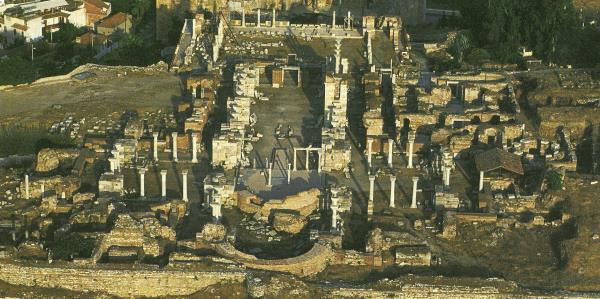
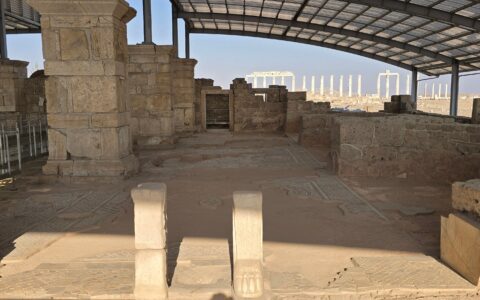
Basilica of Saint John the Evangelist has a cross plan. Today a perfectly preserved baptism pool, altar and tomb of Saint John can be visited. Frescoes of Saint John, Jesus Christ and Virgin Mary can be found on the north side of the altar. Massive original walls of the basilica are preserved even today and leave visitors with an awe.
Architecture of the Basilica of Saint John
Let’s have a look at the building itself. The historian Procopius says the older church on this spot was ruined by its great age, so Justinian pulled it down and raised a church “so large and beautiful” in its place. It was finished by 565.
The new church was about 130 meters long and 65 meters wide. Turkish Ministry of Culture describes it with three naves and six domes. Two domes stood over the long nave, one over each arm of the cross, one over the altar side and one in the middle, right above the tomb. Mosaics covered their inside, and the floors also had mosaics.
Justinian had his monogram and the monogram of Empress Theodora carved on the capitals of the columns.
Theodora died in 548, so these capitals were carved before that year. Their shape has a name: the Ionic impost capital. It is a small Ionic capital with a tall stone block, the impost, sitting on top of it. This type was the fashion of Justinian’s time, and you find it also in Hagia Sophia and Hagia Irene in Istanbul.
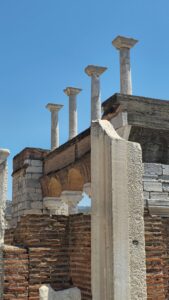
The Ayasuluk Hill excavations have found 91 of these capitals. Today 37 of them stand in the church. The 14 capitals with the monograms sit on the columns between the middle nave and the side aisles. When you walk in the nave, look up to the capitals. The monogram sits in a round medallion on the narrow side of the top block.
Not all capitals came from the same hands. The nave capitals were probably made in Constantinople or at the marble quarries of Proconnesus, while local craftsmen carved many of the capitals in the eastern part of the church. These ones mostly carry a cross or a Christogram instead of a monogram. Some of them were probably cut from old marble blocks of the Temple of Artemis.
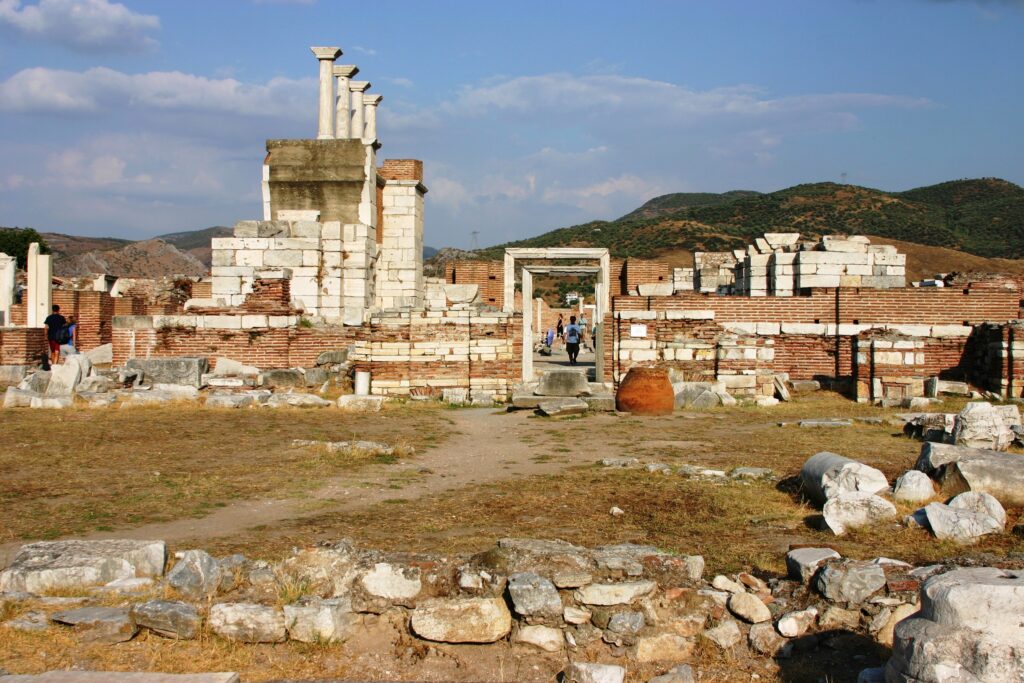
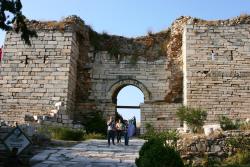
The baptism pool was inside a large eight-sided baptistery on the north side of the church. Pilgrims entered the church grounds through the Gate of Persecution. It took this name from an old relief which later visitors read as Christians being persecuted, but the relief really told a story of Achilles. By the way, we call it Takip Kapısı in Turkish.
The Achilles relief is not the only old stone in these walls. When the walls on south side of the hill were built, the builders brought marble from Ephesus Ancient City and from the Temple of Artemis, and broken statues went into the walls too. Pieces of these statues came to light again when the walls were excavated and restored.
They show Aphrodite, Artemis of Ephesus, Cybele, Hecate, Zeus, Apollo, a river god and Dionysus. So the old gods of Ephesus ended up as building stones in the walls that protected the church of Saint John. I like to tell this to my guests when we walk through the Gate of Persecution.
Baptistery and Treasury of the Basilica of Saint John
The baptistery of the Basilica of Saint John looks much like the baptistery of the Church of Mary, where the Council of Ephesus met in 431. Next to it was a rectangular room with a marble floor and an apse paved with mosaic. An inscription over its door called it the secreton, the room where the bishop sat as a judge.
The treasury of the church, the skeuophylakion in Greek, also stood on this north side beside the baptistery. Here the church kept its holy vessels and other valuables. Only a few church treasuries of this kind survive in the ruins of the Byzantine world, and another one belongs to Hagia Sophia in Istanbul.
Myths and Stories About the Basilica of Saint John Nearby Ephesus
- Many Christian theologians agree today that Saint John is the one and only disciple who passed away because of the natural reasons. Even though it is known that he passed away due to old age, it is still believed that Saint John had assumption into heaven by Christ. This theory is supported by the Byzantine Emperor Constantine because he claimed the remains were missing when he opened the tomb.
- Another story was told by Ramon Muntaner who was a Spanish mercenary working for the Byzantine Empire and who visited the tomb of Saint John personally. Ramon Muntaner claimed he could still hear the breathing of Saint John under the ground, and he witnessed dust particles coming out of the tomb. When people with sicknesses inhaled these holy dust particles, they were back to being healthy.
Pilgrims called this holy dust manna. By tradition it appeared on the grave each May 8, and believers kept a night-long vigil to receive it. They took it back to their countries in little flasks with a picture of Saint John on them. The Orthodox Church still remembers Saint John on May 8 because of this old pilgrimage. Many of my guests ask for a few quiet minutes at the tomb, and I always give them that time.
What Happened to the Basilica of Saint John
In the early 14th century the Turkish beyliks took Ayasuluk, and the church was used as a mosque for a while before it fell into ruins. After 1923, parts of the basilica were rebuilt with money from religious foundations in the United States. That is why so many columns stand again today.
Popes Been to the Basilica of Saint John
Saint John’s Basilica today is accepted as an official holy sight by the church. The Basilica of Saint John was visited by several holy figures including Pope John Paul the VI in 1967, Pope John Paul II in 1995 and John Bendictus in 2007.
Ayasuluk Fortress and Isa Bey Mosque
The walls on the top of Ayasuluk Hill belong to the Ayasuluk Fortress. It was built after the Arab raids of the 7th century to protect the basilica, and the Turkish rulers repaired it later. Inside there are cisterns, a small mosque and a Turkish bath. The fortress is open to visitors, and you walk up to it from inside of the basilica site.
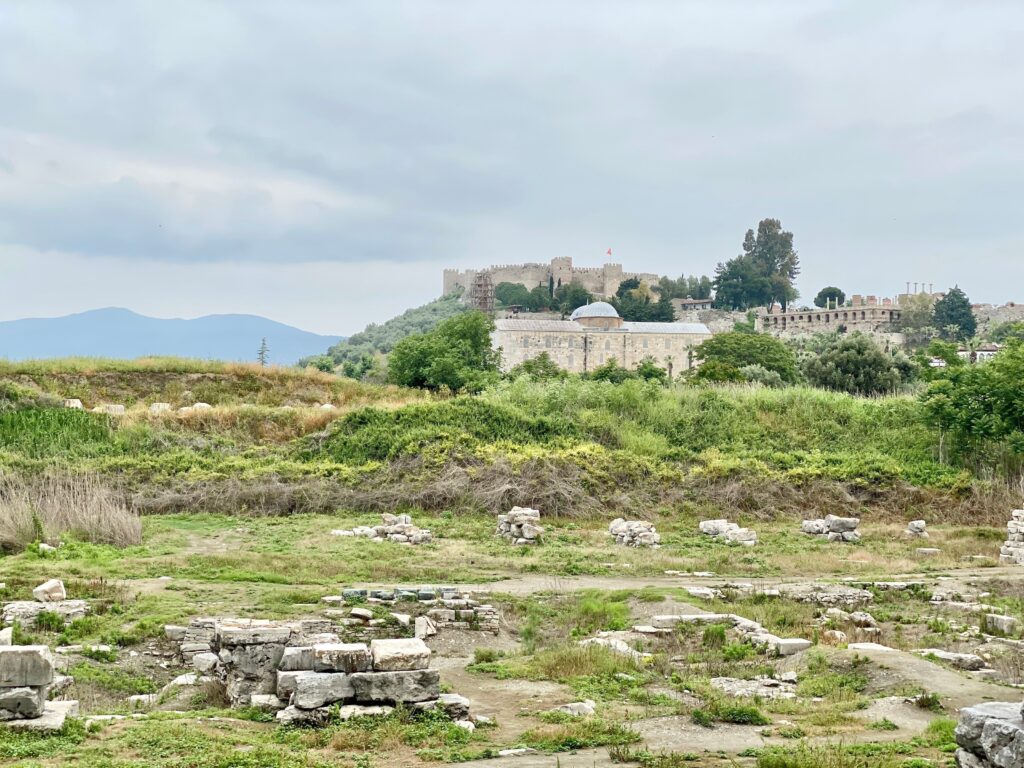
At the foot of the hill, right next to the basilica, stands the Isa Bey Mosque, built in 1375 for Isa Bey of the Aydınoğulları. I try to show my guests the church, the fortress and the mosque on the same visit.
Visiting the Basilica of Saint John
The Basilica of Saint John is about two kilometers (1.3 Miles) away from Ephesus and about 30 minutes drive from Kusadasi port city. You can drive about one hour from Izmir city or from Izmir Adnan Menderes Airport to visit Saint John’s Basilica.

The Basilica of John is open every day of the week. John’s Basilica is open in between 08:30 and 19:00 in Summer period and in between 08:30 and 17:30 in Winter period. Entrance fee is 6 Euros and tickets can be bought at the entrance.
The paths are uneven marble and earth with little shade, so in summer I recommend my guests to come in the morning or late afternoon with a hat and water. Plan about one hour for the basilica, more with the fortress. In October 2026 the Ministry’s page for the site gave the fortress shorter hours, 09:00 to 16:00, so go up there first.
Most of my Ephesus days start at the Upper Gate and end at the Lower Gate. From there Selçuk is a short drive, so the basilica fits well into the same day. You can see my guiding rates and guiding areas here.
Frequently Asked Questions
Where is Saint John buried?
By the old tradition of the church, Saint John the Evangelist was buried on Ayasuluk Hill in Selçuk, nearby Ephesus. The Basilica of Saint John was raised over his grave by Emperor Justinian, and four marble columns mark the spot today.
When was the Basilica of Saint John built?
The ruins you see today belong to the church of Emperor Justinian from the 6th century, finished by 565. It replaced an older church over the tomb.
Is there a dress code at the Basilica of Saint John?
No. It is an open-air archaeological site, not a working church, so comfortable clothes and shoes are fine. In the Isa Bey Mosque next door, women cover their hair and everyone covers shoulders and knees.
Hire a Tour Guide to Visit Basilica of Saint John nearby Ephesus
The Basilica of Saint John nearby Ephesus is fascinating piece of our past and I feel proud to be a member of the community living nearby it. I like to take my family and friend to Saint John’s Basilica during our free time since the building at its surroundings are peaceful. I would be happy to take you to Saint John’s Basilica too. Contact me to learn more about Saint John the Evangelist and about time acts of Saint John the Evangelist in Ephesus.
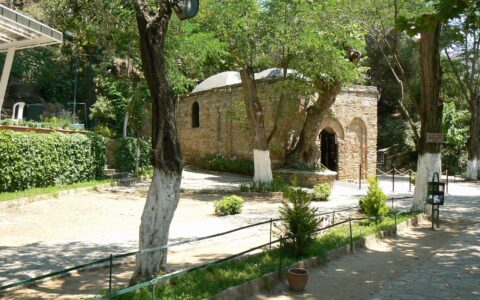
Write to me to hire a professional licensed Biblical tour guide in Ephesus to see the Basilica of Saint John. My recommended starting points for this tour are Kusadasi cruise port, Kusadasi hotels, Selcuk hotels, Izmir hotels and Izmir Adnan Menderes airport but also a tour to Basilica of Saint John can start from you required location too. Please don’t skip nearby Ephesus Ancient City, Isa Bey Mosque and the House of Virgin Mary when you visit the Basilica of John. See you soon, Hasan Gülday.

4 comments