By Hasan Gülday — Licensed Professional Tour Guide, Ephesus \ Kuşadası


If you have ever visited the famous white travertine terraces of Pamukkale, you have visited, without perhaps knowing it, one of the most important early Christian sites in the world. The ancient city of Hierapolis, on top of those terraces, is where, according to the strong early tradition, the apostle Philip lived his last years, preached his last sermons, and was martyred. His tomb has been identified by Italian archaeologists in the last twenty years. His martyrium has been excavated. His shrine has been one of the major Christian pilgrimage sites of Asia Minor for almost two thousand years.
And most of the tourists who go to see the white pools below — cotton castle, Pamukkale, in Turkish — never walk up the hill to see the place where Philip is buried.
I want to tell you about Philip, his daughters, his death, and the strange and beautiful site on top of the cotton castle which most visitors miss.
Which Philip
We have to be careful here, because there are two different Philips in the New Testament, and the early Christian tradition sometimes confused them.
The first Philip is one of the twelve apostles. He appears in the Gospel of John several times. He is the one who said to Jesus, Lord, show us the Father, and it sufficeth us, before the famous discourse of John chapter 14. He was, according to tradition, from Bethsaida in Galilee, the same town as Peter and Andrew.
The second Philip is one of the seven deacons appointed in Acts chapter 6 to help with the distribution of food in the early Jerusalem community. This Philip became a missionary preacher, baptized the Ethiopian eunuch in Acts chapter 8, and later settled in Caesarea on the coast of Palestine, where he had four virgin daughters who prophesied.
The early Christian writers, including Eusebius, sometimes mixed up these two Philips. The Hierapolis tradition is most strongly attached to the first Philip, the apostle. But some scholars have argued that the actual person who lived and died in Hierapolis was the second Philip, the deacon-evangelist with the four daughters. The mention of Philip’s daughters at Hierapolis, by the second-century bishop Polycrates of Ephesus, fits the deacon-evangelist much more than the apostle.
I am not going to settle this question here. Honestly, the early Christian tradition itself was confused about it, and modern scholars are still arguing. What we can say is that a man named Philip, who was a major apostolic-generation Christian leader, who had daughters who lived as virgin prophets, lived and died at Hierapolis. Whether he was the apostle of Galilee or the deacon of Caesarea or, in some sense, both — this is a question I leave open.

The Tradition
The earliest reference to Philip at Hierapolis comes from Polycrates, who was bishop of Ephesus around 190 AD. In a letter to Pope Victor of Rome, defending the Eastern practice of celebrating Easter on the day of Passover, Polycrates lists several great Christian leaders who had been buried in Asia Minor and who had supported the Eastern practice. Among them, he mentions Philip and his three virgin daughters.
”Philip, of the twelve apostles, who fell asleep in Hierapolis, and his two daughters who grew old as virgins, and another of his daughters who lived in the Holy Spirit and rests in Ephesus.” – Polycrates
Polycrates, who lived only a hundred years after the events, places the tomb of Philip in Hierapolis with confidence. He is a witness from the next generation but one. The tradition was, by his time, well established.
A few decades later, the bishop of Hierapolis itself, Papias, who had also known Polycarp of Smyrna, wrote that he had heard stories about Philip and his daughters from old people in Hierapolis who had themselves known the daughters in their youth. Papias’s own writings are mostly lost, but Eusebius preserves several quotations from him, and the connection of Philip with Hierapolis is clearly attested in Papias.
What Brought Him to Hierapolis
The tradition does not give us a clear story about why Philip went to Hierapolis. The most likely answer is that, like John in Ephesus, Philip went westward after the destruction of Jerusalem in 70 AD, looking for a Christian community where he could spend his last years.
Hierapolis was, in the late first century, a substantial city. It had a major textile industry, particularly wool dyeing, which used the natural hot mineral springs of the place. It had a famous healing centre, with the thermal pools used for the same medical purposes that they are still used for today. It had a large Jewish community, evidenced by inscriptions and burial monuments. It was on the same Common Highway that connected Ephesus, Laodicea, Colossae, and the inland Phrygian plateau.
For a missionary in his old age, the city had several attractions. There was an existing Christian community, founded probably by Epaphras, the same disciple of Saint Paul who founded the church of Laodicea. The city was a major regional centre, with people coming and going for the hot springs and the textile trade. The location was a good base for further outreach into inland Anatolia.
So Philip, with his daughters, settled here. The exact dates we do not know. The traditions suggest the late first century, perhaps the 70s or 80s.

The Daughters
The daughters of Philip are a small but important detail in the tradition. They are mentioned by Polycrates, by Papias, by Eusebius, and by various later sources which confirms their existince.
The book of Acts mentions four daughters of Philip the deacon, who were virgins and prophets. Polycrates mentions three daughters at Hierapolis. The exact number varies. The fourth daughter of Acts, in the Polycrates tradition, is the one who lived in the Holy Spirit and rests in Ephesus. So three at Hierapolis with their father, one separately at Ephesus.
The image is striking. A retired apostle or evangelist, in his old age, settled in a Greek city, with his unmarried daughters around him, living as a small prophetic family. The daughters are described as virgins and as prophets. They had a public spiritual ministry. They were respected in the community. They had their own roles, not merely as helpers to their father.
This is one of the few clear glimpses we have of female prophetic ministry in the post-apostolic generation. The early church had many such women — Lydia of Thyatira, Phoebe of Cenchreae, Priscilla of Ephesus, the unnamed Smyrnaean deaconesses interrogated by Pliny the younger. But the daughters of Philip, with their long public lives at Hierapolis, are perhaps the best documented.
The local memory of them was strong. Papias, writing around 130 AD, says that he had heard stories from old people in Hierapolis who had known the daughters as young girls. The chain of memory was direct. The community of Hierapolis, even into the second generation, remembered Philip’s daughters with affection and respect.
The Martyrdom
How did Philip die?
The tradition says he was martyred in Hierapolis, although the details vary in different sources. Some traditions say he was crucified upside down, like Peter. Others say he was hanged from a tree. Others say he was stoned. The earliest sources, including Polycrates, speak only of his death and burial at Hierapolis without specifying the method.
The most likely scenario is that Philip died, perhaps under official Roman pressure, perhaps in a local mob action, sometime in the late first century. The community buried him on the hill above the city, in the standard Greco-Roman manner of using a hillside necropolis. Over his grave, a small shrine was probably built. By the late second century, this shrine had become a regional pilgrimage site.

The Martyrium of Saint Philip
In the late fourth century, around 400 AD, the Christian community of Hierapolis built a great octagonal church on the hill above the city, on the spot where Philip’s shrine had been. This building is known today as the Martyrium of Saint Philip. It is one of the most distinctive Byzantine ecclesiastical buildings in Asia Minor.
The Martyrium is octagonal in plan, with eight equal sides, surrounding a central worship space. Around the octagon, there are smaller rooms — chapels, baptistery, accommodation for pilgrims — arranged in a square layout. The whole complex is large, well planned, and deliberately monumental. It was built to receive significant pilgrim crowds.
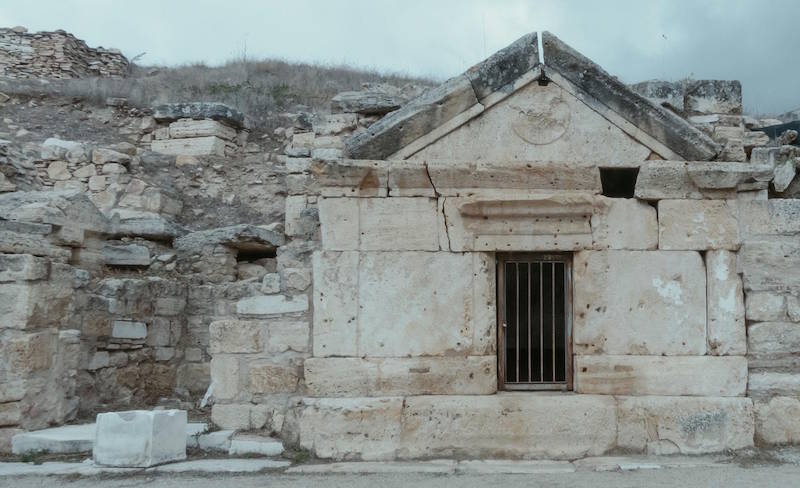
In 2011, the Italian archaeological team led by Francesco D’Andria, working in Hierapolis since the 1950s, announced an extraordinary discovery. About a hundred metres from the Martyrium, on a slope below it, they had identified a small earlier church, built in the fifth century, which contained a tomb. The tomb had been disturbed and the relics removed in antiquity. But the architectural and inscriptional evidence strongly suggested that this was the original tomb of Philip himself.
The discovery resolved a long-standing puzzle. The Martyrium up the hill had always been understood to be the church built in memory of Philip. But the actual tomb had been somewhere else. The 2011 discovery identified the original tomb location. Pilgrims now visit both sites — the original tomb church below, and the great octagonal Martyrium above.


What You Can See Today
If you go to Pamukkale, you should not miss the climb up to the Martyrium of Saint Philip. The walk takes about twenty minutes from the centre of the ancient city of Hierapolis. The path goes up a steep slope, past the necropolis, with the great theatre of Hierapolis visible to the south.
When you reach the top, the octagonal foundations of the Martyrium are clearly visible. Most of the upper structure is gone, but the lower walls, the column bases, and the eight sides of the central building are obvious. You can walk through the central worship space. You can see the small surrounding rooms.
A few minutes’ walk down the slope from the Martyrium is the more recently identified original tomb church. The walls are lower, the building smaller, but the tomb chamber is still recognizable. There is a small explanatory sign in Turkish and English.
The view from the Martyrium is one of the great views of western Turkey. To the south, the great theatre of Hierapolis. To the south-west, the white travertine terraces of Pamukkale, glowing in the sun. Beyond them, the green Lycus valley stretching towards the mountains. On a clear day, the air is full of birds — swallows, kestrels, occasional eagles.


Practical Notes
The hike up to the Martyrium is moderately difficult in summer. The slope is steep. There is no shade. June through September, do this hike either in the early morning before 9 AM, or in the late afternoon after 5 PM. April, May, October, and even November are much more comfortable.
Allow about an hour for the Martyrium and the surrounding area. Combine with the rest of Hierapolis — the great theatre, the necropolis, the agora, the gymnasium, the Plutonion — for a full half-day visit. With the white terraces below, plus Laodicea nearby, this is comfortably a full day.
The cafeteria at the entrance to the white terraces is reasonable but not exciting. For a real meal, drive a few minutes to the village of Pamukkale, where there are many small restaurants. The local gözleme — the thin Anatolian flatbread filled with cheese, herbs, or potato — is good. The ayran, the salted yogurt drink, is essential after the heat of the climb.

One Closing Reflection
The Martyrium of Saint Philip is, for me, one of the quietest of the great Christian sites of Asia Minor. The white terraces below get all the visitors. The Martyrium gets few especially because of its hard to get location. On most days, you can have the place almost to yourself.


This quietness is, in its own way, appropriate. Philip — apostle or deacon, we cannot quite tell — was not the most famous of the early Christian leaders. He did not write a Gospel. He did not write letters that have come down to us. He is mentioned only briefly in the New Testament, and in early traditions only in passing.
But here, on this hill above the white terraces, an enormous octagonal church was built over his tomb. The community of Hierapolis remembered him. The community of Asia Minor pilgrimaged to him. For more than a thousand years, his shrine was one of the major holy places of the region. And after the long Ottoman silence, when the church had collapsed and the location had been forgotten, the modern excavators came back, found the site, and opened it up again.
The man whose name is in the New Testament only as a brief note — the man with the daughters, the prophet’s family — was, in the local Anatolian memory, very far from forgotten. He stayed remembered. Hatırlanmış kaldı. The remembering, in some places, simply does not end.
That is the apostle Philip at Hierapolis.
Contact me to learn more on Apostle Philip, to hire a professional, licensed, Biblical and licensed tour guide for visiting Apostle Philip’s Martyrium in Hierapolis (Pamukkale). See you soon, Hasan Gülday!