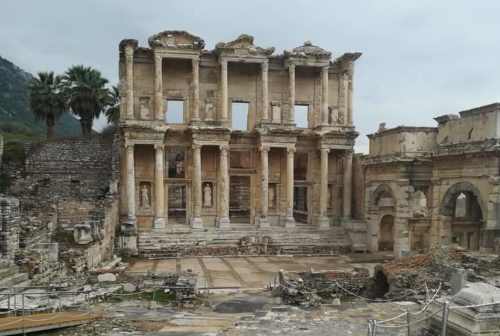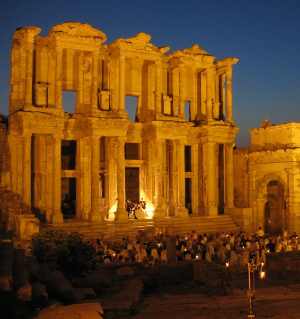
By Hasan Gülday — Licensed Professional Tour Guide, Selçuk / Ephesus


In the summer of 431 AD, more than two hundred bishops gathered in Ephesus for one of the most dramatic and most consequential meetings in Christian history. The summer was hot. The bishops were tired and angry. The political pressure from Constantinople was heavy. The theological argument was sharp. And in a few weeks of intense debate, with two rival councils running at the same time, with messengers galloping back and forth to the imperial court, with bishops imprisoned and bishops counter-imprisoned, the church of the East and the church of the West produced a decision which has shaped Christianity for sixteen hundred years.
The decision was that Mary the mother of Jesus is Theotokos, the God-bearer.
This article is about that hot summer in Ephesus which still has effect even today!
Why It Mattered

Most modern Christians, when they hear the title Theotokos, Mother of God, do not realize how strange this title sounded to many people in the early fifth century.
The objection was simple. God has no mother. God is eternal, before all time. How can a young Jewish woman in Galilee, in 4 BC, be the mother of God who existed before the foundation of the world? The title seems, on the surface, to confuse the eternal nature of God with the creaturely nature of human beings.
The defenders of the title answered with an equally simple argument.
Jesus is one person. The same person, in the same body, is both God and man. Mary did not give birth to God-the-Father. She gave birth to Jesus, who is God incarnate. To deny her the title Theotokos is to suggest that the Jesus born of Mary is not really God.
The fight over this title, in the year 431, was therefore not about Mary at all. It was about Christ. It was about whether the unity of his divine and human natures could be expressed in language. The defenders of Theotokos were, in their own view, defending the full divinity of Jesus. The opponents were trying to keep the divine and human natures conceptually separate.
This is one of those moments in Christian history where the technical theological language really matters. Small differences in vocabulary produce large differences in faith. Bir kelime, bir dünya, as we say in Turkish — one word, a world.
The Two Bishops
The two main figures in the controversy were Cyril of Alexandria and Nestorius of Constantinople.
Cyril was the patriarch of Alexandria, the second most prestigious bishopric in the East after Constantinople. He was the nephew of an earlier patriarch, Theophilus, who had been a fierce opponent of John Chrysostom. Cyril was politically skilful, theologically sharp, and not afraid of conflict. He was also, by all accounts, ruthless when he believed the truth was at stake.


Nestorius was a monk from Antioch, who had been appointed patriarch of Constantinople in 428 AD. He was a brilliant preacher and a serious theologian. But he had what we might today call poor political instincts. Soon after his arrival in Constantinople, he allowed one of his deputies to preach a sermon attacking the title Theotokos. He himself argued, in subsequent sermons, that the title was misleading, and that Mary should be called Christotokos — Christ-bearer — instead.
The reaction was immediate and angry. The popular piety of Constantinople, which had honoured Mary as Theotokos for many generations, was outraged. The monks of the city protested in the streets. The wider church of the East joined the protests. And Cyril of Alexandria saw an opportunity.
The Letters and the Anathemas
Cyril wrote a series of letters to Nestorius, demanding that he retract his teaching. The letters became sharper. Cyril eventually attached to his letter a list of twelve anathemas, twelve theological condemnations, each beginning with the formula if anyone says…let him be anathema. The anathemas were directed precisely at Nestorius’s teaching.
Nestorius, in turn, wrote a counter-list of twelve anathemas against Cyril’s teaching.
The exchange escalated. The bishop of Rome, Celestine, was drawn in. He sided with Cyril. The emperor Theodosius the second, in Constantinople, was drawn in. He tried to remain neutral. The eastern bishops, especially those from the school of Antioch which had a different theological tradition, sided with Nestorius. The western bishops and the Egyptian bishops sided with Cyril.
The dispute could not be resolved by letters alone. The emperor called a general council to settle the matter. The location chosen was Ephesus.


Why Ephesus
Why Ephesus, and not Constantinople or Antioch or Alexandria?
Several reasons. Ephesus was a major city of the eastern empire, geographically central, with adequate facilities. It had the great church of Saint Mary in the centre of the city, which could host the bishops. It was on a major route, accessible by sea from Italy, Egypt, Syria, and Greece. And, perhaps most importantly, it was the city traditionally associated with the last years of Mary herself. To meet about Mary, in the city of Mary, was theologically meaningful.
The choice of Ephesus also had a small political dimension. Ephesus was outside the direct power of any of the rival patriarchates. Cyril could not pack the council with Egyptian bishops. Nestorius could not control it from Constantinople. Theodosius hoped that the neutral location would produce a fair hearing.


The Bishops Arrive
In the late spring of 431 AD, the bishops began to arrive. Cyril came from Alexandria with about fifty Egyptian bishops, sailing across the eastern Mediterranean. Nestorius came from Constantinople with sixteen of his supporters. The papal legates arrived from Rome a little later. The Antiochian delegation, led by John of Antioch, was delayed by floods on the road from Syria.
The Egyptian arrivals had a particular character. Cyril was accompanied not just by bishops but by what some sources call parabolani, a group of monks and servants who functioned as a kind of paramilitary security force. They were not soldiers, but they were intimidating. The streets of Ephesus, in those weeks before the council opened, were filled with rival groups of monks and clergy, each loyal to its own party.
The local Ephesian bishop, Memnon, was firmly in Cyril’s camp. He used his local authority to make life difficult for Nestorius and his supporters. The local clergy, the local monks, the local population, all sided with Cyril. Nestorius later complained that he had been treated as a prisoner from the moment he arrived.
The Council Opens, Without Antioch

The council was scheduled to open on June 7. By that date, the Antiochian delegation had not yet arrived. Cyril, knowing that the Antiochians would side with Nestorius, decided not to wait.
On June 22, against the protests of Nestorius and against the wishes of the imperial commissioner, Cyril opened the council. About two hundred bishops were present. Nestorius refused to attend. The session lasted one long day. Cyril’s letter to Nestorius was read aloud. The bishops voted. The vote was overwhelming. Nestorius was condemned, deposed from his see, and excommunicated. The title Theotokos was solemnly affirmed.
That evening, the people of Ephesus held a torchlit procession through the streets, celebrating the decision. Theotokos! Theotokos! The crowds were chanting. The mother of God had been defended in the city of her last years.
The Counter-Council


A few days later, the Antiochian delegation arrived. John of Antioch was furious that the council had been opened without him. He held a counter-council, with about forty bishops, and condemned Cyril and Memnon in turn.
For the next several weeks, two rival councils were operating in the same city, each claiming to be the legitimate ecumenical council, each excommunicating the other.
The papal legates, who arrived in early July, sided with Cyril. The imperial commissioner, who had to manage this chaos, sent reports to Constantinople. The emperor Theodosius the second, faced with two rival councils, eventually accepted Cyril’s council as the legitimate one. He arrested both Cyril and Memnon and Nestorius temporarily, hoping to force a compromise. The compromise did not come quickly.
Eventually, after months of negotiation, a Formula of Reunion was agreed in 433 AD, two years after the council. Nestorius remained deposed. Cyril remained patriarch of Alexandria. Theotokos remained the official title of Mary. The two great schools of Eastern theology — Alexandrian and Antiochene — remained, with grudging acceptance of the formula.
The compromise did not heal everything. Some of the eastern churches, particularly those who continued to follow the school of Nestorius, separated from the rest of Christianity. They became the Church of the East, which spread eastward through Persia, central Asia, India, and as far as China in the medieval period. They are still there today, in various forms, in the modern Assyrian Church of the East and the Chaldean Catholic Church. The split of 431 was real, and it has not been fully closed sixteen hundred years later.
What You Can See Today
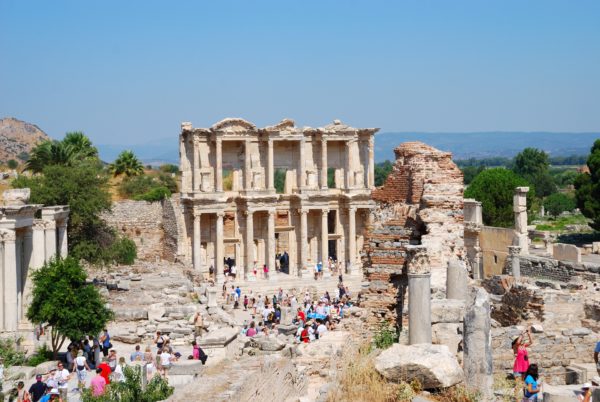
The Church of Saint Mary, the Marienkirche, where the council met, can still be visited. It is in the lower part of the ancient city, near the harbour ruins, just south of the modern road. You should take the road by the lower gate. The remains include the foundations of the original basilica, the baptistery, and several side chapels.
The site is one of the most important Christian sites in Ephesus. It was the first church in the Christian world dedicated to Mary. It was the location of the most consequential Marian declaration in church history. And it is, today, mostly empty of visitors. Most tour groups, including some of mine in earlier years, walk past it without stopping as long as it is not a Biblical tour in Ephesus.


I now make a point of bringing my groups here. We stand inside the foundations of the basilica. We read aloud the famous declaration of June 22, 431. We try to imagine the two hundred bishops, the torchlit procession, the chanting crowds, the political tension, the theological intensity.
The space is quiet now. Wildflowers grow between the stones in spring. In summer the marble heats up. In winter the rain pools in the lower areas. Birds nest in the standing arches.
Now It Is Your Turn To Visit Ephesus With Professional Tour Guide

The Council of Ephesus is, in some ways, an uncomfortable story. There is too much politics. There is too much ambition. There is too much intimidation. The behaviour of some of the participants, including the great Cyril of Alexandria, was not always edifying.
And yet, in the middle of all this human messiness, the council produced a theological declaration which has held for sixteen hundred years and which is shared today by the Catholic Church, the Eastern Orthodox churches, the Oriental Orthodox churches, and most Protestant churches. Theotokos. The mother of the one who is fully God and fully man.
The declaration is a small thing, in words. But it has shaped how Christians of every continent and every language pray, paint, sing, and think about Mary, about Christ, and about the relationship between God and humanity.
That is the legacy of those hot summer weeks in Ephesus in 431. A messy human council produced, somehow, a clean theological truth. The Holy Spirit, in the strange way the Holy Spirit works, was at work even in the middle of the political fighting.
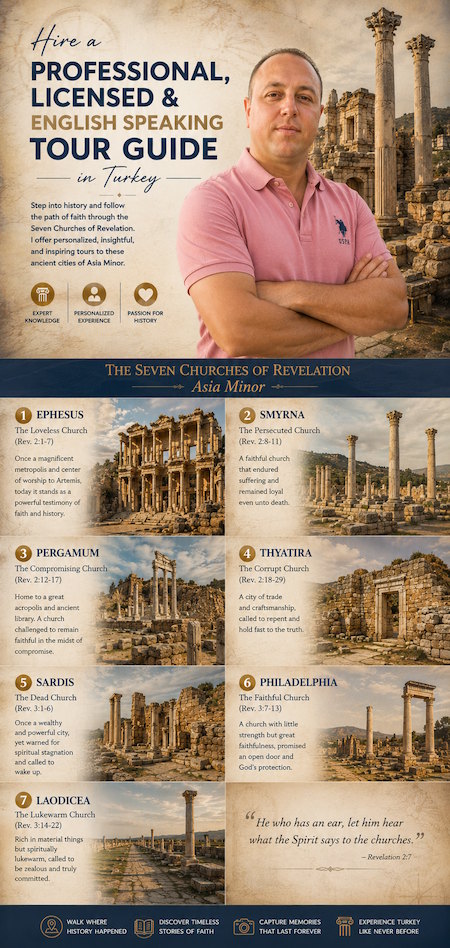
That is the council of Ephesus which shaped the upcoming centuries. The church where the actual council took place is still standing today. Now it is your time to come and witness the same locations where the Ephesus Council took place. Contact me to learn more about Ephesus Council and to hire a Biblical tour guide for Ephesus and the Seven Churches of Revelation.
See you soon, Hasan Gülday