By Hasan Gülday — Licensed Professional Tour Guide, Selçuk / Ephesus
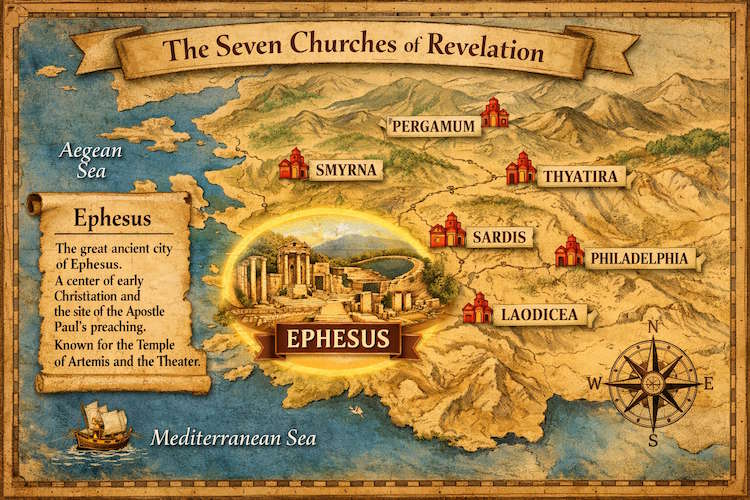
The first of the seven letters of Revelation is sent to the church which I personally know best. The mother church of Asian Christianity. The church which Paul founded, which John shepherded for almost thirty years, which Mary the mother of Jesus probably visited in her last years, which is sitting only twenty minutes by car from where I write these lines.
For me, this letter is also the most personal. Because the warning at the centre of it — thou hast left thy first love — is a warning which any old church, any old believer, any tour guide who has been giving the same speech for twenty years, can recognize from the inside.
The letter is in chapter 2 of Revelation, verses 1 to 7. Let us walk through it slowly.
The Address
Unto the angel of the church of Ephesus write: These things saith he that holdeth the seven stars in his right hand, who walketh in the midst of the seven golden candlesticks.
The seven candlesticks are the seven churches. The seven stars are the angels of the seven churches, which most modern scholars take to mean either the bishops, or the spiritual representatives, of each community. Either way, the image is the same. Christ is in the middle of these seven small communities. Holding their leaders. Walking among their lampstands.
This is a comforting image. But it has a sharp edge. He is walking among them. Watching. Inspecting. Like a master walking through his garden, looking at each plant, deciding which is healthy and which is sick.
For Ephesus, the senior church, the one which is being addressed first, this inspection is going to be detailed.


The Praise
I know thy works, and thy labour, and thy patience, and how thou canst not bear them which are evil: and thou hast tried them which say they are apostles, and are not, and hast found them liars: And hast borne, and hast patience, and for my name’s sake hast laboured, and hast not fainted.
Notice how much praise comes first. Works, labour, patience, intolerance for evil men, testing of false apostles, endurance, hard work, no fainting. The list is long. The Ephesian Christians were a hard-working, doctrinally serious, morally careful community. They were not lazy. They were not gullible. They had clearly identified some travelling teachers as false, and they had refused to receive them.
We know from other early Christian writings, especially the letter of Ignatius of Antioch to the Ephesians written about twenty years after Revelation, that this church was particularly well organized, with a strong bishop and a clear hierarchy and a careful theological life. Ignatius praises them for exactly the same qualities which Christ praises in this letter. They were the seriously theological church.
And yet.


The Diagnosis
Nevertheless I have somewhat against thee, because thou hast left thy first love.
This is one of the most quoted lines of the entire Apocalypse, and there have been many interpretations. What is the first love?
Some interpreters say it is love for Christ himself. Others say it is love for fellow Christians, the brotherly affection which had been so strong in the early Ephesian community. Others say it is love for outsiders, the missionary warmth which had brought so many people into the church in the first generation.
I personally think the answer is all three. Because in any healthy Christian community, these three loves are linked. Love for Christ produces love for fellow believers, which produces love for outsiders. When the first love starts to dry up, all three slowly contract together. The community becomes correct, organized, watchful, but also cold. The doctrine remains pure. The fire goes out.
This is what had happened to Ephesus by 95 AD. They were still doing everything correctly. They were still keeping out the false apostles. They were still working hard. But the warmth of the early years, when the church first heard Paul preaching in the hall of Tyrannus, when Mary was perhaps still alive among them, when the burning of the magic books was a recent memory — that warmth had cooled.
I find this very sobering. Because if Ephesus, with all its advantages, with apostolic founders, with clear teaching, with a serious bishop, with everything in order — if Ephesus could lose its first love, no community is safe from this disease.

The Three Commands

Remember therefore from whence thou art fallen, and repent, and do the first works.
The cure has three steps.
Remember. Look back. Where did you start? What was the original quality of your life together? What did the early Ephesian community feel like in 55 AD, when Paul was teaching daily? Remember.
Repent. Recognize that the present condition is not where you should be. Decide to come back.
Do the first works. Not feel the first feelings, which would be impossible to command. Not have the first warmth, which would be impossible to manufacture. Do the first works. Act in the way you used to act. Practice the same hospitality, the same teaching, the same care for the poor, the same prayer rhythms, the same brotherly love. Do them, and trust that the warmth will follow.
I think this third command is the most practical and the most useful one. It does not ask for an emotion. It asks for a practice. The first warmth left because the first practices had been let go. To recover the warmth, you have to recover the practices. Damlaya damlaya göl olur, as we say in Turkish. Drop by drop, a lake is formed. The cure starts with one small returned practice.
The Warning
Or else I will come unto thee quickly, and will remove thy candlestick out of his place, except thou repent.
The threat is sharp and specific. The candlestick of the Ephesian church will be removed. The community will lose its place among the seven. Its lampstand will be moved.
This actually happened. Not immediately, but slowly. Over the following centuries, the church of Ephesus declined as the city itself declined. The harbour silted up. The population moved. The bishopric moved up the hill to Ayasuluk, into the Basilica of Saint John. By the time the Turks arrived in the 14th century, the great Christian community of ancient Ephesus had already been dissolved. The lampstand had been moved.
I always feel a small chill when I read this passage with my groups inside the modern ruins of Ephesus. Because we are walking through the visible fulfilment of the warning. The streets are empty. The basilicas are roofless. The candlestick is, in some sense, gone.
But it is not completely gone. The hill of Ayasuluk, just north of the ancient city, still has the tomb of John. The Basilica of Saint John, even in its ruined state, is still a place of pilgrimage. The Christian story of Ephesus did not end. It moved.

The Nicolaitans
But this thou hast, that thou hatest the deeds of the Nicolaitans, which I also hate.
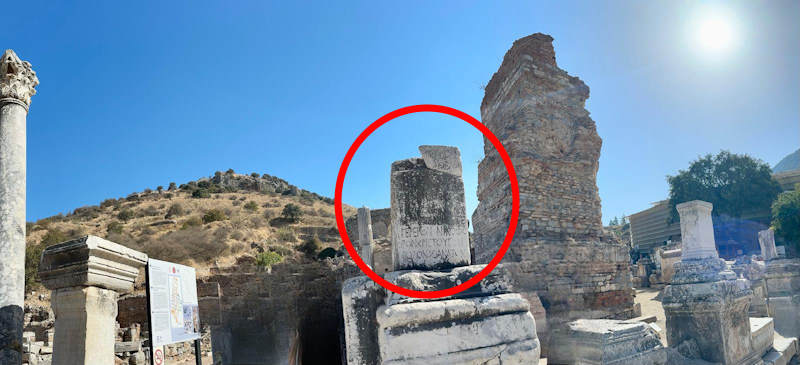
A small but interesting detail before the closing. Christ adds, almost in passing, that the Ephesians have rightly hated the deeds of the Nicolaitans. The Nicolaitans appear here and again in the letter to Pergamon, as a sect or a teaching which the early Christian communities were dealing with.
Honestly, we know very little about who they were. The early Christian writers Irenaeus, Hippolytus, and Epiphanius mention them, but their reports are partly legendary. The most likely picture is that the Nicolaitans were a sect that taught accommodation with pagan culture, particularly with idol-worship and with sexual practices outside marriage. They argued, like Jezebel in Thyatira, that Christians could attend pagan banquets, eat sacrificed meat, and follow the loose sexual norms of their pagan neighbours.
The Ephesians had refused this teaching. Christ commends them. But notice the quiet irony — the same community that has resisted false teaching has lost its first love. Resisting evil is not the same as keeping warmth. You can have one without the other. Ephesus had one. They had let go of the other.


The Promise
He that hath an ear, let him hear what the Spirit saith unto the churches; To him that overcometh will I give to eat of the tree of life, which is in the midst of the paradise of God.
The promise is the tree of life. This image is taken directly from Genesis, from the garden of Eden. The first humans were expelled from Eden because they had reached for the wrong tree. Now, to the one who overcomes, who comes back to the first love, the tree of life is offered.
This is one of the most healing images of the Bible. The fall is not final. The expulsion is not permanent. The tree which was lost in Genesis is offered again in Revelation. And it is offered specifically to the church which has been told that it has fallen, but can rise. The Ephesians, who have fallen from their first love, are promised the tree of life if they will return.
Now It Is Your Time To Visit Ephesus

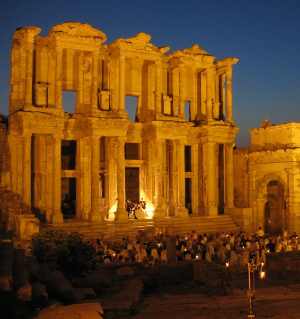
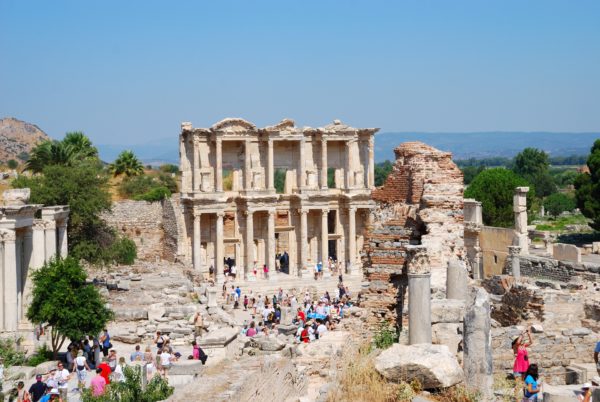
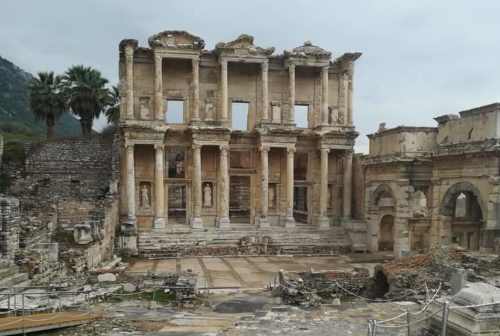
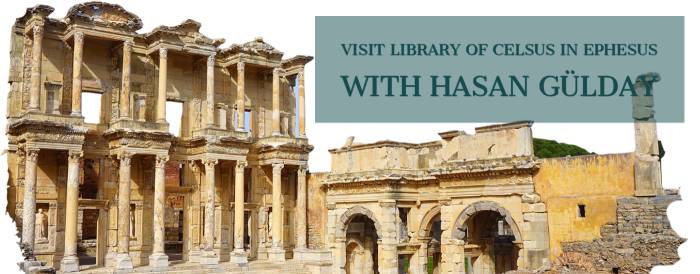
IThe next time you visit the great Library of Celsus in Ephesus, stop for a moment in the small open space in front of the building. The marble street, the late afternoon light, the empty stone benches. Imagine the Ephesian Christians, in 95 AD, listening to this letter being read aloud for the first time, perhaps in a house just off this same street. The praise, the warning, the call to come back. Imagine them, going home that evening, talking quietly with their husbands and wives, asking the question that everyone in that small congregation must have asked themselves.
Have I left my first love?
Now it is time for you to stand where the Ephesians once stood and ask the same question to yourself.
Contact me to hire a Biblical tour guide at Ephesus ancient city and to learn more about the Church of Ephesus.
Have your professionally guided Ephesus tour.
See you soon, Hasan Gülday