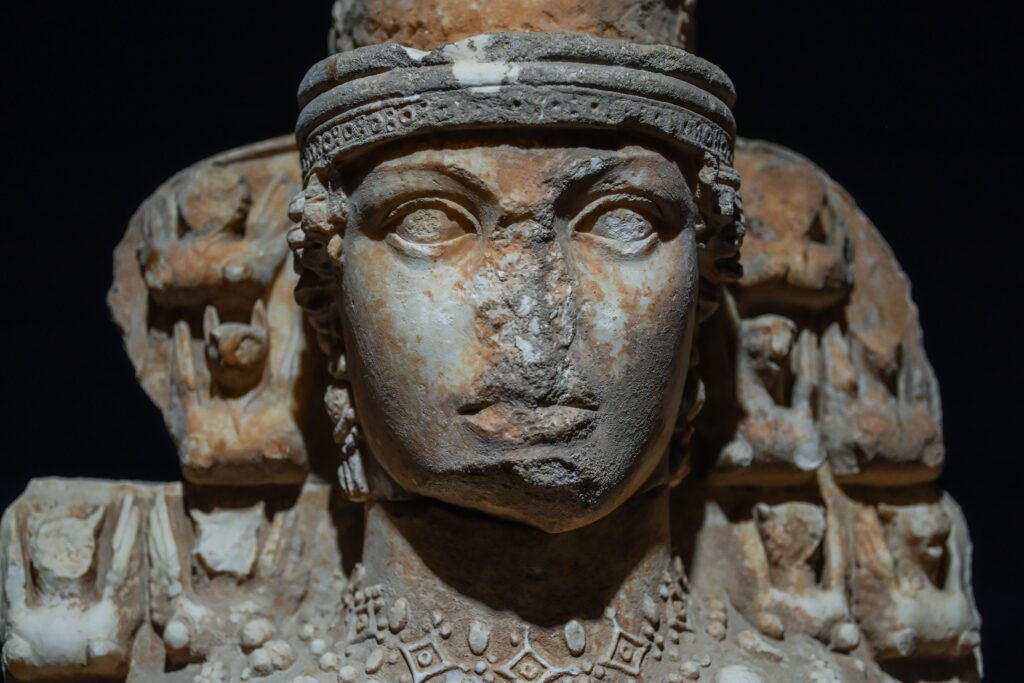
Ephesia Grammata means Ephesian Letters. It was a charm, usually a set of six strange words, that the Greeks believed could keep evil away and bring luck. The statue of Artemis in Ephesus is said to have carried the words on its feet, belt and crown.
Ancient and late antique Mediterranean worlds were strange places where magic was a common daily practice believed by millions of people. Believers used several types of magical systems to connect with polytheistic deities. Ephesia Grammata: Magic in Ancient Ephesus was the most popular magical system and it even became the daily word used for any type of magic in the ancient Mediterranean world.
Meaning of the Six Ephesian Letters
The six Ephesian letters are askion, kataskion, lix, tetrax, damnameneus and aision. In daily Greek they meant nothing, and that was the point. Later Greek writers still gave each word hidden meaning, and this is the list most people look for today:
| Word | What it was said to mean |
|---|---|
| askion | darkness, from a word for “without shadow” |
| kataskion | light, from a word for “shadowy” |
| lix | the earth, an old word |
| tetrax | the year with its four seasons |
| damnameneus | the sun |
| aision | truth, from a word for “right and fitting” |
People used the words in three ways. They spoke them, and a spell only worked if you said every word correctly. They wore them, written on a belt or tied around an ankle before a fight or a court case. And they carved them on things that mattered, like the old statue of Artemis I mentioned above, which carried them on her feet, her belt and her crown.
By the way, the most famous user was a king. Croesus, the king of Lydia at Sardis, who also paid for the marble temple of Artemis, is said to have spoken the Ephesian letters when he stood on his funeral pyre, and he was saved. I like to tell this story at the single column of the temple, because it ties the magic words to the man who built it.

Ephesia Grammata which can be translated as “Ephesian Words” was one of the most popular magical practices in the ancient world. These ancient magical formulas started to appear in the fifth century BC in today’s Ephesus. The earliest forms of Ephesia Grammata inscriptions were found on the holy site of temple of Artemis nearby Ephesus.
How Did People Use Ephesia Grammata?

Anaxilas Comicus, a fourth century BC poet, speaks about Ephesia Grammata as powerful words which kept the evils away. His words made us to believe that Ephesia Grammata was used in protective ways.

Words cited by the magicians were completely meaningless. They believed the real power of Ephesia Grammata was not in the meaning, it was in the sound of the words. You had to recite the magical words perfectly to benefit from them.

Ephesia Grammata belong to a time not just earlier than Christianity also earlier than classic Greek \ Roman paganism as we know it. Magical words were mostly dedicated to goddess Hecate and goddess Diana. Pilgrims who visited the temple could get magical amulets with enchanted words written on them.

Ephesia Grammata inscription
ασκι κατασκι αασιαν ενδασιαν
aski kataski aasian endasian
These translated words found on a leather piece has no meaning.
The Story of the Ephesian Boxer
There was a commonly known story of an Ephesian boxer. Ephesian boxer attended the Olympics in Athens and won all his matches without any trouble. Every one was surprised with Ephesian boxers luck. Then they realized he hides an Ephesia Grammata amulet underneath his clothes. He lost 3 consecutive matches after removing his lucky charm.
Who Made and Bought Ephesian Magic?

Another interesting topic about Ephesia Grammata is that most of the magicians were woman while nearly all the magic users or buyers were men. Many people used magic to resolve their problems with business deals, relationship problems, athletic competitions, legal disputes.

Amulets and tablets were the most common magic items. Especially amulets were everyone’s popular must have magical accessories. Amulets were mostly used for protection, invoking healing powers of Apollo or luck of Nike. Tablets were used for cursing someone. We mostly find them concealed in graves or houses of unknowing victims.

Magic was common in the antiquity but it didn’t mean it was freely made and commonly accepted by the masses. Witches were disgraced members of the society and especially users of cursing tablets, if it was used on alive people, could face serious punishments.
Frequently Asked Questions
What are the six words of Ephesia Grammata?
The best known set is askion, kataskion, lix, tetrax, damnameneus and aision. Some copies spell them a little differently, so list is not always the same.
Were the Ephesian letters among the books burned in Acts 19:19?
Acts 19:19 does not name them. Still, the Ephesian letters were the best known magic of Ephesus, so some say they were in those scrolls. Read the story in my post on the burning of the books on magic.
What other magic was practiced in ancient Ephesus?
Priests, oracles and fortune telling were part of life in Ephesus and Asia Minor, and laws of the Christian era later banned magic. I tell this part in my post on magic in ancient Ephesus and Asia Minor.
How do you pronounce Ephesia Grammata?
Say it eh-FEH-see-ah GRAH-mah-tah. It is Greek, Ephesia grammata, and it simply means Ephesian letters or Ephesian words. The six magic words themselves are read as they are written: askion, kataskion, lix, tetrax, damnameneus, aision.
Did the Ephesian letters work against evil spirits?
The Greeks believed so. People who were thought to be possessed by a spirit were told to recite the Ephesian letters, and the words were also worn for luck in a wrestling match or a lawsuit. The power was in the sound, so a wrong syllable spoiled everything.
Hire Ephesus Tour Guide
Ephesia Grammata and magic in ancient Ephesus has always been interesting subject during my Ephesus tours. Contact me to learn more about ancient magic in Ephesus and to hire an English-speaking professional licensed tour guide for Ephesus ancient city in Turkey.