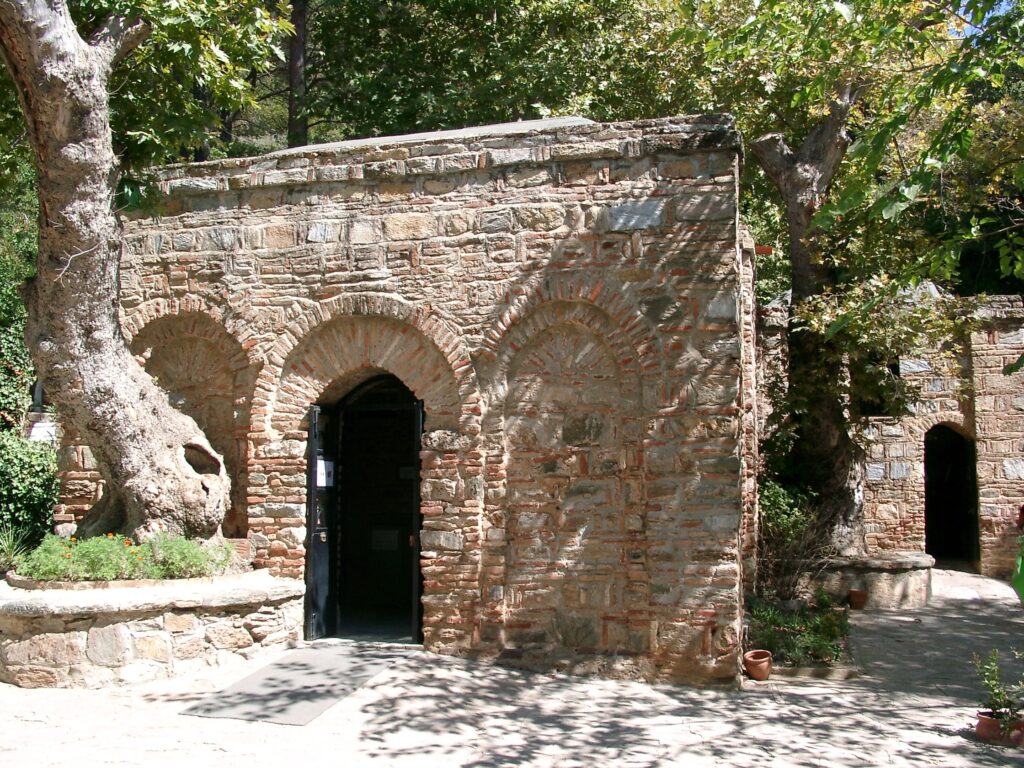
Nightingale Mountain is the higher of the two mountains of Ephesus. The House of the Virgin Mary stands on its top, and the Terrace Houses lie on its slope along Curetes Street. Its old Greek name is Mount Koressos, and in Turkish we call it Bülbüldağ.
| Where | South side of the ancient city of Ephesus |
|---|---|
| Also called | Bülbüldağ (Bülbül Dağı), Mount Koressos, Mount Nightingale |
| On its top | House of the Virgin Mary |
| On its slopes | Terrace Houses, the wall of Lysimachus, the tower called St. Paul’s Prison, a hidden rock monument, the Grotto of Saint Paul (closed) |
Nightingale Mountain is 12 km from Selcuk district. The importance of Nightingale Mountain in terms of archeology and religious history is that the ancient city of Ephesus, one of the most important historical and touristic settlements, is located at its foot. Nightingale Mountain used to host festivals of the Christian communities during the Ottoman era. Christians always knew there is a grave or a shrine of an important Christian figure on Nightingale Mountain. Later the discovery of the House of Virgin Mary on Nightingale Mountain proved them to be right. Contact me to hire a professional tour guide for the House of Virgin Mary which is nearby Ephesus Ancient City and located on the top of Nightingale Mountain. See you soon, Hasan Gülday.

Where Is Mount Koressos?
Mount Koressos is the ancient name of Nightingale Mountain, Bülbüldağ in Turkish, the long ridge which rises on the south side of Ephesus Ancient City. In ancient times it carried the city wall of Lysimachus, the Terrace Houses and the tower which people call St. Paul’s Prison.
When Lysimachus moved Ephesus to its new place at the beginning of the 3rd century BC, he built a strong city wall along this ridge. At its western end, on a hill looking over the plain, stands an old Greek tower which local people call St. Paul’s Prison. It is one of the best kept parts of the old walls, but nobody knows if the Apostle was really kept there.
On north slope of the mountain, opposite the Temple of Hadrian on Curetes Street, rich families of Roman Ephesus built their houses on three terraces. Today we call them the Terrace Houses. The Grotto of Saint Paul is also on the north slope of Nightingale Mountain, but it is closed to visitors.
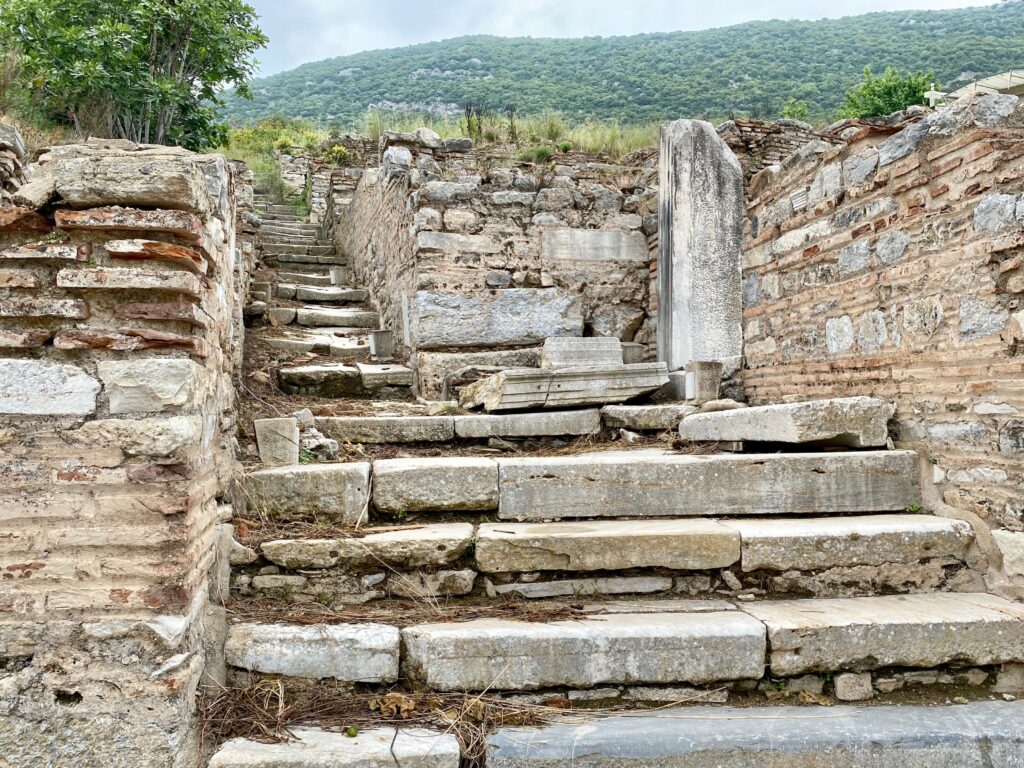
Higher on the southeast side of the mountain, hidden in the forest today, there is a strange monument cut into the rock. It has a few steps, a platform with side walls like a throne and two round hollows which probably held drink offerings. It looks like the rock monuments of Phrygia, so it is believed to be very old. Since it was probably nearby a spring, some say it belonged to the Mother Goddess, who had a big rock sanctuary on Panayır Mountain too.
Frequently Asked Questions
Why is it called Nightingale Mountain?
Bülbül is the Turkish word for nightingale, the songbird, so Bülbüldağ means Nightingale Mountain. The name is Turkish and much younger than the Greek Koressos, and I do not know who gave it.
Who found the House of the Virgin Mary on Nightingale Mountain?
Two Lazarist priests from İzmir found the ruined house in 1891. They followed the visions of a German nun, Anne Catherine Emmerich, who had never seen Ephesus. More in my post on the House of the Virgin Mary.
Is Nightingale Mountain higher than Panayır Mountain?
Yes, it is the higher and longer of the two hills of Ephesus. Panayır Mountain is smaller hill at the east end of the valley, with the Great Theater cut into its slope.



2 comments