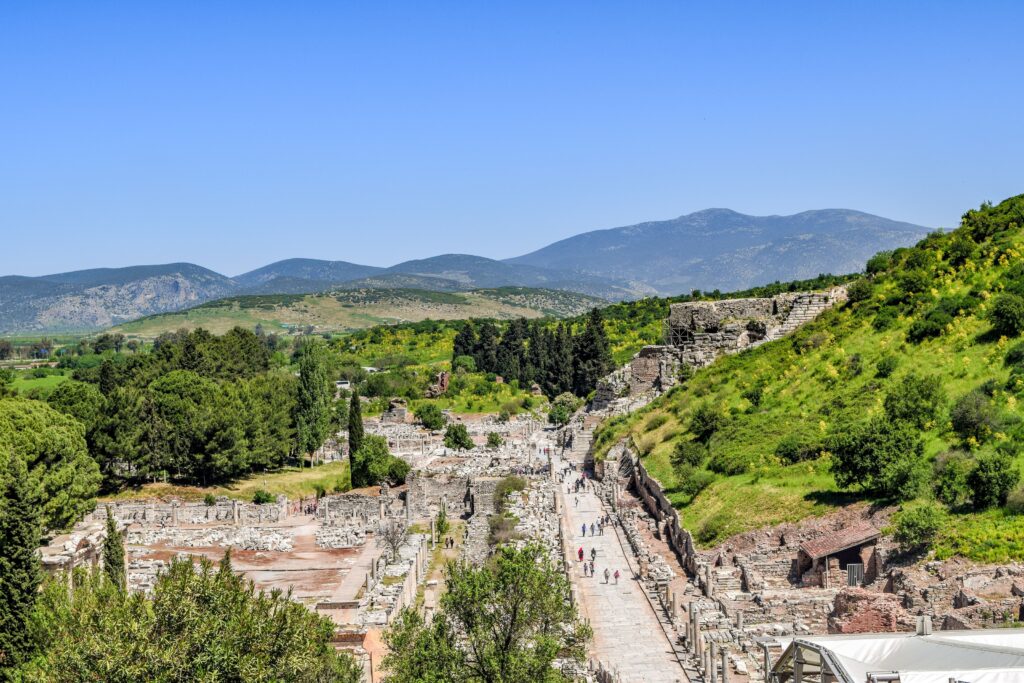
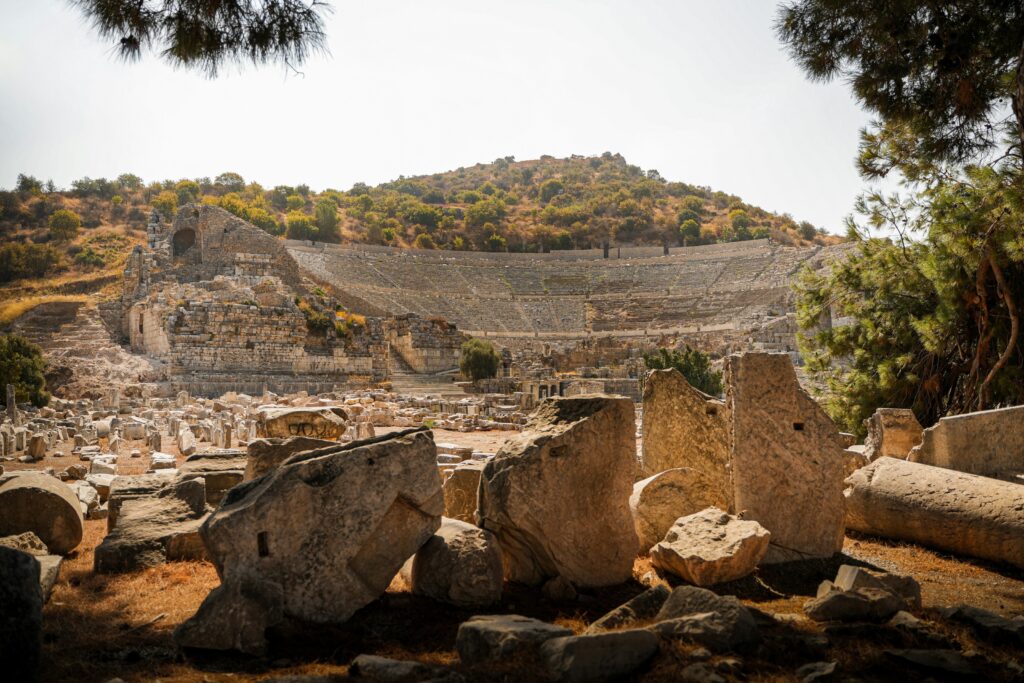
Panayır Mountain is the hill behind the Great Theater of Ephesus, and its ancient name is Mount Pion. The theater is cut into its slope, and a palace and a sanctuary of the Mother Goddess were built there too. On the other side of Ephesus rises its bigger neighbor, Nightingale Mountain.
| Where | East end of the Ephesus valley, behind the Great Theater |
|---|---|
| Also called | Mount Pion, Pion Mountain, Panayır Dağı |
| On its slopes | Great Theater, Odeon, part of the Magnesian Gate, a palace, a rock sanctuary of Cybele, the Cave of the Seven Sleepers |
Panayır Mountain, which is also known as Pion Mountaion, is one of the two mountains surrounding Ephesus Ancient City. Panayır Mountain gets its name from the Greek word, which means ”Gathering”. Throughout the Byzentinian and Ottoman eras, local Christian people used to meet on the outskirts of this mountain to celebrate religious holidays. It is not so surprising to know that later the House of Virgin Mary was discovered nearby the Panayır Mountain. Today some parts of Ephesus Ancient City such as Odeon and Magnesia gate stand partially on Panayır Mountain. Contact me to hire a professional licensed tour guide for Ephesus ancient city and Panayır Mountain. See you soon, Hasan Gülday.

Palace and Cybele Sanctuary on Panayır Mountain
Panayır Mountain, the ancient Mount Pion, carried a palace on its west slope above the Great Theater and one of the largest rock sanctuaries of the Mother Goddess Cybele in western Anatolia. The Greeks of Ephesus called her simply Meter, which means mother.
The first palace was built around the middle of the 2nd century BC, when Ephesus belonged to the kings of Pergamon. The builders had to cut terraces into the steep slope to make room for it, and its middle line pointed down to the Harbor Street. It is believed that an official of the Pergamene kings lived and worked there.
In Roman times the house grew into a real palace of at least 10,000 square meters, with a second courtyard, a big hall with an apse and a bath complex. Most probably it was residence and office of the proconsul, the Roman governor of the province of Asia. Some parts of it were still in use in the 6th century AD.
The rock sanctuary of Meter had many niches cut into the natural rock, and small marble reliefs of the goddess were set in them. Its best years were the late 4th and the 3rd century BC. 91 of these reliefs are known today, the largest group of Meter sculptures from one workshop, and it is believed their marble came from the quarries of Ephesus itself.
Next time you sit in the Great Theater, look up to the slope above the top seats. A Roman governor probably looked down at the same seats from his palace.
Frequently Asked Questions
Is Panayır Mountain the same as Mount Pion?
Yes. Panayır Dağı is the Turkish name and Pion is the ancient Greek one. It is the same hill behind the Great Theater, at the east end of the old city of Ephesus.
What does Panayır mean in Turkish?
Today panayır means a fair or a festival. The word comes from Greek, where it meant a big gathering of people, and it fits the local Christians who met on outskirts of the mountain for their holidays.
Is the Cave of the Seven Sleepers on Panayır Mountain?
Yes, the cave lies on its slope near Selçuk. Digs there in 1926 to 1928 found several hundred graves of the 5th and 6th centuries. I tell the legend in my post on the Seven Sleepers.