How Pagan Asia Minor Became Christian — and What Was Lost in the Process
By Hasan Gülday, Profeesional Tour Guide, Turkey Specialist

A Column in a Field
There is one column left standing at the Temple of Artemis in Ephesus. One, out of the hundred and twenty-seven that once made it one of the Seven Wonders of the ancient world. A stork has built a nest on top of it. When you go in the evening, if the light is right, you can see the whole thing — the single column, the flat marshy ground where the rest of the temple once stood, the stork at the top — and it is at once beautiful and extremely melancholy.
People assume Rome destroyed the Temple of Artemis. Rome did not. Christians did. Or more precisely: the process by which a deeply pagan Asia Minor became a Christian one involved, at various points and in various places, the destruction, dismantling, and deliberate desecration of the temples, statues, and ritual sites that had shaped this land for a thousand years.
This is not the comfortable part of early Christian history. But it is the true part, and I think it is worth understanding.
The World Christianity Walked Into
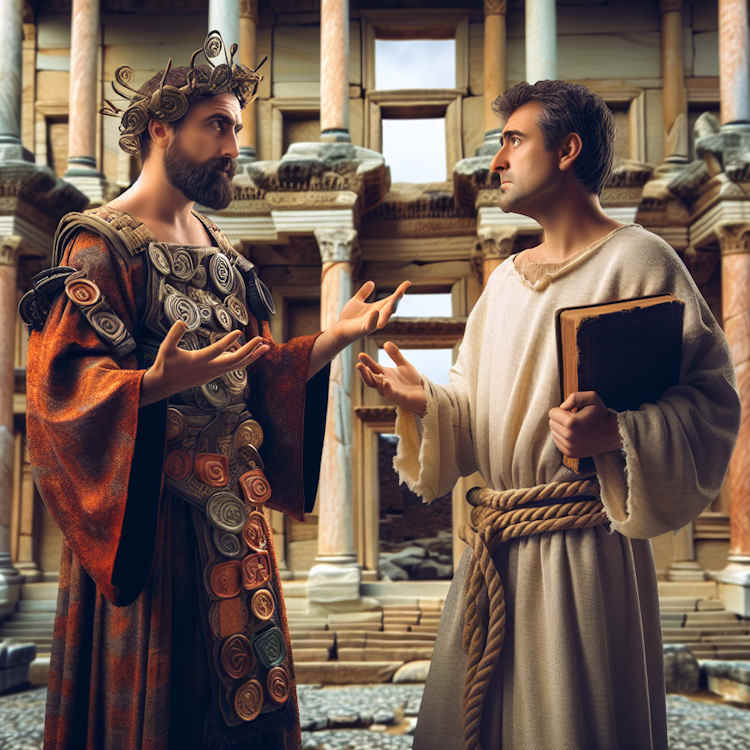
When Paul arrived in Ephesus in the 50s AD, he was walking into a city saturated with the divine. The Temple of Artemis employed thousands of people — priests, priestesses, temple servants, merchants, silversmiths who made the miniature silver shrines that Acts describes the guild of Demetrius producing. The temple was a bank, a sanctuary, an economic engine, and a sacred heart all at once. Artemis herself was something older and stranger than the Greek goddess of the hunt — an Anatolian mother deity, many-breasted in her most famous images, whose worship had roots in this soil that went back before Greek colonisation.
And Artemis was only the most famous. Cybele, the ancient mother goddess of Phrygia, was worshipped across the interior. Apollo had his oracular shrine at Didyma, near Miletus. Aphrodite, Dionysus, Asclepius the healer — his great sanctuary at Pergamon drew the sick from across the empire, the ancient equivalent of a teaching hospital with a divine patient intake form. Zeus dominated Pergamon’s skyline from his great altar. The imperial cult temples stood in every major city.
This was not a world of empty superstition waiting to be enlightened. It was a world of genuine religious experience, civic identity, economic infrastructure, and a thousand years of accumulated meaning.

The Long Middle — When They Coexisted


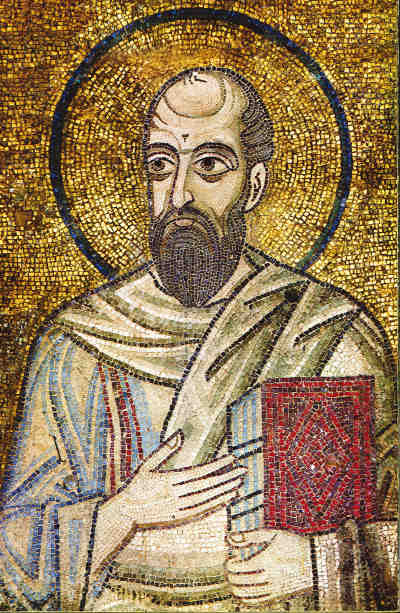
Apostle Paul in Miletus city gave his one of the final speeches in Asia Minor
For much of the second and third centuries, paganism and Christianity coexisted in Asia Minor more than is sometimes admitted. Pagan temples continued to function. Christians met in houses and adapted pagan spaces as they could. The philosophical culture of the region — Stoicism, Neoplatonism, the mystery religions — influenced Christian theology in ways that make the boundaries between the traditions blurrier than either side would have liked.
Tertullian, writing in North Africa but describing a world that applied equally to Asia Minor, complained that Christians were borrowing too much from pagan culture — their dress, their entertainments, their conceptual frameworks. Justin Martyr, writing in the second century, tried the opposite approach: arguing that the best of Greek philosophy was essentially proto-Christian, a preparation for the gospel. Both men were responding to the same reality: these traditions were not hermetically sealed from each other.
The turning point came not gradually but decisively, and it came from the top.
Theodosius and the Closing of the Temples
The Emperor Theodosius the First issued a series of edicts between 380 and 391 AD that progressively made Christianity the official religion of the Roman Empire and progressively restricted, and finally prohibited, pagan worship. The Edict of Thessalonica in 380 declared Nicene Christianity the state religion. The edicts of 391 went further: public pagan sacrifice was forbidden. The temples were to be closed.
What followed in Asia Minor was uneven and often violent. In some places the closure of temples was a legal formality — the buildings stood, their cult activity quietly ceased, their economic functions gradually transferred. In others, monks and zealous bishops led what we would now have to call mob violence against sacred sites.
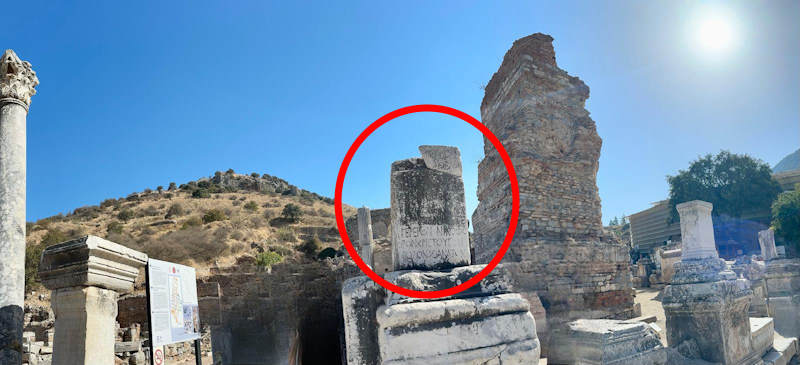
The Temple of Artemis in Ephesus was almost certainly destroyed in stages. Some of its columns and marbles were taken to build the great Church of Hagia Sophia in Constantinople under Justinian. Others were used in the construction of churches across the region — you can sometimes spot the recycled capitals and column drums if you know what you are looking at. The site itself was used as a quarry for centuries. The bishop of Ephesus, a man named Demeas, erected a triumphal inscription on the temple’s forecourt commemorating the defeat of the goddess.
What Christianity Built on Top of Pagan Ground
Destruction was only part of the story. Transformation was the other part, and it is architecturally visible across Asia Minor in ways that still move me when I point them out to groups.


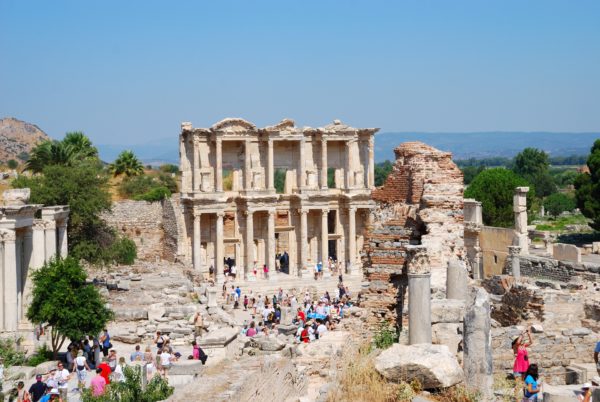
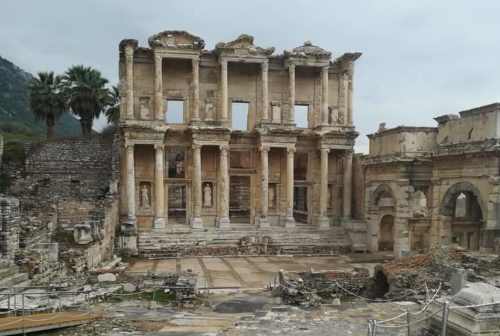
The great civic basilica of Ephesus — a large rectangular hall used for commerce and law — was converted into a church in the fourth or fifth century. It was here, in this repurposed building, that the Council of Ephesus met in 431 AD and declared Mary the Theotokos, the God-bearer. The irony that this declaration happened inside a building in the city of Artemis — herself the great mother and protector — was not lost on contemporaries and has not been lost on historians since.
In Pergamon, the Serapeion — the red-brick temple complex dedicated to the Egyptian god Serapis, one of the largest religious buildings in all of Asia Minor — was converted into a Christian church. You can visit it today. The brick walls still stand to impressive height. The conversion is visible in the architecture if you look: blocked niches, added apses, the footprint of the pagan building folded into a Christian plan.
Across Anatolia, this pattern repeated. Saints replaced local gods in the popular imagination, often with striking geographical and symbolic continuity. Healing springs that had been sacred to Asclepius became associated with healing saints. Mountains that had been the homes of local deities acquired hilltop chapels. The mother goddess in her various local forms found a new name: Meryem Ana, the Virgin Mary.
I do not say this to diminish Mary or to flatten the genuine theological transformation that occurred. I say it because the continuity is real, and because I think it is more interesting than a story of simple replacement. Religions do not arrive in empty landscapes. They land in places already full of meaning, and they negotiate with what they find.
What Was Lost
The single column of the Artemis temple. That is what I keep coming back to.
History is not a morality play. The faith that survived and spread across Asia Minor brought with it literacy, hospitals, a concept of human dignity that genuinely changed the world. It also broke things. Both of these things are true.
Come to Ephesus. See the column. See the church built over the basilica where they declared Mary the mother of God in a city that had worshipped a mother goddess for a thousand years. See the layered thing that this land is. It rewards that kind of attention.
Contact me through e-mail or phone to explore these sites in person. See you soon, Hasan Gülday