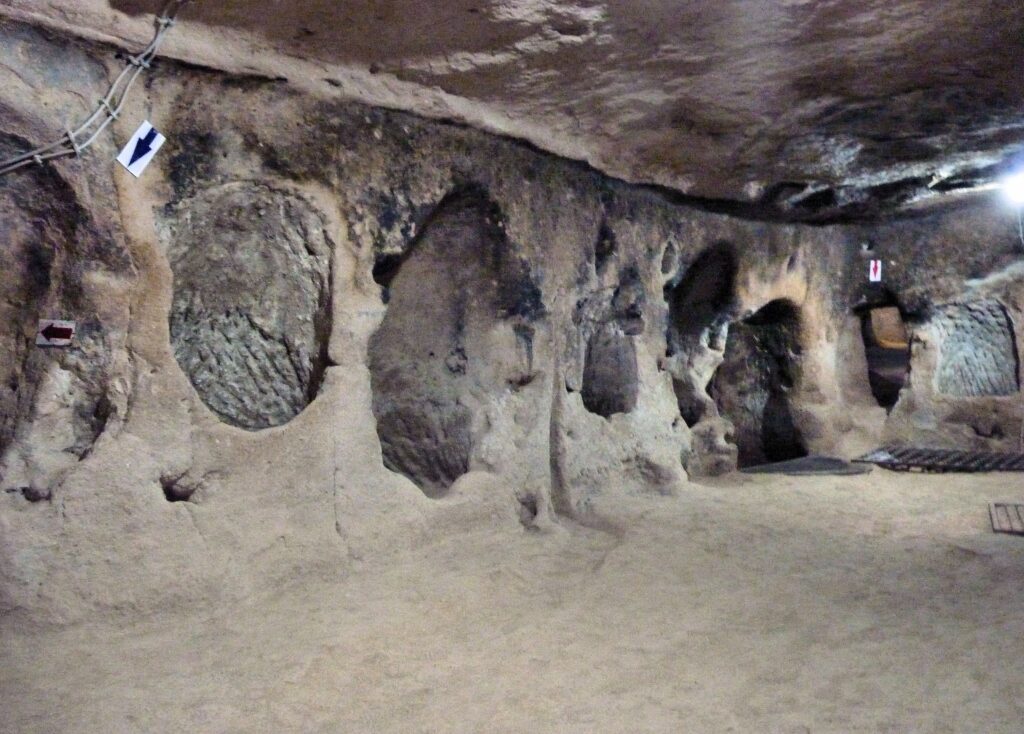
The underground cities in Cappadocia are rock-cut refuges, carved down into soft volcanic tuff, with air shafts, wells, stables, churches and heavy stone doors that closed from inside. The Ministry of Culture estimates 150 to 200 such settlements in the region, and Derinkuyu reaches about 85 meters down. Who dug them and when is still debated, but the best evidence for their big growth comes from the Byzantine centuries.
Add Tours Around Turkey as a preferred source on Google
Cappadocia is not part of my day guiding, but I join my guests there on longer journeys. Let’s have a look at seven underground cities, from famous Derinkuyu to quiet sites that few visitors reach. You can read more about the volcanic landscape in my article on 10 interesting facts about Cappadocia.
Who Built the Underground Cities?
Nobody can say for sure. Some researchers think the Phrygians, one of the many civilizations of Anatolia, cut the first rooms in the 8th or 7th century BC. The cities grew into many levels much later, in the Byzantine period, especially during the Arab raids between about 780 and 1180.
In 1925 the French scholar Jerphanion read the millstone doors as a sign of insecure times, the years when Arab raiders crossed the Taurus Mountains. Two researchers who updated the survey of the Kayseri area in 2022 still agree with him in principle, although some shelters may be older (Yamaç and Bixio, 2022).
Many people connect the cities with the Roman persecution of early Christians. That is a popular idea, but the clearest evidence comes from later centuries. By then Cappadocia, once a Roman province, belonged to the Byzantine Empire.
Derinkuyu and Kaymaklı
Derinkuyu is the best known of these cities, and its name means “deep well”. Some estimates say it could shelter up to 20,000 people with their animals, but I am careful with the biggest numbers. A 55-meter shaft served as air shaft and well at the same time. Stables, kitchens, wine and oil presses and chapels were carved into the rock, and a church lies in the lowest level.
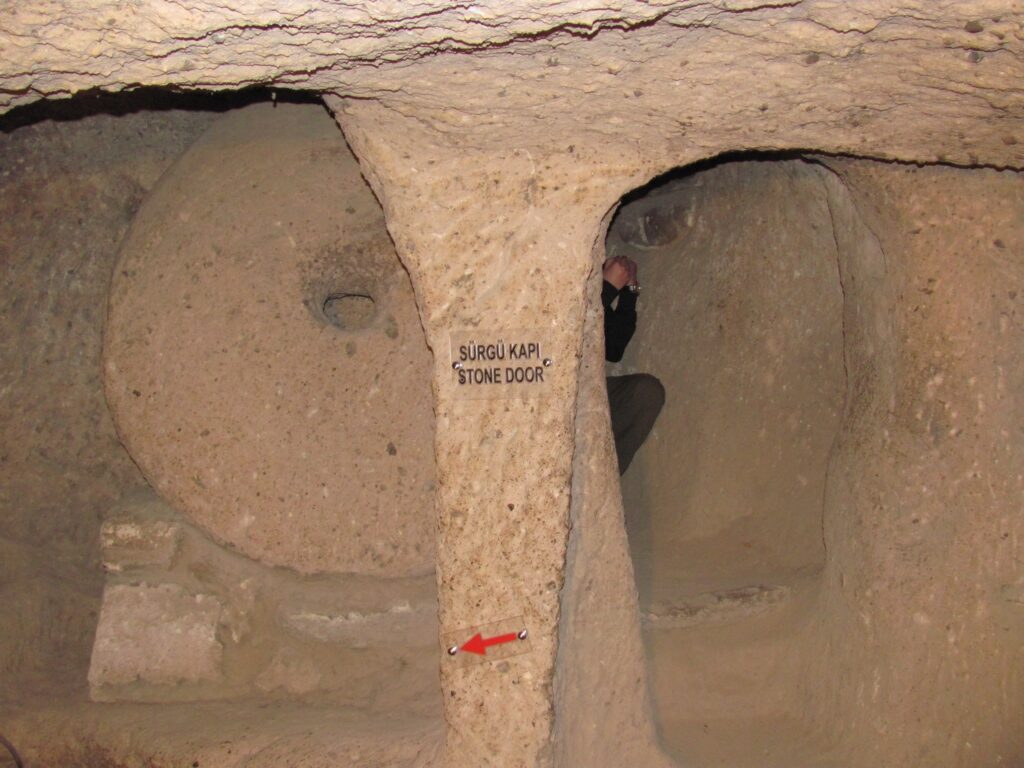
A room on second floor is believed to have been a religious school. Heavy round stone doors could close each floor separately, and they were rolled shut from inside.
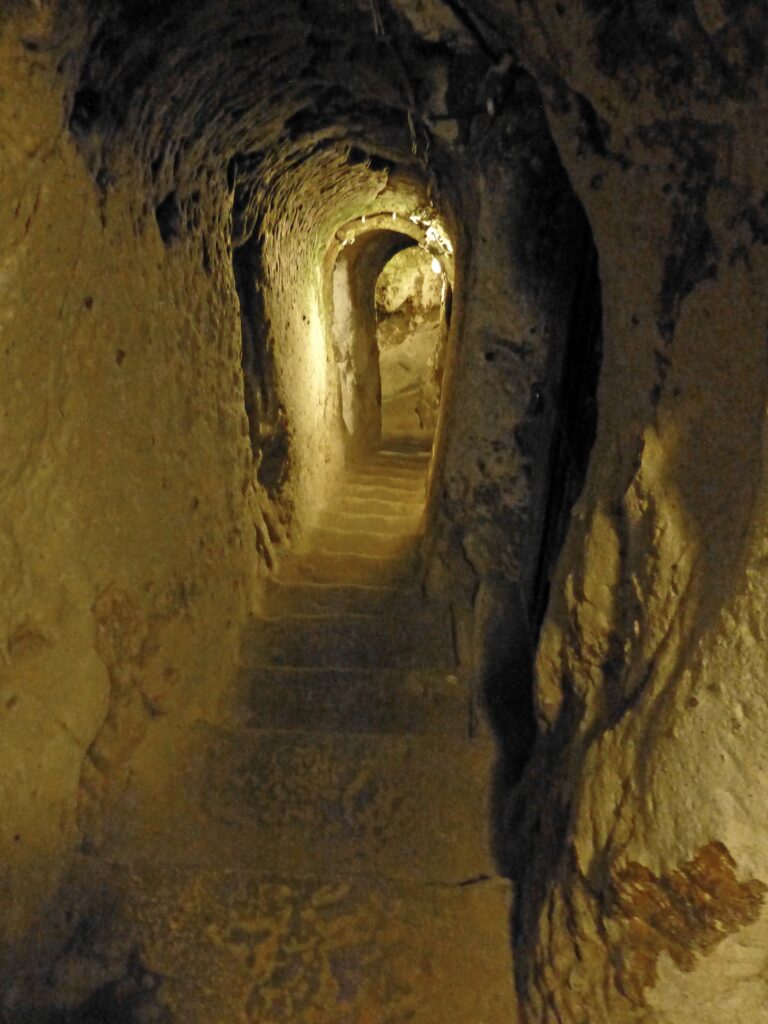
A local man rediscovered Derinkuyu in 1963, when he knocked through a wall while renovating his house. It opened to visitors in 1965, and only about ten percent can be seen today. Expect low passages and a lot of bending. It is not the best place for the claustrophobic.
Kaymaklı lies about 19 kilometers from Nevşehir and opened to tourists in 1964. Its passages are lower, narrower and steeper than in Derinkuyu, and four floors are open. A church with a nave and two apses is on the second floor. The third floor has the kitchens, storage rooms and wine presses.
Tunnels of 8 to 9 kilometers are said to connect Kaymaklı with Derinkuyu, visitors cannot walk them.
Özkonak and Mazı
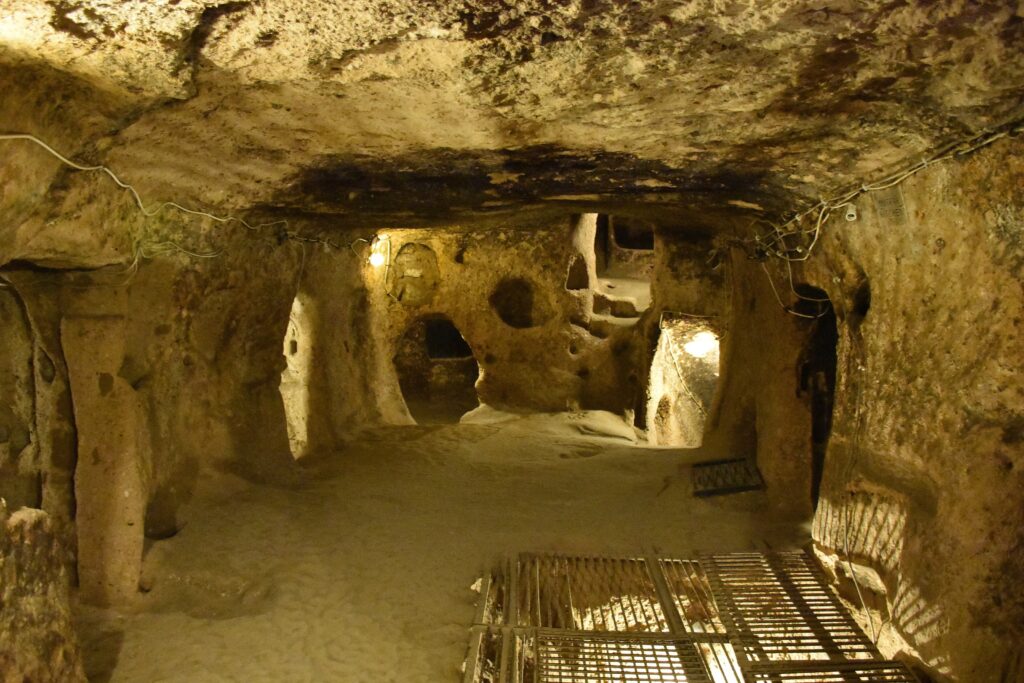
Özkonak is nearby Avanos, about 14 kilometers from the town. In 1972 a local farmer, Latif Acar, wondered where the irrigation water of his field was disappearing and found a hidden room. Ten floors are known, down to 40 meters, but only four are open.
Narrow holes of about 5 centimeters connect the floors. People used them to talk between levels, and they also let in air when the rooms were closed.
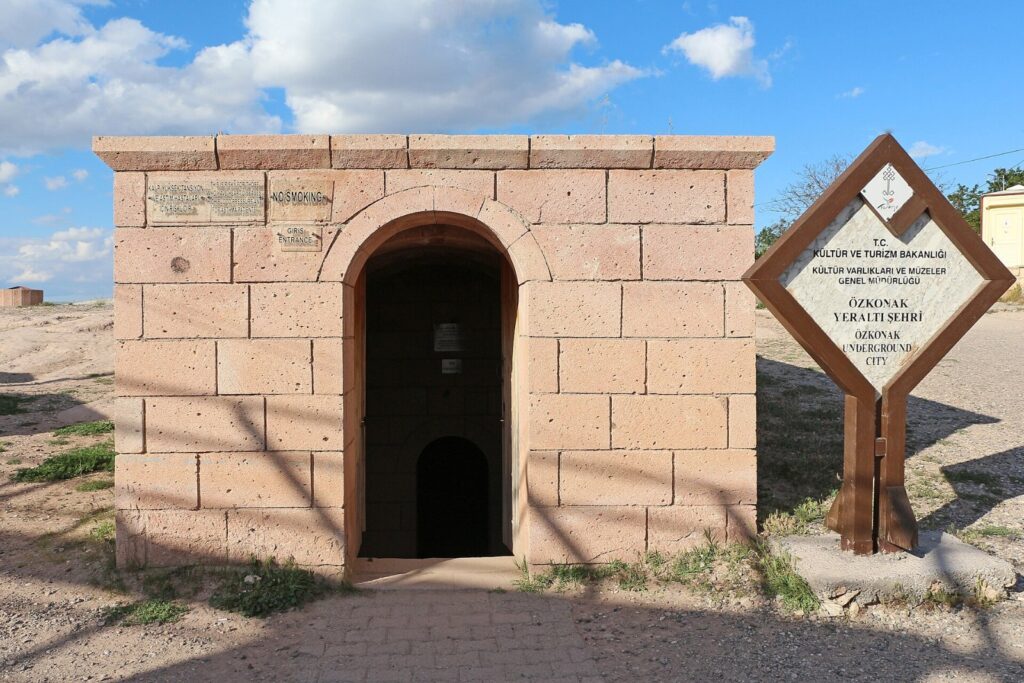
Mazı is a quieter place, about 18 kilometers from Ürgüp. Its ancient name was Mataza. It is believed to have four levels, and two of them have been open since 2015. Four entrances lead into the city.
A short corridor from the stables leads to the church, and a rolling stone could close its entrance. The many stables suggest that people here kept a lot of animals. Grapes fell through chimneys from surface to the wine chambers.
Tatlarin, Saratlı and Gaziemir
Tatlarin lies on a hill north of Acıgöl, which the villagers call Kale. It was first recorded in 1975, and a part of it opened to visitors in 1991. Two floors are open today. A giant stone infront of the entrance could be closed and opened only from inside. Most churches in the Kale area collapsed over time. Some scholars think the site was a garrison or a monastery complex.
Saratlı, also called Kırkgöz, is laying in Gülağaç district of Aksaray Province, about 22 kilometers from Aksaray city. The Küre Encyclopedia dates it to the Roman period and estimates seven levels. Digging began in 2000, and three levels opened in 2001. It has kitchens, wells, stable places with mangers and millstone doors.
Gaziemir is a village in Güzelyurt district, also in Aksaray Province. Its underground city belongs to the Byzantine period. It has two churches and a winery, and a big room where camels were kept. Animals were clearly part of daily life in most of these cities.
What the Cities Tell Us
Whatever the exact dates, the wells, stables and churches show that people planned to stay down there for some time. Walking through Derinkuyu today, you feel how fragile life was for the families who hid here.
In addition, these places remind us that Christian communities in Anatolia sometimes needed a refuge from danger. If you would like to see more of this story, read my guide to Christian Turkey for first-time visitors and my short list of Byzantine attractions in Turkey.
Frequently Asked Questions
How many underground cities are there in Cappadocia?
The Ministry of Culture and Tourism estimates between 150 and 200 underground settlements of different sizes. Only a handful are open to visitors, such as Derinkuyu, Kaymaklı, Özkonak and Mazı.
Who built the Derinkuyu underground city?
Nobody knows exactly. The first rooms may have been cut by the Phrygians in the 8th or 7th century BC, and the city took its full form in the Byzantine period. It grew most during the Arab-Byzantine wars, roughly between 780 and 1180.
Which is better, Derinkuyu or Kaymaklı underground city?
Both are worth seeing. Derinkuyu reaches about 85 meters, while Kaymaklı has four open floors and lower, narrower, steeper passages. When I travel with my guests in Cappadocia, I like to see both on one day, because the contrast shows how different these cities are.
Hire Tour Guide in Turkey
I’m a nationally licensed Turkish tour guide based in Kuşadası. My day guiding is in Ephesus, İzmir and Pamukkale. For longer journeys, such as a trip to Cappadocia, I can join you as your personal guide with my national license.
You can see my guiding rates and guiding areas, or write to me through my contact page to ask about my availability.
I hope we will see these underground cities together one day. You can always write to me with your questions about Cappadocia and its Christian history. See you soon, Hasan Gülday.