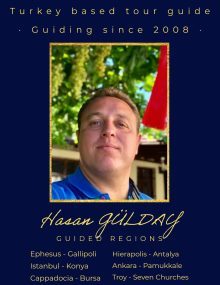
Original Article by Hasan Gülday — Licensed Turkish Tour Guide
A Personal Note Before We Begin
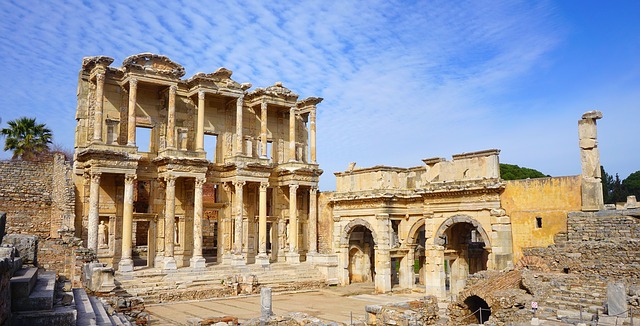
I should admit something before you read these stories. Long before I became a tour guide, before I ever stood on the marble streets of Ephesus and explained the Library of Celsus to a group of travellers, I was a boy who loved to disappear into other worlds. Science fiction and fantasy were my first great loves — the novels, the films, the stories of starships and wizards, of distant deserts and dragons and heroes who turned out to be braver than they thought they were. I have never grown out of them, and I hope I never do. There is a part of me that still believes the most serious thing a person can do is to imagine.
Today I am the father of two daughters, and they have given my old habit a new purpose. On long evenings, on the road, and whenever they ask, I make up stories for them — original ones, out of my own head, mixing the ancient places I know so well with the imaginary worlds I have always loved. Ephesus slips into almost all of them. My daughters know the Library of Celsus not only as a real ruin their father talks about for a living, but as a magical building that, in our family’s bedtime stories, has turned up in a hundred different lands — sometimes guarded by knights, sometimes by talking animals, sometimes lit by two small girls holding lanterns of their own.


So when I came with the idea of these ten images of Celsus Library reimagined across ten universes, it felt as though someone had reached straight into my imagination and pulled out the very thing I have been doing for my daughters all these years. I could not resist writing a story for each one. They are written, really, the way I would tell them at home — for two little girls who love to wonder, and for the child in any reader who still does too.
A Very Old Line of Storytellers
When I tell my daughters a story at night, I sometimes think about how little I have truly invented. I am only the latest in a very long line of storytellers who have worked this same stretch of earth, and the older I get, the more I feel them standing behind me.
Consider where I live. The greatest storyteller the world has ever known, Homer, was by the oldest tradition a son of Smyrna — modern İzmir, less than an hour up the coast from my home. The Iliad and the Odyssey, the two poems that begin all of Western literature, were sung first in this Aegean air, and the war they describe was fought at Troy, on the Turkish coast to the north. The man often called the father of history, Herodotus, was born just down the coast at Halicarnassus, today’s Bodrum; he filled his great work with so many marvels and tales that the ancients sometimes teased him as the father of lies as well. Both the first storyteller and the first historian of the Western world were, in a sense, my neighbours.


And then there is my own Turkish tradition, which is just as rich. There is Dede Korkut, the legendary white-bearded bard of the Oghuz Turks, whose epic tales were sung around fires for centuries before anyone thought to write them down. There is Nasreddin Hodja, the gentle thirteenth-century jester-sage of the Konya country, whose little stories — about a man, a donkey, and a great deal of common sense — still make Turkish children laugh today, eight hundred years later. There are the aşıks, the wandering minstrel-poets who carried news and legend from village to village with a saz across their backs, a tradition that lived on into my own century in beloved figures like the blind poet Aşık Veysel. And there is Evliya Çelebi, the great Ottoman traveller, who spent forty years wandering the empire and writing down everything he saw and half of what he was told — a guide and a storyteller in one, which is perhaps why I feel closest of all to him.
I am not comparing myself to these giants. I am a tour guide who makes up bedtime stories. But I do think we are all doing the same very human thing, and that the thread between us has never actually broken.
The Library of Celsus in The Lord of the Rings Universe

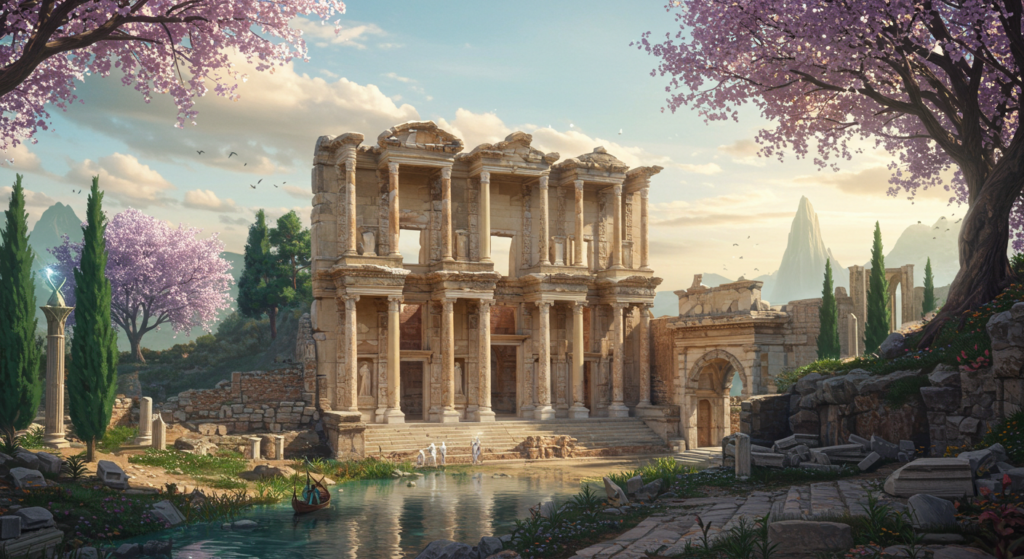
In an age the chronicles have forgotten, the fair folk raised a hall of pale stone beside a quiet pool and planted slender trees that blossomed violet even in the cool of morning. They carved upon its face the four virtues their loremasters loved most, and upon a single column they set a phial of captured starlight, so that no traveller would ever find the door in darkness. Within lay the songs and histories of a people who knew they would one day sail away and not return.
A small boat waited always at the water’s edge, for the keepers believed that knowledge, like a guest, should never be made to feel trapped. Pilgrims came from beyond the mountains simply to stand before the carved maidens and remember that they were not the first to wonder, and would not be the last. When at last the fair folk departed and the light of their age dimmed, the phial on the column did not go out. That is the way of true knowledge: the makers leave, but the light they kindled stays behind, waiting patiently for the next pair of eyes.
The Library of Celsus in the Pokémon Universe

The young trainer climbed the last steps as the afternoon light flared white across the old stone, and there they all were, mid-battle in the great courtyard — the little yellow one crackling with electricity, the orange dragon roaring flame, the blue shellfish bracing its cannons, and a half-dozen others circling, eager and unafraid.
For generations this ruined library had been a training ground, but the champions who came here learned something the rookies always missed. The lesson of this place was never only how to win a battle. It was how to understand the creature fighting beside you — to read its courage, its fear, its heart. The four carved figures above the door had watched thousands of trainers arrive certain they already knew everything, and leave understanding that they had only just begun. The trainer called out, and the little yellow one looked back, and in that single glance there was more than strategy. There was trust. Standing where scholars once stood, the trainer realised that knowledge and friendship grow in exactly the same way — slowly, patiently, and only when you are brave enough to keep showing up.
The Library of Celsus in the Marvel Comic Book Universe

When the sky tore open above the ancient city, they came from every direction at once — one swinging between the columns, others streaking down out of the clouds in red and gold, the strongest of them planting his green feet on the cracked marble and daring the danger to come closer.
They had defended towers and cities and whole worlds before. But here, before the old library, the mission felt different, and the quickest of them said so aloud: they were not protecting gold or a weapon. They were protecting the memory of everyone who had ever lived in this place — twelve thousand voices, written down and waiting. Any one of them could lift a building or outrun a missile. None of them could replace a single lost book. And in that knowledge there was a strange humility, even for heroes. The greatest power a person can carry, the leader with the shield reminded them, is not strength at all. It is the willingness to guard what others built, and to hand it forward unbroken. The four carved women on the façade — Wisdom, Excellence, Thought, and Knowledge — seemed almost to be smiling.
The Library of Celsus in Star Trek Universe

The starship had been mapping a quiet sector when the sensors found it: a structure on a half-forgotten world, far older than anything in the charts. The away team beamed down at dusk, beneath a sky crowded with unfamiliar moons, and stood in silence before a façade of weathered columns.
It was a library, or it had been, long ago. The science officer ran a scan along the carvings — four figures, clearly meant to represent ideals — and reported, with something like wonder, that this was the place where a young species had first written down its questions about the stars. Not its conquests. Its questions. The captain looked up at the constellations turning overhead and understood that the whole long mission they were on — to seek out new life, to go where no one had gone before — had not begun on any starbase. It had begun here, in spirit, the moment some ancient hand carved a word into stone so that a stranger centuries later could read it. Every voyage to the stars, the captain thought, begins with someone brave enough to write a question down and trust that someday, somewhere, it would be answered.
The Library of Celsus in Star Wars Universe

The sun was going down in bands of fire when the squad reached the ancient archive. Fighters screamed low over the broken roofline, engines blue against the dusk, and the armoured soldiers fanned out across the old courtyard with weapons raised.
They had been told the library held knowledge the regime feared — and the regime was right to be afraid. Fleets can be destroyed and rebuilt. Cities can be burned and raised again. But a single preserved truth, once it slips free and finds even one more mind to live in, can outlast any empire that ever flew a flag. That was why the order had come to seize this place, and why, deeper in the ruin, others were racing to copy the records before the soldiers reached them. Above the doorway the four carved guardians watched it all without flinching, as they had watched conquerors come and go for centuries. Hope, in the end, is only information that refuses to be erased. As long as one scroll, one file, one memory survives and is passed to someone willing to carry it, the light is not lost — it has only changed hands.
The Library of Celsus in Warhammer 40,000 Universe

In the grim darkness of the far future, on a world already half-consumed by war, the last defenders held a thin line before a crumbling library while fire flickered behind its empty windows. The enemy came in a roaring green tide, endless. The armoured warriors in blue did not retreat.
They were not holding this ground for territory; there was no territory left worth holding. They were holding it for the data-scrolls sealed beneath the ruin — the records of a golden age when their kind had still believed in building things more beautiful than weapons. Their commander had read those records once, long ago, and never forgotten them. In an age that had learned to worship only war, he had quietly decided that the preservation of knowledge was a thing worth dying for. The four carved figures on the façade — scarred now, blackened by old fires — still gazed out over the battlefield: Wisdom, Excellence, Thought, Knowledge. Even here, at the bitter end of everything, someone still stood beneath them and refused to let the light go out. And that refusal, against all the darkness of the galaxy, was itself a kind of light.
The Library of Celsus in The Wizard of Oz Universe

The yellow road wound out of the green hills and ran straight as a ribbon to the foot of the great pillared hall, where red poppies nodded along the broken roofline and watchful figures in tall black hats kept their distance on either side.
Four travellers walked the road together — a girl far from home, a man of tin, a lion learning to be brave, and a fellow stuffed with straw — and each of them believed the library at the end held the one thing they lacked. A brain. A heart. Courage. A way home. They climbed the steps and passed beneath the four carved women, and somewhere among the endless shelves they discovered the secret the building had been keeping all along: the gifts they were seeking had never been missing. The scarecrow had been solving problems the whole way. The tin man had wept for his friends. The lion had walked straight toward his fears. The library did not give them anything; it simply let them read, at last, what had always been written in them. Wisdom and heart and courage, the carved women seemed to whisper, are not waiting at the end of the road. They are what you become while walking it.
The Library of Celsus in the Wizarding World of Harry Potter

At the blue hour, when the day-people had gone and the stones held the last of the light, the young witches and wizards came drifting down on their brooms, and the small loyal creatures who tended the shelves scurried out to meet them with wandlight bobbing in the dark.
To them, this ancient library was the most magical place in the whole world — and not because of the spells. They had learned the secret early: every book is itself a kind of spell. A few marks on a page, set down by a hand long turned to dust, can reach across a thousand years and change what happens inside a living mind. That is enchantment of the deepest kind, older than any wand. The little keepers guarded the scrolls as if they were treasure, because they were. Above them the four carved guardians had watched generations of students arrive thinking magic meant power, and leave understanding that the truest magic is simply a story, written down by someone who cared, and read by someone who needed it. In any world, that is the spell that never breaks.
The Library of Celsus in the Dune Universe

On a planet of endless sand, where a single cup of water was wealth and memory was the most sacred thing a people owned, a lone figure crossed the dunes toward a façade the great worms had not yet swallowed.
Behind the traveller, the desert itself seemed to rise and turn — vast, ancient, patient — but the traveller did not run. There was something in the half-buried library worth the risk. Within those drowned halls lay the records of a civilisation that had once known green worlds, falling rain, and water enough to waste. The traveller had been taught from childhood that to lose a memory was a kind of death, and that the future of a people is only ever as strong as what they manage to carry forward through the hard years. The four carved women still watched from the façade, half-blinded by blowing sand: Wisdom, Excellence, Thought, Knowledge. In a place where everything was scarce, the traveller understood, knowledge was the most precious water of all. And those willing to cross the desert to protect it were not fools. They were carrying the future, one fragile scroll at a time.
The Library of Celsus in Game of Thrones Universe

The sun was bleeding out behind the hills and the cold was coming early when they gathered before the ancient library — soldiers in dark steel, and beyond them, drifting up out of the dusk on the far side, the pale blue figures that meant the long night had begun to march.
A dragon turned overhead, vast and dark against the dying light. But the living had not come here to fight, not yet. They had come because somewhere in this old hall, among scrolls no one had read in centuries, might lie the one forgotten thing they needed: the knowledge of how the long night had been ended once before. Kings had spent the realm’s wealth on swords and walls and thrones. In the end, when the dark truly came, no one ran to the throne room. They ran to the library. Because the past, the four carved women had always known, is where the answers to the future are kept. A single old book, found in time, can do what ten thousand swords cannot. When the world grows darkest, look not for a crown — look for what someone, long ago, was wise enough to write down.
Ten Worlds, One Building, One Tour Guide to Hire
Ten worlds, one building. I find it wonderful that the Library of Celsus fits so naturally into every one of them — among elves and starships, heroes and dragons, sand and snow. I think it is because the Library was never really about the stone. It was about a single, stubborn human hope: that what we learn might outlast us. The four women on the façade have watched real empires rise and fall in front of them for nineteen centuries, and they are still gazing out over Ephesus today. You can come and stand beneath them yourself. Whatever universe you imagine, wisdom, courage, and memory are always worth building something beautiful around.
Contact me to learn more on Ephesus, to hire a professional tour guide in Turkey and to explore Celsus Library to create your own story!
See you in Ephesus. — Hasan Gülday