By Hasan Gülday — Licensed Professional Tour Guide, Kusadasi / Turkey


There is a strange thing about the Book of Revelation, and almost nobody talks about it. The book is enormous. Twenty-two chapters. Hundreds of dense, image-rich sentences. Quotations and allusions to almost every prophet of the Old Testament, from Isaiah and Ezekiel to Daniel and Zechariah. To write a text of this kind, the author has to have a desk, a chair, ink, paper, time, and most of all, a complete library inside his own head.
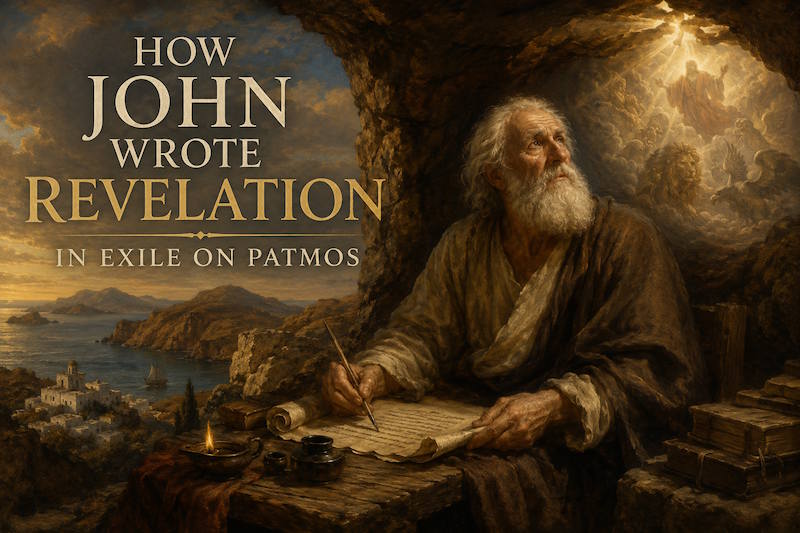
And our author, when he wrote it, was an old man on a small Roman penal island.
How did this work, in practice?
This is the question I want to look at in this article. Not the theology of the Apocalypse, which we will come to in the seven letter articles further on. Just the very practical, very physical question of how an exiled apostle in his late eighties produced one of the most influential books of world literature, on a rock in the Aegean, in conditions that any of my pilgrim guests would describe as a hard camping holiday.
What is *Relegatio in insulam* Exactly
The Roman legal system had, broadly, two kinds of exile. The harsher one was deportatio, full deportation, which carried the loss of citizenship and confiscation of property. The lighter one was relegatio, banishment, which preserved citizenship and most property rights but kept the prisoner away from a specific place — often Rome, sometimes Italy, sometimes the wider world just like in the case of Saint John the Evangelist.


A relegatus could keep his property. He could correspond with his family. He could, in some circumstances, even work. But he could not leave the island. He could be killed if he tried.
The most famous Roman example of this kind of exile, before John, was the poet Ovid, who was banished to Tomis on the Black Sea in 8 AD by the Emperor Augustus. Ovid wrote his Tristia and his Letters from Pontus during his exile, and in those letters he gives us a great amount of detail about how a Roman political prisoner actually lived. He had a house. He had servants, possibly. He had access to writing materials. He could send and receive letters, slowly, by ships passing through the area.
We have to assume that John on Patmos was in roughly the same situation. He was not in a stone dungeon. He had a small house or a cave. He had some money — either his own savings, which he had brought with him, or the support of his community, which was sending him provisions through the ferries from Ephesus and Miletus. He had ink. He had papyrus or parchment. He had a friend or two on the island who could write for him if his eyes were failing.
This is not the prison camp of Hollywood movies. It is closer to a forced retreat at a remote island guesthouse, with the difference that you are not allowed to leave and a Roman soldier is keeping a list of your visitors.
The Date — and a Disagreement
When was the Book of Revelation actually written?
Most modern scholars place it during the reign of Domitian, around the years 95 to 96 AD. This is the traditional dating, supported by the testimony of Irenaeus, who in the late second century writes that John saw the vision almost in our own time, towards the end of the reign of Domitian. This is the dating I myself accept, and it is the dating which fits best with the imperial cult pressure visible in the seven letters.

But I have to be honest with you, there is a minority opinion which is much older. Some scholars, going back to the 19th century and continuing today with names like Kenneth Gentry, are arguing that the book was written earlier, during the reign of Nero, around 65 to 68 AD. Their main argument is that the book seems to predict the destruction of the Temple of Jerusalem, which happened in 70 AD, and so it must have been written before that.
I disagree with this earlier dating, but I want you to know that the question is not completely closed. The early Domitianic dating is still the majority view among serious scholars, and it fits everything we know about Patmos as a place of exile and about the political situation in Asia in the 90s AD.
The Cave and Its Cracks
Where did John actually live on Patmos?
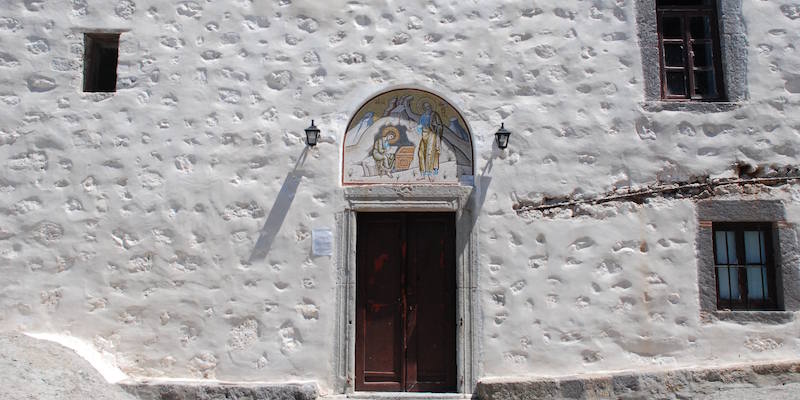
The tradition, which goes back at least to the 4th century, places his dwelling and the place of his vision in a cave halfway up the hill above the harbour of Skala. Today this cave is enclosed inside a Greek Orthodox monastery called the Holy Cave of the Apocalypse, Spilaion tis Apokalypseos. You enter through a narrow door, you go down a few steps, and you are in a low rock chamber maybe four metres wide.


There are three things that the monks will show you when you visit. First, a triple crack in the rock ceiling. The tradition is that this is where the angelic voice of God’s threefold nature came through. Second, a hollow in the rock floor where John is said to have rested his head when he slept. Third, a kind of natural shelf in the rock wall where he is said to have leaned to dictate to his disciple Prochorus.
Whether or not all three of these specific markers are historically accurate, the cave itself is almost certainly authentic. There are no other competing traditions for the place of the vision. The cave has been a place of veneration since at least the 4th century, when the first written records of pilgrims to Patmos start to appear.
I have stood inside it twice in my life. The first time was in 2007, with a group of Greek Orthodox pilgrims from Thessaloniki who happened to visit at the same time with me. We were ten people, more or less, packed into the cave. The chanting of the small monk in the corner, in a language I did not understand, with the smell of incense and beeswax, with the cold of the rock under your hand, this is one of the things which I cannot describe properly even today. The hair on the back of my neck stood up. I am not a particularly emotional man, but it was a very special moment.
The Practical Logistics of Writing
So we have an old man, an island, a cave, and a vision.
Now we have to ask, how does the vision become a book?
Visions are not the same as books. A vision is an experience. A book is a manuscript. Between the two there is a process which involves writing materials, light, time, dictation, editing, copying, distribution. None of this is mystical. All of it is practical. And on a Greek island with no university, no scriptorium, and no resident scribes, this process needed some serious effort.


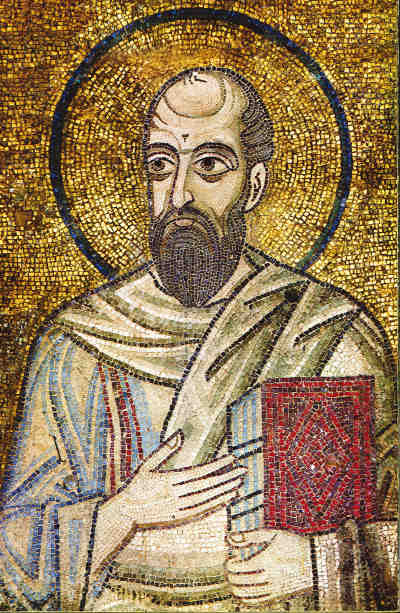
The early tradition of the Eastern Church, going back to the 5th-century Acts of John by Prochorus, is that John was not alone on Patmos. He was accompanied, or joined later, by a younger disciple named Prochorus. Prochorus is the traditional secretary, the amanuensis, the man who actually held the pen while John dictated. He might be one of the seven deacons mentioned in the Acts of the Apostles chapter 6.
This is consistent with everything we know about the writing habits of older men in antiquity. Saint Paul, much younger than John, was already dictating most of his letters to a secretary called Tertius, who actually identifies himself in the letter to the Romans, chapter 16. Cicero in his old age dictated most of his letters to Tiro. By the year 95 AD, John would have been around eighty-nine years old, and his eyesight, like the eyesight of every man over seventy I have ever known, was probably going.
So the picture is this. The old man dictates. The young Prochorus writes. The visions come, the visions go, but the writing happens slowly, line by line, in the cave or in a house near the cave, in the long Aegean afternoons.
The Long Aegean Afternoon
Have you ever spent an afternoon on a Greek island in late summer? I have, many times. The wind drops. The sea goes flat and silver. The cicadas start in the pine trees. By around 4 in the afternoon, the heat is leaving and the light becomes golden. Everything slows down. The shopkeepers in the harbour close their doors and disappear inside. The fishing boats are pulled up on the beach. There is nothing to do, nowhere to go, no urgency, no traffic, no bus, no plane.

This is the kind of afternoon in which a long, dense, image-rich book can actually be written. Not the morning, when the boats are coming and going. Not the evening, when the dinner has to be cooked. The middle of the afternoon, when the wind has dropped and the light is gold.
I am projecting, of course. I cannot prove that John dictated his book in the long Aegean afternoon. But every time I am sitting in a quiet harbour in the Dodecanese myself, after lunch, with my Turkish coffee (NOT GREEK COFFEE!) getting cold in front of me, I think to myself, this is the moment. This is when it would have happened.
How the Book Got Off the Island
Now we have a manuscript on Patmos. How does it get to the seven cities?
The answer is the same as the answer for almost everything else in the eastern Mediterranean of the first century.
By boat.


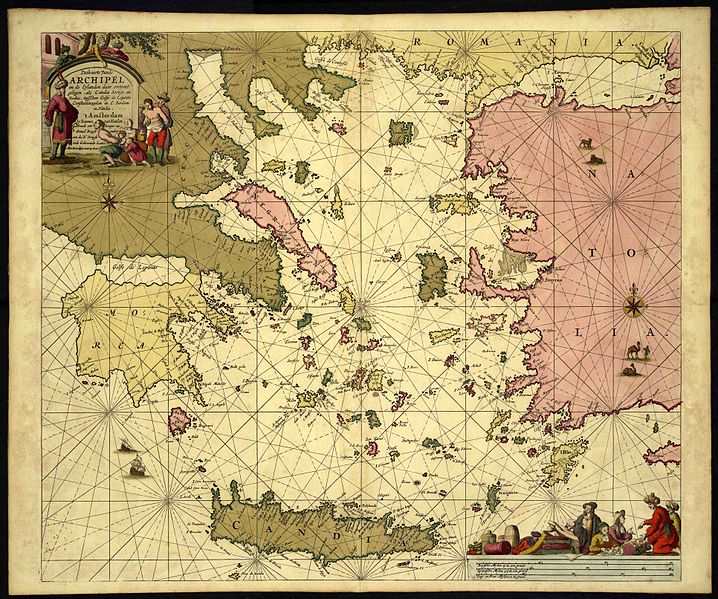
There were small ships sailing between Patmos and Miletus, between Patmos and Ephesus, all the time. The Roman empire had no postal service for ordinary citizens, but there was an informal network of merchants, ship captains, and Christian travellers who carried letters along the trade routes.
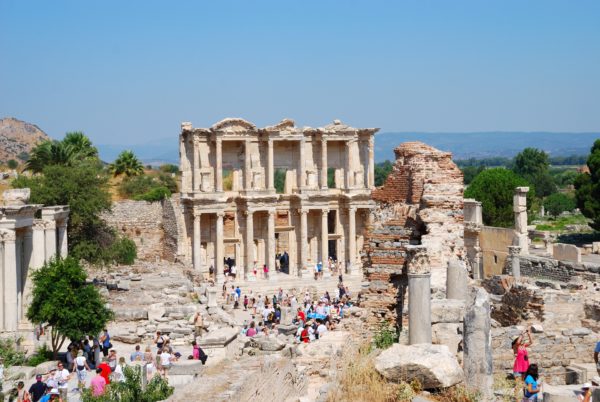
A copy of the Apocalypse, with the seven letters at the front, would have been wrapped in waxed cloth, sealed inside a clay tube or a leather bag, and handed to a trusted Christian merchant who was travelling to Ephesus. From Ephesus, more copies would be made. The seven addressed cities — Ephesus, Smyrna, Pergamon, Thyatira, Sardis, Philadelphia, Laodicea — would each receive a copy along the postal road of Asia, which we will look at in detail in the article about the postal route.
This is not a romantic picture. It is a very practical, very Mediterranean, very first-century picture. Boats, merchants, ferry crossings, sealed letters, payments in coin, copies made by hand on the receiving end. The Apocalypse left Patmos the same way that Saint Paul’s letters left Corinth and Ephesus before it.
If you want to follow this route yourself today, the closest you can get to the original sailing experience is the small ferry from Kuşadası to Patmos and back. Two crossings, three hours each. The wind, the salt, the diesel of the boat, the coffee of doubtful quality. You watch the coast of Asia Minor disappear behind you, and you watch the small island of Patmos rise out of the sea ahead. As We say in Turkish, Bu yol kısa görünür ama uzun bir yoldur. This road looks short, but it is long.
The Final Years and the Tomb
After Domitian was murdered in 96 AD, his successor Nerva annulled most of his political exiles. John was free to leave Patmos. According to the consistent tradition, he came back to Ephesus.

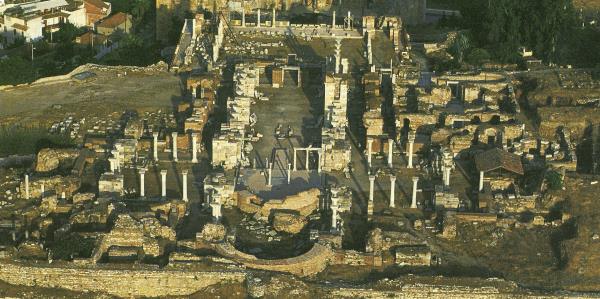
He spent the last few years of his life here. Saint Jerome, writing in the late 4th century, preserves a charming story from earlier writers. John was so old by this stage that he could no longer walk. His disciples carried him into the church on a chair. He could no longer give long sermons. So he repeated, again and again, the same short sentence. Little children, love one another. The disciples, after months of this, asked him why he kept repeating the same words. And he answered, Because it is the commandment of the Lord, and if it is fulfilled, it is enough.
Whether or not this story is literally true, it captures something which I find very moving about the end of his life. The young man who had stood at the cross, who had crossed the Aegean as a refugee, who had founded churches all over Asia, who had been exiled to Patmos and had written one of the most complex books in human history, ended his life saying the simplest possible thing.
Just one sentence.
Love one another.
Coming Back to the Hill

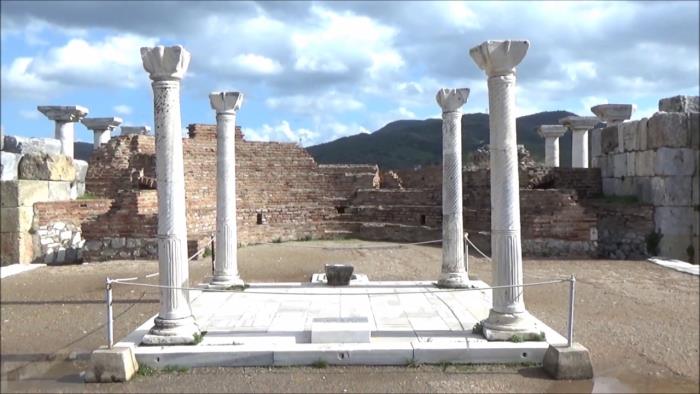
John died in Ephesus around the year 100 AD, when he was about ninety-four years old. He was buried on the hill which today is called Ayasuluk or the Basilica of Saint John, in Selçuk, nearby my home town. The original tomb was a simple structure. In the 4th century, Constantine’s son built a small basilica over it. In the 6th century, the Emperor Justinian built the magnificent domed Basilica of Saint John which we still see today, in ruins, on the same hill.
I drive past this hill almost every morning of my life. From my house in Kusadasi, the silhouette of the basilica is visible against the eastern sky in the early light. It is not a ruin which has been swallowed by tourism. It is part of the daily geography of my town. The neighbourhood children play football below the hill. The old men of Selçuk drink tea in the çay bahçesi at the foot of the hill. The cats of Selçuk, which are many, lie on the warm stones of the apse in the afternoon.
But before we go, I want you to keep one image in your mind. The cave at Patmos, where the book was dictated. The hill at Ayasuluk, where the writer is buried. The Aegean Sea between them. And the seven cities, on the shore of Anatolia, waiting.
That sea has not changed.

Learn More On Saint John and The Revelations
Contact me to hire a local, professional, English-speaking, Biblical tour guide.
We can explore the life and legacy of Saint John the Evangelist together.
Let’s read the scriptures and find out his legacy both in ruins and in the living spirit today.
See you soon, Hasan Gülday!