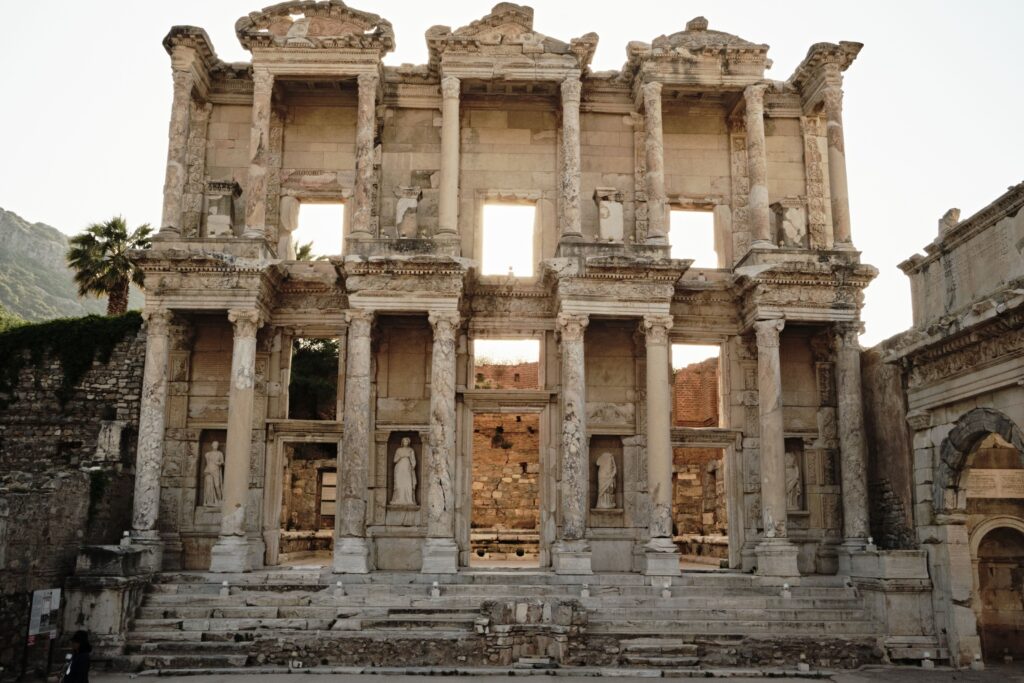
The Celsus Library excavations of 1903 and 1904 found the facade in pieces, and a Turkish, German and Austrian team rebuilt it in the 1970s. What you see today is a rebuilt front standing before ruined walls. Small repairs on the north wing came in 2024.
| Excavated | 1903 to 1904, by Austrian archaeologists |
|---|---|
| Facade rebuilt | 1970 to 1978 |
| Method | Fallen original blocks set up again, missing parts completed |
| Repairs | 2024, on the north wing |
The history of the Library of Celsus has been shaped by extensive excavation, restoration, and conservation work from the early 20th century to the present day. Thanks to the dedication of pioneering archaeologists such as Rudolf Heberdey, Josef Keil, Franz Miltner, Volker Michael Strocka and Hermann Vetters, and well-established institutions such as the Austrian Archaeological Institute, this ancient building still stands today and attracts millions of people around the world.
Tiberius Julius Celsus Polemaeanus was the Roman senator and governor in whose honour the magnificent Library of Celsus was built at Ephesus — the most famous and most photographed monument in the whole ancient city. His story is one of the most remarkable I get to tell, because the beautiful façade that draws travellers from all over the world is, in truth, a son’s loving monument to his father, and his very tomb.
The Library of Celsus is not just a library; it is a monument that reflects the cultural heritage of the Roman Empire and the value placed on knowledge in the ancient world. Let’s take a look at The Legacy Of Celsus Library Excavations and Restorations. Also, let’s have updates about the latest status update on Celsus Library restorations.
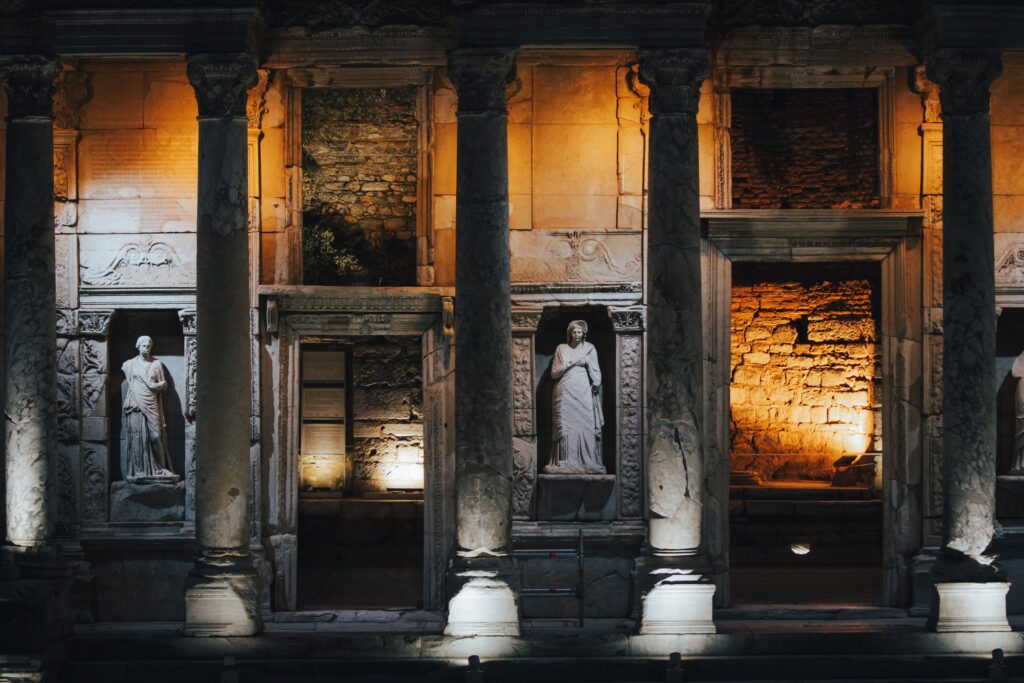
The library was designed to hold many thousands of scrolls and ranked among the great libraries of the ancient world, alongside those of Alexandria and Pergamon. But its glory is its two-storey marble façade, with its columns, its richly carved detail, and four statues set in niches that represent the virtues of Celsus himself — Wisdom, Knowledge, Intelligence, and Virtue. The figures you see on the building today are copies; the originals were carried off long ago and now stand in a museum in Vienna.
Early Works of John Turtle Wood (1869)
The beginning of systematic archaeological research at Ephesus dates back to John Turtle Wood in 1869. Wood, a British archaeologist, was more focused on the search for the Temple of Artemis and did not go beyond making trenches in the area of the Library of Celsus.
Austrian Archaeological Institute Begins Excavations (1895, 1903-1904)
In 1895, under the leadership of Otto Benndorf, he began his work in Ephesus. This excavation, led by the Austrian archaeologist Otto Benndorf, revealed the front surface of the library and the sarcophagus of Tiberius Julius Celsus Polemaeanus, for whom the library is named. Later excavations in 1903 and 1904 partially uncovered the façade of the library, and some original sculptural fragments were transported to Vienna. Rudolf Heberdey and his team, who took over the work after Otto Benndorf, uncovered the basic building blocks and architectural elements of the library. Rudolf Heberdey’s excavations revealed the importance of the building in the ancient world and introduced the Library of Celsus to the world of archaeology.
Wilhelm Wilberg and the Celsus Library Facade (1908)
Wilhelm Wilberg was the architect of the Austrian excavations who drew the reconstruction of the Celsus Library facade published in 1908. About sixty years later, his drawing became the starting point for rebuilding the facade between 1970 and 1978.
Wilberg was born in Athens in 1872 to a German family. He learned to draw ancient buildings there and worked some years in Troy excavations before he came to Ephesus. In 1898 he became the excavation architect of the Austrian Archaeological Institute, which was founded that same year.
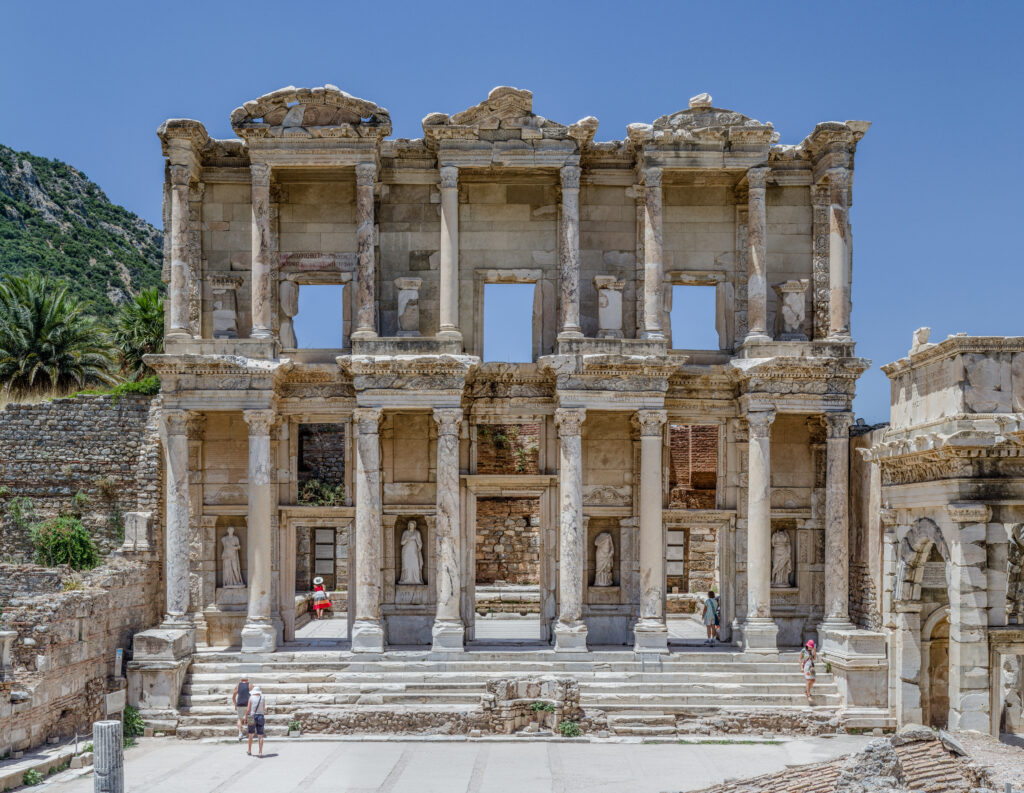
The excavations of 1903 and 1904 found the two-story facade in pieces. An earthquake in the 10th or 11th century had brought it down. Wilberg studied the fallen marble blocks and drew how the columns, niches and pediments once stood on top of each other.
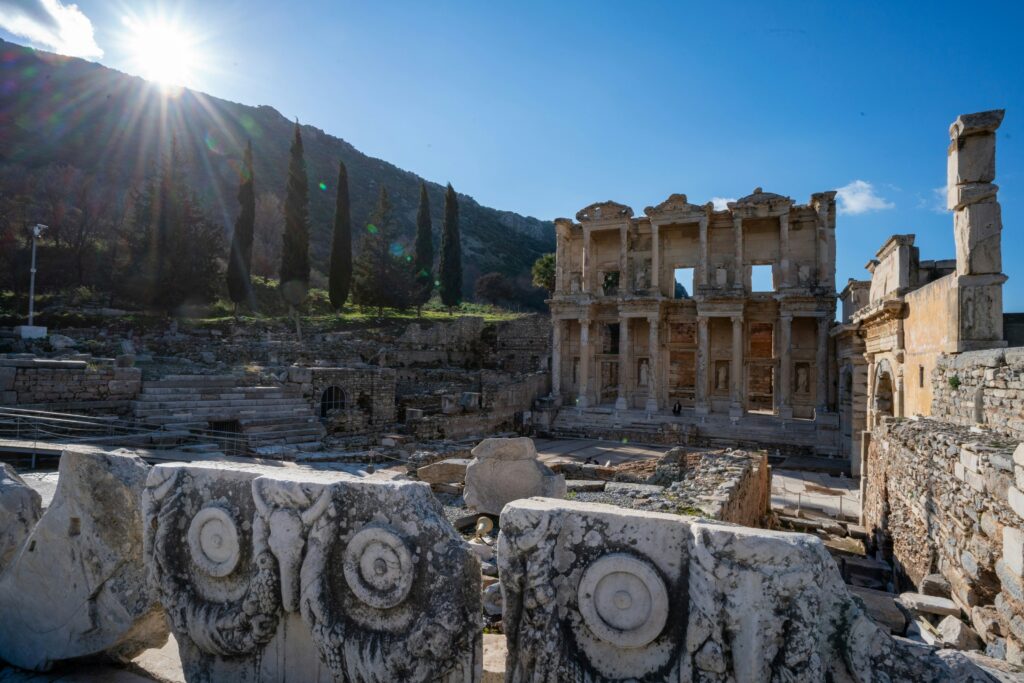
Wilberg knew this corner of Ephesus very well. In 1914 he wrote his doctorate about the South Gate of the Agora, the Mazeus and Mithridates Gate, which stands right next to the library. He died in 1956 in Gmunden, Austria. He did not see the facade standing again, but his drawing was ready for the restorers.


A Tale of Modern Restoration (1970 – 1978)
In the 1970s, a major restoration project was initiated under the leadership of German archaeologist Volker Michael Strocka and Austrian architect Friedmund Hueber. During the restoration process, Turkish, German and Austrian archaeologists and architects collaborated to reorganize the library close to its original form.
The restoration work lasted until 1978 and resulted in the library’s current appearance. In this extensive work, the missing parts of the library were completed and the original sculptures, which had been transported to Vienna, were replaced with exact replicas.
This restoration work not only revealed the original appearance of the Library of Celsus, but also the architectural and artistic heritage of the ancient world. The monumental marble façade, which was built for the function of a mausoleum and library, was redesigned in detail in the light of archaeological finds and documents and restored to its present appearance.

Aftermath Of The Great Izmir Earthquake (2020)
Following the October 30, 2020 Izmir earthquake, several tests and evaluations were conducted on the Celsus Library to assess its structural integrity. While the initial results indicated that the Celsus Library had withstood the earthquake without significant structural damage, the tests revealed minor vulnerabilities in certain areas of the façade and the masonry.

Latest Reconstruction And Preservation Works (2024)
A major check was carried on the Celsus Library at the beginning of 2024. Some micro cracks were discovered on the north wing of the library. These micro cracks could be a problem in the future if left unattended. A group of Turkish and Austrian archeologists carried the reinforcement and repair works. Library was closed for the touristic visits between 24th of September and 30th October. You can visit the Celsus Library without any restrictions today.
Frequently Asked Questions
Is the Library of Celsus original or rebuilt?
The facade was rebuilt from 1970 to 1978, mostly from the original marble pieces, with new stone for the missing parts. Only the front was put back, the inside stays a ruin. See excavations in Ephesus through time.
What destroyed the Library of Celsus?
A fire gutted the inside in 262 AD, and it is not known if it was a Gothic raid or an earthquake. The facade stood until an earthquake in the 10th or 11th century brought it down.
Where is Celsus buried in the library?
His marble sarcophagus lies in a crypt under the floor of the apse, the big niche at the back. The library was built as his tomb and memorial. More in my post on the Library of Celsus.
Get Your Local Tour Guide To Learn More About Celsus Library Of Ephesus

The legacy of Celsus Library excavations and restorations is a topic which can take you through the old and the new stories of Ephesus. I love the library as the place where archeologists of different nations and cultures cooperated. Come and visit Ephesus with me to learn more on Celsus Library.
I never tire of standing before the Library of Celsus with my guests and telling them whose memory it keeps — a local boy who rose to rule an empire, and a son’s devotion that has lasted nearly two thousand years. If you would like to walk the marble streets of Ephesus and hear the full story for yourself, I would be honoured to be your guide. You can reach me, a nationally licensed Turkish guide based in Kuşadası beside Ephesus, through toursaroundturkey.com.
See you soon, Hasan Gülday.



1 comment