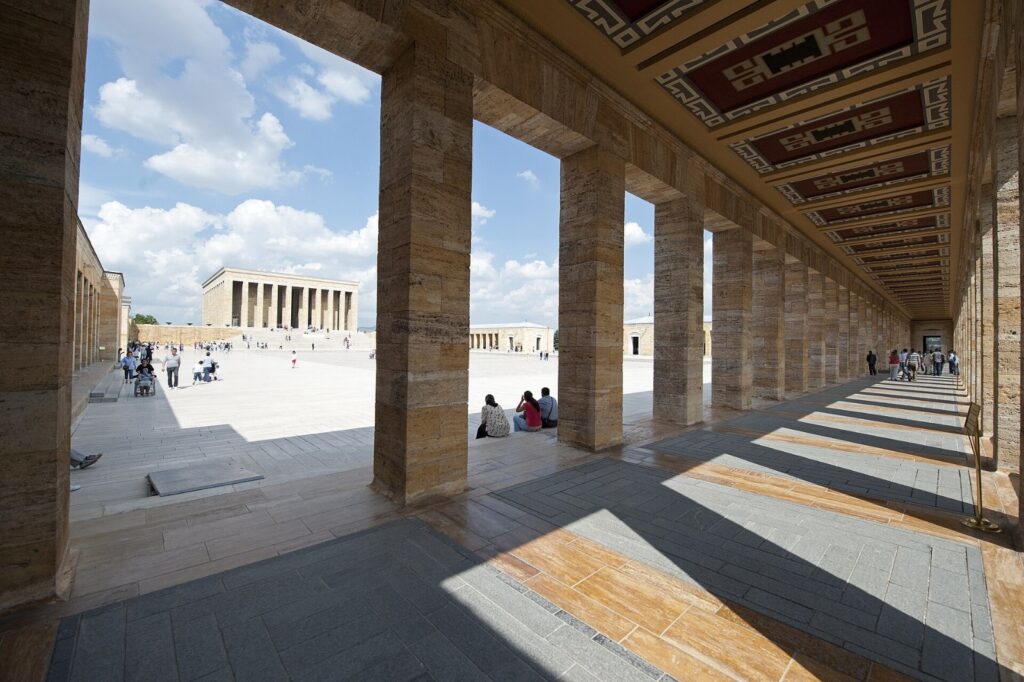
Anitkabir is the mausoleum of Mustafa Kemal Atatürk, the founder of the Republic of Turkey, in Ankara. It stands on a hill inside a wooded park. You walk along the Lion Road to a big ceremonial plaza, and the mausoleum rises on one side of it.
| Where | Çankaya district, Ankara |
|---|---|
| What | Mausoleum of Mustafa Kemal Atatürk |
| Built | 1944 to 1953 |
| Setting | Anıttepe hill, inside the Peace Park |
Anıtkabir and Ankara Guided Tour

Mausoleum of Atatürk, Anitkabir, Ankara is the monumental grave (also known as Anıtkabir Mausoleum) built in the name of the founder of our republic, Mustafa Kemal Atatürk. Atatürk lived the first half of his life as an Ottoman officer, and he lived the second part of his life as a rebel who became the first president and founder of the modern democratic secular Turkish republic. Following his passing in Istanbul on the 10th of September in 1938, Atatürk’s body was preserved in chemicals and placed in the Ethnography Museum of Ankara. Construction of Anıtkabir started in 1944 after long debates and competitions to decide the design.
Anıtkabir was completed in 9 years and was opened for visits on the first of September 1953. Anıtkabir was built on a very central location in Ankara which is known as an observation hill. The building was visible from all around the city but today unfortunately other buildings blocked the view. Anıtkabir Mausoleum has two entrances. One is on feet and the other is on wheels. You should have a full empty trunk if you came with your car or bus for safety reasons. There will be a security check on your belongings and then you will need to walk uphill for about five minutes. You will find yourself in front of the monument. There is a large courtyard surrounded by mausoleum and museum facilities. One hour will be enough to see the basics and entrance is free of charge. See you soon, Hasan Gülday.

What Is Inside Anıtkabir?
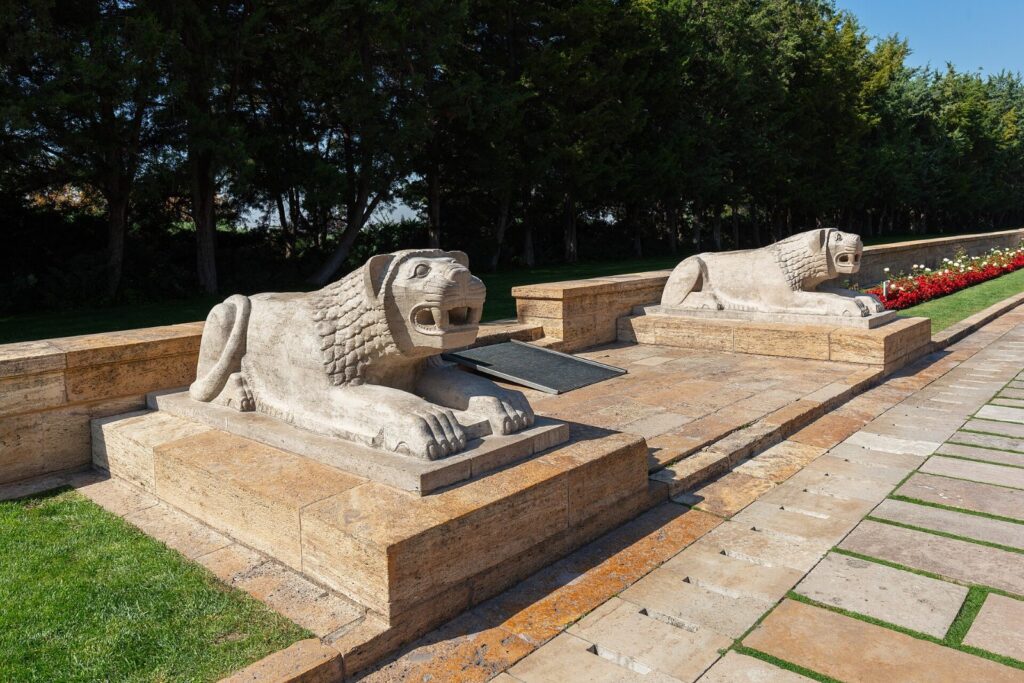
Anıtkabir is a whole complex, not only one building. You enter by the Lion Road, cross the ceremonial plaza and climb to the Hall of Honor, where the sarcophagus stands. Atatürk’s grave is in a chamber right below it.
Let’s have a look at the Lion Road first. It is about 260 meters long, and 24 stone lions sit along it, twelve on each side. Sculptor took an old Hittite lion statue as his example.
The plaza at the end of the road is about 129 by 84 meters, and its floor is paved in patterns taken from old Turkish carpets. Ten towers stand around the complex, with names such as Independence, Freedom and Victory. Reliefs of the Battle of Sakarya and the Battle of Dumlupınar flank the stairs to the mausoleum, two battles of the War of Independence.
The sarcophagus in the Hall of Honor is made of red marble, but it is symbolic. Atatürk’s body rests in the burial chamber below, in a grave dug into the earth. Under the mausoleum area there is also the Atatürk and War of Independence Museum, which opened in 2002. It has big panorama paintings of the battles of Gallipoli, Sakarya and the Great Offensive.
Changing of the Guard at Anıtkabir
Soldiers from the Army, Navy and Air Force stand guard at Anıtkabir, and the guard is changed in a ceremony at set times. Please keep it in mind that this is a place of deep respect for the Turkish people. I ask my guests to stay quiet and follow the soldiers’ instructions during ceremony.
Frequently Asked Questions
What does Anıtkabir mean?
Anıt means monument and kabir means grave, so Anıtkabir is the Monument Grave. In English people usually call it Atatürk’s Mausoleum or the Mausoleum of Atatürk.
Who designed Anıtkabir?
The architects Emin Onat and Orhan Arda designed it. Their project won an international competition in the early 1940s, and the building work started in 1944.
Who else is buried at Anıtkabir?
Only İsmet İnönü, the second president of Turkey, who was buried on the grounds in 1973. His symbolic sarcophagus stands across the ceremonial plaza from the Atatürk mausoleum.