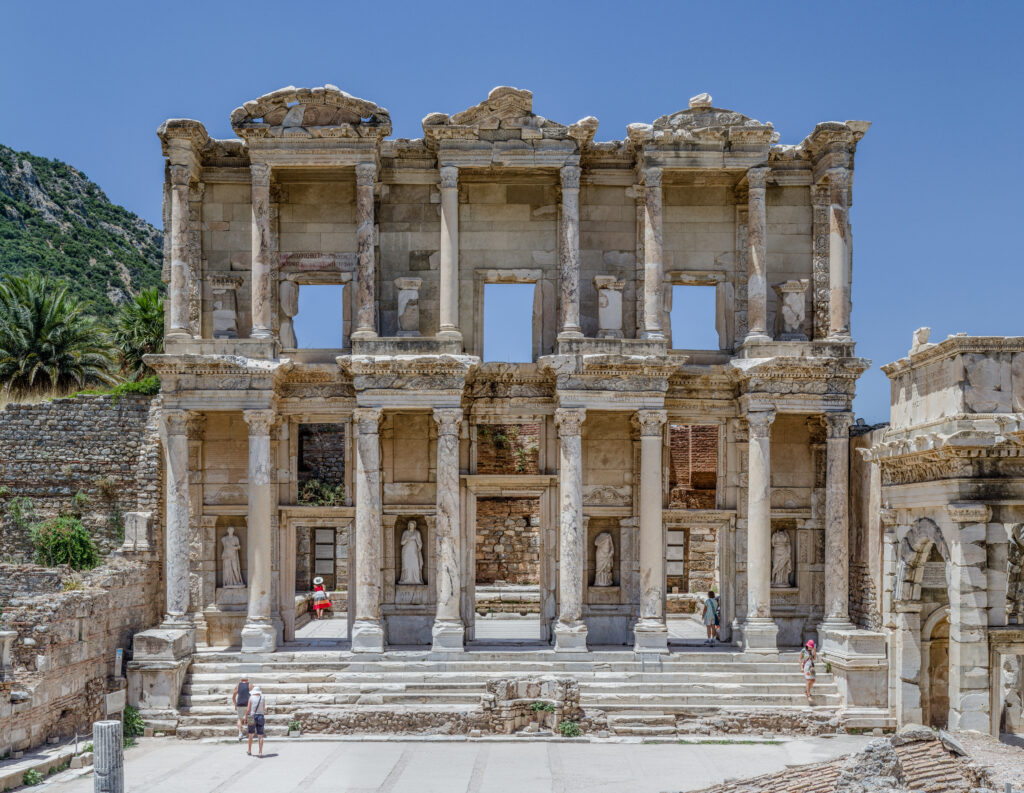
Etrog symbols in Ephesus are faint carvings of the etrog, the citron fruit of the Jewish festival of Sukkot. The best known one is on the marble stairs of the Library of Celsus, just above a menorah. It is a small sign that a Jewish community lived here and kept its festivals.
The Jewish community of Ephesus contributed to the social and cultural fabric of Ephesus, during the golden times of Asia Minor. The etrog (citron), an important symbol in Judaism, provides a remarkable clue to trace the Jewish presence in Ephesus.

The etrog is a special kind of citrus fruit used in Judaism on the holiday of Sukkot. It has a significant place in religious rituals and symbolizes fruitfulness, abundance, and renewal. The etrog symbols found in Ephesus offer critical clues about the existence of a Jewish community in this ancient city.

Ephesus was home to a large Jewish community during the Roman Empire. Historical records suggest that this community had a significant population in the city and was active in various fields such as trade and crafts. Jewish residents of ancient Ephesus were allowed to carry on their religious freedom and worship freely during the Roman period.
What Is an Etrog in Judaism?
The etrog is the citron, a large yellow fruit with a thick, bumpy rind and very little juice, and it is one of four plants that Jewish people carry at Sukkot. The Torah asks for “the fruit of goodly trees” on the first day of the feast (Leviticus 23:40), and tradition says this means the citron.
Because it belongs so closely to the festival, the etrog became a favorite picture in Jewish art. It appears on the coins of the Bar Kokhba revolt and on the mosaic floors of old synagogues, often beside a menorah or a shofar.
Where Can You See the Etrog in Ephesus?
You can see the etrog on the stairs of the Library of Celsus, where a large seven-branched menorah is engraved into one of the steps. Above the menorah is the faint rounded shape my photo points at. Some people also see a lulav and a small shovel next to it, two more objects from the Temple service.
Nobody knows when the step was carved, the Library was built in the early second century AD but the carving may be younger. The stone may also have been used before in another building. When we stop at the Library with my guests, I ask them to look down at the steps, because most people only look up at the façade.
The second possible place is the famous footprint on marble street, nearby the Library. Next to the foot is a shape that many people read as a heart or a purse. In my photo I ask if it could be a silphium seed or even an etrog, and honestly we cannot say for sure. I told the story of this slab in my oldest advertisement in Ephesus post.
The other Jewish carvings I know in Ephesus are menorahs. One is on the street between the Library and the Grand Theater, and one is on the inner side of the Mazeus and Mithridates Gate. You can see them in my menorahs in Ephesus post.
What Do These Symbols Tell Us About Jewish Ephesus?
They tell us that Jewish families in Ephesus kept their festivals and their symbols in the middle of a Greek and Roman city, even though nobody has found their synagogue yet.
The community was already old by then. Letters and decrees from the first century BC confirm that the Jews of Ephesus were allowed to meet, keep the Sabbath and follow their own laws. Later Apostle Paul spoke in the synagogue of Ephesus for three months (Acts 19:8).
I like these small signs. They are not temples or palaces, only the marks of ordinary people who wanted to say who they were. For the whole story, read my Judaism in Ephesus article, and for the clues about the building itself see Synagogue in Ephesus.
Frequently Asked Questions
What does the etrog symbolize?
An old Jewish teaching says the etrog stands for people who have both learning and good deeds, because the fruit has both taste and fragrance. Another teaching compares it to the heart among the four plants of Sukkot.
What is an etrog used for?
The etrog is used at Sukkot, the seven-day autumn festival. On each day except the Sabbath it is held together with palm, myrtle and willow branches and waved in all directions during the prayers.
Was Ephesus a Jewish city?
No, Ephesus was mainly a Greek and Roman city, but it had a large Jewish community with its own rights. Jews lived there beside Greeks, Romans and later Christians, and they left menorahs, tombstones and the etrog as signs.
Hire An Ephesian Tour Guide
The ancient city of Ephesus was home to a rich cultural and religious heritage, including the Hebrew society. As part of this heritage, the Etrog symbol offers clues to the history of Judaism in Ephesus. Come to Ephesus and explore the symbols with me! See you soon, Hasan Gülday