Saint Nicholas in Turkey is the true story behind Santa Claus. Nicholas was a Greek-speaking Christian bishop of Myra, today’s Demre in Antalya Province, and by tradition he died around 343 AD. He is said to have been born in nearby Patara. Most of his bones were taken to Italy in 1087, but his church and his empty tomb still stand in Demre, and you can visit them.
When I take my guests to Demre, the reaction is nearly always the same. They arrive curious, asking if Santa Claus in Turkey is for real, and they leave surprised at how historical the man is. Let’s have a look at his life, the gift-giving story, his relics, and how a bishop became Santa Claus.
Who Was Saint Nicholas?
We know very little about the real Nicholas. Any writings of his are lost, and no writer of his own time mentions him. The earliest accounts of his life were written centuries later. The oldest full Life, by Michael the Archimandrite, dates to the early ninth century, so historians have to separate what is probably true from what is later legend.
By tradition Nicholas was born around 270 AD in Patara, a harbor city of Lycia on the Mediterranean coast, in a wealthy Greek Christian family. Some accounts say that his parents died in an epidemic and that he gave away the inheritance for the poor. In some accounts his uncle was a bishop who ordained him a priest.
After a pilgrimage to Egypt and the Holy Land, Nicholas came back to Myra. The story says that the bishop of Myra had just died, and the local priests agreed that the first priest to enter the church that morning would become the new bishop. Nicholas went in to pray, and so he became the Bishop of Myra.

The same caution applies to the Council of Nicaea in 325 AD. His name appears on a few early lists of the bishops who attended, including one from the early 6th century, but Athanasius and Eusebius, who were both at the council, never mention him. Many scholars think he was not there. The famous story that he slapped the heretic Arius is late legend, first told in the 14th century.
By tradition Nicholas died on 6 December around 343 AD, which is why his feast day falls on that date. By the 6th century his fame was well established. Emperor Theodosius II, who ruled from 401 to 450, ordered church at Myra over the site of the church where Nicholas had served, and his remains were placed in a sarcophagus there.
Saint Nicholas and the Three Daughters
The most famous story about Nicholas started the whole tradition of gift-giving. It is first told in the Life by Michael the Archimandrite. A man who had once been rich lost all his money and could not pay dowry for his three daughters. Without dowries they could not marry, and in that world they might be forced into prostitution.
Nicholas heard about the family but he was too modest to help in public, and he did not want to shame the father with charity. At night he threw a purse of gold coins through a window of the house. The father married off his eldest daughter. Later Nicholas threw a second purse, and then a third for the youngest.
The father stayed awake to see who the giver was. He caught Nicholas, fell on his knees infront of him to thank him, and Nicholas told him to keep it secret. Painters loved this scene. It is one of the most popular pictures in Christian art, and Nicholas is often shown holding three purses, three coins or three gold balls.
The 1087 Theft of the Relics of Saint Nicholas
In 1071 the Byzantine army lost the Battle of Manzikert, and the Seljuk Turks took most of Asia Minor. The Greek Christians of Myra now lived under new rulers, and the western and eastern churches had also split in 1054. In the spring of 1087, sailors from Bari in southern Italy used this confusion to take the bones of Nicholas.
They removed main bones from the sarcophagus over the objections of the Greek monks guarding the church. The remains reached Bari on 9 May 1087 and two years later Pope Urban II placed them under the altar of the new Basilica di San Nicola. Orthodox Christians and Turks have long called it a theft, while the people of Bari call it a rescue.

The sailors took only about half of the skeleton. According to a chronicle written at the Venetian monastery of San Nicolò al Lido, around 1100 a Venetian fleet on its way to the First Crusade stopped at Myra and took the remaining bones to Venice. So today most of the bones are laying in Bari, the rest are in Venice, and the tomb in Demre is empty.
From Saint Nicholas to Santa Claus
In the Middle Ages Saint Nicholas was loved across Europe, and his feast on 6 December became a day to help the poor and give small gifts to children. Later, in many Protestant places, the gift-giver changed to the Christ Child and the gifts moved to Christmas. In the Netherlands, however, Saint Nicholas never disappeared.
In the Netherlands he became Sinterklaas, a bishop with a white beard who arrives from Spain by steamboat in November and rides a white horse. Children put a shoe by the chimney, and in the morning they find sweets or a small present in it.

Dutch settlers may have brought the custom to New Amsterdam, today’s New York, in the 17th century, although scholars disagree. The name “Santa Claus” first appears in the American press in 1773. In 1809 Washington Irving’s funny History of New York turned Sinterklaas into Santa Claus, and much of that picture was his own joke.
The poem “A Visit from St. Nicholas”, better known as “The Night Before Christmas”, was published without a name in a New York state newspaper in 1823. It helped fix the sleigh, the reindeer, the chimney and the round, jolly figure in people’s minds.
The cartoonist Thomas Nast drew Santa for Harper’s Weekly from 1863 and may have invented his home at the North Pole. In the 1930s the artist Haddon Sundblom painted Santa for Coca-Cola’s Christmas ads. The idea that Coca-Cola invented Santa or his red suit is not true, but those ads made one image famous around the world.
So the round figure with the sack of toys is a young invention, but it grew from the reputation of a real man for secret generosity. Saint Nicholas in Turkey is the link between a small port town on the Lycian coast and Christmas morning everywhere. By the way, in Turkey we call Santa Claus “Noel Baba”, which means Father Christmas.
Saint Nicholas in Turkey Today
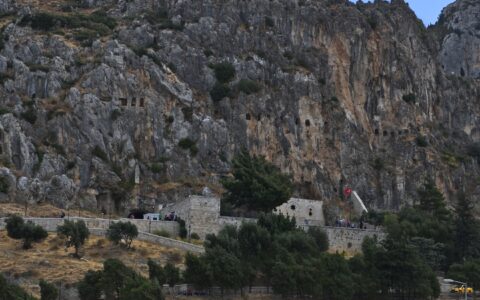
Demre is a town on the Lycian coast in Antalya Province, built over ancient Myra. It was called Kale until 2005. The Church of Saint Nicholas stands in the middle of town and is run by the Ministry of Culture and Tourism as the Saint Nicholas Memorial Museum, or Aziz Nikolaos Anıt Müzesi in Turkish. It is on UNESCO’s tentative list for World Heritage status.
The oldest part of the building goes back to about 520 AD, when it was built on the foundations of the older church. Much of what you see comes from later Byzantine rebuilding, and a monastery was added in the late 11th century. Russian money paid for a restoration, finished in 1863, that added the bell tower.

Inside you can still see patches of the colored marble floor, made in the technique called opus sectile, and faded frescoes on the walls. The arcade of the northeast annex has the only cycle of Nicholas’s life on ancient frescoes in Turkey. A damaged sarcophagus shown in a side space is traditionally pointed out as his grave, but experts now doubt that it stands where it was first placed.
In December 2024 the excavation team led by Associate Professor Ebru Fatma Fındık found a plain limestone sarcophagus, about two meters long, in its original place in the two-story building south of the courtyard. She calls it a find that supports the written sources. It is too early to date it and nobody can say that it is the saint’s grave.
Demre is not just a museum also a place of pilgrimage. With the Ministry’s permission an Orthodox liturgy is held in the Church on 6 December. In 2024 about 500 people came, most of them Orthodox Christians, and many were Russian citizens. Many of the pilgrim groups I guide come from Russian Orthodox, Romanian Orthodox, Bulgarian Orthodox, Greek Orthodox and Catholic backgrounds, and they all know him.
I have visited the Church of Saint Nicholas many times. Allow about an hour for the church, and together with Myra it makes a good half-day visit. Demre itself is a small modern town and one of Turkey’s big centers for greenhouse tomatoes and other vegetables. Plain around the town is covered with greenhouses. The local fish is excellent too, for example çipura (gilt-head bream) or levrek (sea bass), grilled and served with a simple salad and a glass of rakı.
Paul himself changed ships at Myra on his way to Rome (Acts 27:5-6), which I tell in my article about Paul’s voyage to Rome. I also described this church in my list of Byzantine attractions in Turkey.
Patara, Birthplace of Saint Nicholas
By tradition Nicholas was born in Patara, about 60 kilometers west of Demre in a straight line, near today’s village of Gelemiş. Patara was the main seaport of Lycia and for a time its capital. It was also a leading city of the Lycian League, which gave it three votes, the most any city could have.

Patara is a New Testament place too. On his way back to Jerusalem, Paul and his companions reached Patara, where they “found a ship crossing over to Phoenicia” and sailed on (Acts 21:1-2, WEB). I tell more about the apostle’s stops in my article Cities Visited by Apostle Paul in Asia Minor.
Not far away, the Lycian city of Xanthos and its sanctuary, the Letoon, are on the UNESCO World Heritage list. By road Demre is farther than it looks, so plan the two towns as stops of a longer journey. My guide to Christian Turkey for first-time visitors shows how the Lycian coast fits with the other sites.
Frequently Asked Questions
Is Santa Claus Turkish?
Not exactly. Nicholas was born in Patara, in what is now Turkey, but he was a Greek-speaking subject of the Roman Empire. The Turks began to arrive in Asia Minor in large numbers only in the 11th century. Santa Claus himself grew out of the Dutch Sinterklaas and the American Christmas of the 19th century.
Where is Saint Nicholas buried?
Most of his bones are in the Basilica di San Nicola in Bari, Italy, and the rest are in Venice. By tradition he was buried at Myra, today’s Demre, where the church still stands and the tomb is empty. In December 2024 archaeologists found a sarcophagus there, but it is not proven to be his.
Can you visit the Church of Saint Nicholas in Demre?
Yes. It is a museum run by the Ministry of Culture and Tourism, and you need a ticket. It is in the center of Demre in Antalya Province. Opening hours and prices change, so check them before you travel. An Orthodox liturgy is held there on 6 December.
Hire Tour Guide in Turkey for Saint Nicholas Sites
I’m a nationally licensed Turkish tour guide based in Kuşadası, nearby Ephesus, and I have been guiding since 2008. My day guiding is in Ephesus, İzmir and Pamukkale, so Demre and Patara are outside it.
My license is valid all over Turkey. For Demre, Myra and Patara, I can join you as your personal guide on a longer journey, while you arrange your transport and hotels yourself or through a licensed travel agency. See my guiding rates and guiding areas or write to me through my contact page.
I hope we will meet at the Church of Saint Nicholas in Demre or among the columns of Patara. You can always write to me with your questions about Saint Nicholas in Turkey. See you soon, Hasan Gülday.