


Philadelphia is the city you might miss on the way to somewhere else. Or at least that’s what many of my tourists think when we reach there.
This is honestly true. Most of my pilgrim groups, when we are doing the seven churches tour, treat Philadelphia as a stop between Sardis and Laodicea. We do not stay long. There is not, by archaeological standards, a great deal to see. But the more I read the letter of Christ to this city, and the more I understand the strange and brave history of the place, the more I think Philadelphia is one of the most important of the seven. Maybe the most important for our own time. I will try to explain why by the end of this article.
A Missionary Foundation
The city was founded around 189 BC by Eumenes the second, king of Pergamon, or possibly by his brother Attalus the second, king after him. Both men were patrons of culture and politics, and both were pushing the Hellenistic civilization eastward, just like their old general Alexander the Great dreamed. Philadelphia was named after the brotherly love between these two kings — philos, friend, and adelphos, brother. Brother-love. Kardeş sevgisi, as we say in Turkish.
But the city was not founded as a romantic monument. It was founded as a missionary outpost.
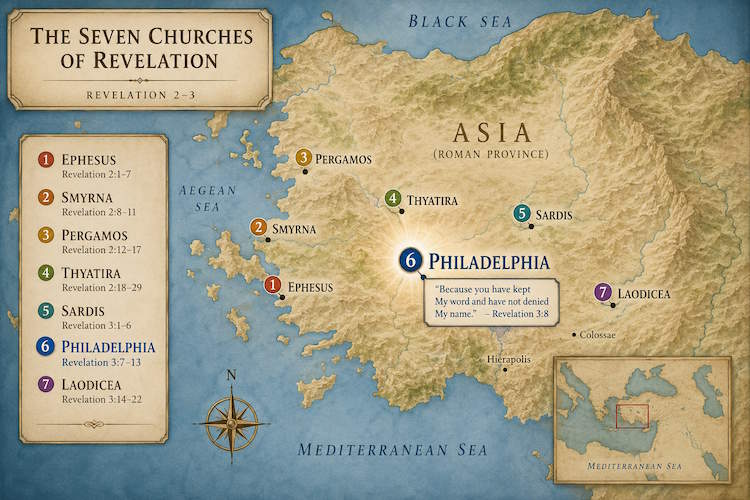
The location is at the eastern edge of the Hermus valley, at the foot of the Tmolus mountains, on the road which leads up into the high plateau of inland Phrygia. The kings of Pergamon wanted to spread Greek language, Greek customs, and Greek civic identity into the Phrygian uplands, where the population still spoke their old Anatolian language and held to their old Anatolian religion. Philadelphia was supposed to be the gateway. The Greek city which would slowly assimilate the upland villages around it.
This is the deepest meaning of the open door in the letter. Christ takes the original missionary identity of the city and gives it a new content. The city had been founded as a mission. The Christians of Philadelphia, two and a half centuries later, were going to inherit that mission from the city’s past, but for a different message. The original founders of the city had the goal of assimilating people’s culture, but the new Christian community had the goal of saving people’s souls.
The Earthquakes
Philadelphia sat on top of an unfortunate geological line. The whole region, from Sardis to Laodicea, is in a major seismic zone. In 17 AD, during the reign of Tiberius, a massive earthquake destroyed Philadelphia along with eleven other cities of the area. Tacitus tells us about this disaster in detail in his Annals. The emperor Tiberius gave the cities tax remissions and rebuilding grants, and Philadelphia, in gratitude, renamed itself for a while Neocaesarea, the new city of Caesar.


But the earthquakes did not stop. The Greek geographer Strabo, writing only a few decades before Revelation, says that the people of Philadelphia preferred to live in the surrounding fields and small farms rather than inside the walled city, because they were afraid of new tremors. He says, in a memorable phrase, that the walls of the city were never at rest. The buildings cracked, the houses tilted, the temples lost their pillars one by one.
This is why, when the letter of Christ promises I will make him a pillar in the temple of my God, the image is so devastating. Pillars in Philadelphia were always falling. To be promised an unfalling pillar in an unfalling temple is, for a Philadelphian, the most reassuring promise imaginable.
The Wine and the Soil
The volcanic soil around Philadelphia, while dangerous because of earthquakes, is excellent for vines. The city had been famous since antiquity for its wine. Coins of Philadelphia from the Roman period often show the head of Dionysus, the god of wine. The local cult of Dionysus was important.

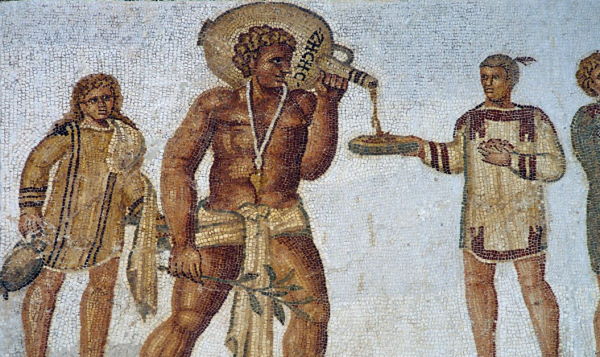
Today, the modern town of Alaşehir, which sits on top of the ancient city, is still famous for its grapes. Especially the sultani variety, the seedless white grape used to make raisins. If you walk through the bazaar of Alaşehir in September, you will see piles of fresh grapes everywhere. In October you start to see the grapes being laid out on flat surfaces to dry. The smell of the city in autumn is a smell of grape juice and warm sun and faint fermentation. Üzüm üzüme baka baka kararır, the local saying goes — “grape darkens by looking at grape”, which means that people influence each other by their company. A folk belief that has held in this winemaking town for centuries.
If you visit, the local raisins are a wonderful gift to take home. Many small shops in the centre sell them by the kilogram.
The Christian Community
Who founded the church of Philadelphia? We do not know exactly. Most likely, like the other seven churches, it was a daughter mission of Paul’s school in Ephesus. By the time of the letter, in 95 AD, the community had been there for perhaps thirty or forty years.


The letter describes this community very tenderly. Christ says they have little strength. They were not numerous, they were not wealthy, they were not influential. The synagogue of the city had at some point closed its doors to them, after a period of conflict whose details we do not know. They had been pushed to the margins of their own town. And yet they had kept the word and not denied the name.
This is a small church under pressure. The kind of small Christian community which, in the pagan world of 95 AD, must have felt like it had no future at all. And yet to this little community, Christ in the letter gives the strongest promises of any of the seven cities. I have set before thee an open door, and no man can shut it.
What You See Today
Modern Alaşehir is a busy provincial town of about a hundred thousand people, on the railway line between İzmir and Afyon. The drive from İzmir is about two hours. The town has, honestly, almost nothing of the ancient Greek city to see, because it has been continuously inhabited for two thousand years and the buildings of each century have been built on top of the buildings of the century before.

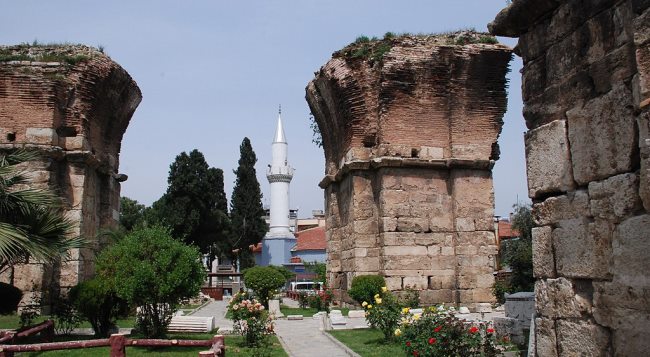
But there is one extraordinary site. In the centre of Alaşehir, in a small fenced enclosure called Kale Mahallesi, the Castle Quarter, you can see the surviving pillars and fragments of a great Byzantine basilica, the church of Saint John, built in the sixth century AD over the place where, according to the local Christian tradition, the original Philadelphian community used to meet. Three of the great brick pillars are still standing, in a small grassy enclosure, completely surrounded by modern apartment buildings.

When I bring my groups here, we always read the letter to Philadelphia aloud in this place. Him that overcometh, will I make a pillar in the temple of my God. And we look at the surviving pillars, the ones the earthquakes did not destroy, the ones the centuries did not erase, and we feel something very specific. The promise has, in some literal way, been fulfilled. Not all the pillars fell.
This is one of the moments in the seven churches tour where my guests are most often quiet. Even the most secular of my visitors, the ones who came to Turkey for the archaeology and not for the religion, often stand here with a thoughtful look on their faces.
The Long Christian Continuity
There is one more remarkable thing about Philadelphia.
Of all the seven cities, this is the one which preserved an active Christian community the longest, into the medieval period. Philadelphia, by then under various Byzantine, then Turkish-Beylik, then Ottoman governments, kept a Greek Christian population continuously into the early twentieth century. The town was sometimes nicknamed the little Athens of the East by Greek travellers, because of the persistence of its Christian identity.

The community was finally dispersed during the population exchange between Greece and Turkey in 1923, when most of the Greek Christians of western Anatolia had to leave. Their descendants today live mostly in Greece, in places like Nea Filadelfeia outside Athens, which was named after the old town in memory of the lost home.
So the open door of Philadelphia, in some way, has stayed open for nearly two thousand years. The exact community has changed, the city has changed, the language has changed, even the country has changed. But the door, in some sense, is still standing.
Practical Notes for the Visitor
Allow about half a day for Alaşehir. The Byzantine pillars, the small museum, a walk through the bazaar, and lunch.
For lunch in Alaşehir, the local food is straightforward and good. Lamb dishes, kebabs, rich tomato-based stews. There is a small place near the central square where the family makes their own yogurt fresh every morning, and the ayran — the salted yogurt drink that I love in a hot summer day! — is the best I have had in this region.
October is the best month to visit, when the grape harvest is just finished, and the smell of fresh grape juice fills the air. The morning light is gentle. The mountains behind the town are starting to turn gold. If you can plan it, come in October.
Why I Said It Might Be the Most Important
I said at the beginning that Philadelphia might be the most important of the seven cities for our own time. I want to explain.

Most modern Christian communities, in most parts of the world, are not facing the situation of Smyrna, where their bishop will be executed by the state. They are not facing the situation of Pergamon, where the imperial cult is the dominant religion. They are not facing the situation of Sardis, where the church is dying inside its own walls. The most common modern situation is something different. A small community of faithful people, with little visible strength, with a closing door behind them, with very modest resources, surrounded by a confident secular or pluralistic society which mostly ignores them.
This is the Philadelphian situation.

And the message of Christ to this situation is not a message of triumph or visibility. It is a message of perseverance, of holding fast to what you have, of trusting that the door which has been opened by Christ cannot be shut by any human power. Hold that fast which thou hast, that no man take thy crown.
I find this message very useful. Both for my own work as a tour guide who works with many small struggling Christian groups, and for any reader who feels that their own faith community is small and tired and pushed to the margins. Philadelphia is the patron city of the small but faithful church. And the promise to such a church is enormous. I will make him a pillar in the temple of my God.
The next stop after Philadelphia is mostly the last of the seven cities, Laodicea, the city of banking and wool, the lukewarm city. The road descends into the Lycus valley. See you there.