By Hasan Gülday — Licensed Professional Tour Guide, Smyrna / Ephesus / Kusadasi


When my pilgrim guests walk with me through the marble streets of Ephesus, or stand inside the Great Theatre of Pergamon, or climb the hill of Ayasuluk to the tomb of John, the question I get most often is some version of this. Hasan, did the apostles really perform miracles here? Right where we are standing?
The honest answer is: yes, in some places, by the testimony of the New Testament itself. And yes, in many other places, by the testimony of the early traditions which the church inherited. And in a few places, the line between solid history and pious legend is harder to draw, and I will be honest with you about where I think it is and where I am not sure.
In this article I want to walk you through the miracles which, according to the New Testament and the early Christian traditions, happened in Asia Minor during the time of the apostles and their immediate successors. The healings. The exorcisms. The resurrections. The visions and the divine redirects. The strange and beautiful interventions which produced, by the end of the first century, the Christian communities of the seven cities and beyond.
This is, by the standards of any region of the ancient Mediterranean world, an unusually rich list. Asia Minor was, in some sense, the most densely miracle-marked region of the apostolic age outside of Palestine itself.


A Note on Method
Before I begin, let me set out my own approach.
The miracles I will describe come from three layers of source material. The first layer is the canonical New Testament — Acts of the Apostles, the letters of Paul, the Book of Revelation. These are the foundational documents of Christian faith and they are, for any believing reader, the highest authority.
The second layer is the early Christian writings of the second century — the Martyrdom of Polycarp, the letters of Ignatius of Antioch, fragments of Papias of Hierapolis. These are not part of the Bible but they are old, well-attested, and broadly trustworthy as historical sources for the period.
The third layer is the apocryphal Acts, particularly the Acts of John, the Acts of Paul and Thecla, the Acts of Philip. These were written between about 150 and 250 AD, mostly in Asia Minor itself. They preserve real local memories alongside heavy doses of pious storytelling. The early church did not accept them as scripture. The second Council of Nicaea, in 787 AD, formally condemned the Acts of John for its theological errors. But these texts contain valuable evidence about how the second-century Christians of our region remembered the apostles.
I will treat each layer with appropriate care. When I am citing the New Testament, I will say so plainly. When I am citing the apocryphal traditions, I will also say so plainly. The reader can then decide what weight to give to each.
A Brief Old Testament Note
Before we come to the apostolic age, two earlier biblical episodes deserve a quick mention because they happened on what is today Turkish soil.
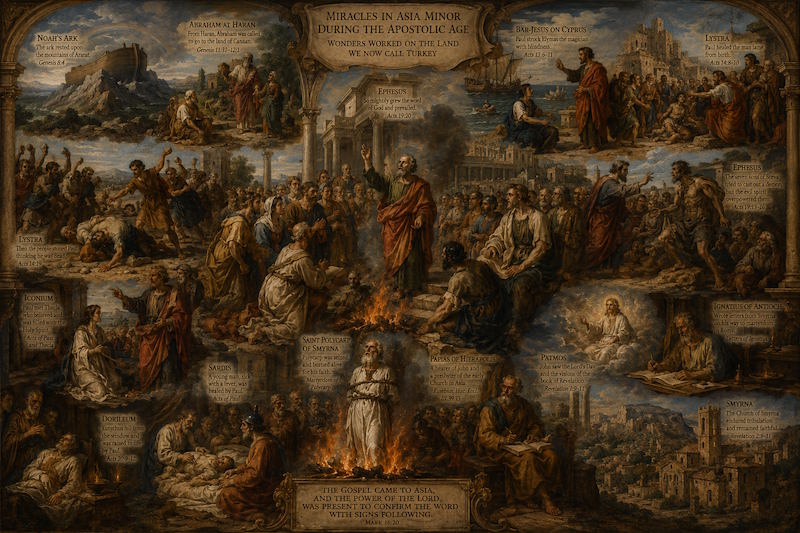
The first is Noah’s Ark
The book of Genesis says that the ark came to rest upon the mountains of Ararat. The exact mountain is not specified, and the modern volcanic peak of Mount Ağrı in eastern Turkey, called Ararat in Western languages, is one possible candidate. Other candidates have been proposed elsewhere in eastern Turkey and northern Iraq. The site is contested. The miracle, however we understand it, is supposed to have happened in our region.
The second is the story of Abraham
Genesis 11 tells us that Abraham’s father Terah moved the family from Ur of the Chaldees to Haran, where he eventually died. From Haran, Abraham received the call to leave for the land of Canaan. Modern Harran in southeastern Turkey, in the province of Şanlıurfa, is the same town. You can still visit the small mound where the ancient city stood. The local tradition firmly identifies this as the place. The Şanlıurfa region also has many traditions associating it with Abraham’s earlier life — the cave where he was born, the fish ponds, the lake. İbrahim peygamber, the prophet Abraham, is honoured here in both Christian and Muslim traditions.
But these are Old Testament. The user has asked specifically about the apostolic age. So let us move forward fifteen or twenty centuries.
The First Miracle on the Way to Asia: Bar-Jesus on Cyprus
The first miracle of the apostolic age which is connected to Paul’s Asia Minor mission did not technically happen in Asia Minor. It happened on the way, on the island of Cyprus, on the first missionary journey around 47 AD. But it deserves a brief mention because it set the pattern for what came after.
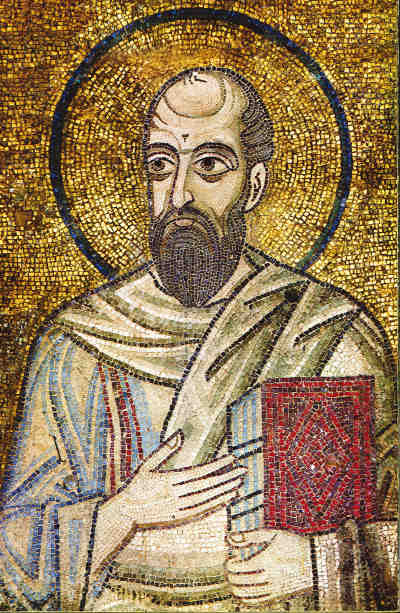
In the city of Paphos, a Jewish magician named Bar-Jesus, also called Elymas, was in the entourage of the Roman proconsul Sergius Paulus. When Paul began to preach to the proconsul, Elymas tried to oppose him. Paul, in one of the harshest moments of his recorded ministry, looked directly at the magician and pronounced a temporary blindness on him. Acts chapter 13 records the words.
O full of all subtilty and all mischief, thou child of the devil, thou enemy of all righteousness, wilt thou not cease to pervert the right ways of the Lord? And now, behold, the hand of the Lord is upon thee, and thou shalt be blind, not seeing the sun for a season.
The blindness fell on him immediately. Sergius Paulus, watching this, was converted on the spot. He became, by tradition, the first Roman provincial governor to embrace the new faith.
The pattern of the miracle is interesting. It is a punitive miracle, a temporary judgement, designed not to harm the magician permanently but to break his opposition. The same pattern of bounded miraculous discipline will appear in other apostolic stories.
Lystra: The Healing and the Stoning


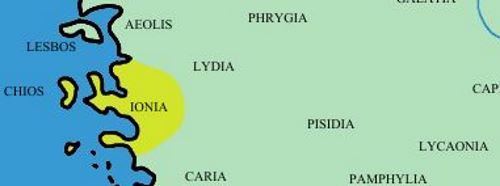
The first major miracle on actual Asian soil, by Paul, took place in the small inland city of Lystra, in modern Turkish province of Konya. The story is in Acts chapter 14.
A man who had been lame from birth was sitting near the place where Paul was preaching. Paul, sensing in him faith to be healed, looked at him and said, Stand upright on thy feet. The man, who had never walked in his life, leaped up and walked.
The reaction of the Lystran crowd is one of the most extraordinary scenes in the Acts of the Apostles. They were not, mostly, Greek-speaking sophisticated city people. They were native Lycaonians, with their own language, their own folk religion, their own pre-Greek cultural assumptions. They began to shout in Lycaonian. The gods are come down to us in the likeness of men.
They identified Barnabas, the senior partner, with Zeus. They identified Paul, the more talkative one, with Hermes the messenger god. The local priest of Zeus, from a temple just outside the city, began to organize a public sacrifice to the two visiting gods. Garlands. Bulls being brought. The whole apparatus of a major pagan festival.
When Paul and Barnabas finally understood, through translators, what was happening, they tore their clothes in the Jewish gesture of distress. They rushed into the crowd. They shouted, We also are men of like passions with you. They eventually managed to stop the sacrifice, but only with difficulty. The crowd had been emotionally prepared, by their own folk religion, to receive miracle workers as gods.
I always think this is one of the most revealing details about the religious culture of inland Asia Minor in the first century. The local Lycaonian populations had not been deeply Hellenized. Their religious imagination was older than the Greek pantheon. They were ready, at any moment, to recognize the descent of gods in human form. The descent had a precedent in their own local mythology — Zeus and Hermes had, by tradition, visited an old couple in the same general region in earlier times. The Lystrans knew the pattern.
This miracle of healing was the first half of the Lystra story. The second half came a few weeks later, and it was even more dramatic.
Some Jewish opponents from Antioch in Pisidia and from Iconium arrived at Lystra. They turned the local crowd against Paul. They organized a stoning. Paul was hit with stones until he was unconscious. He was dragged outside the city walls and left, by the crowd, for dead.
Then Acts records, in a single short sentence, what may be the most under-appreciated miracle of the apostolic age.
As the disciples stood round about him, he rose up, and came into the city.
That is all. Just that one sentence. He rose up. He went back into the city. The next morning, he and Barnabas walked on to the next town, Derbe. Within a few weeks, Paul was preaching again.


Most modern readers, I have noticed, miss the strangeness of this passage. A man who has been beaten with stones until he is unconscious does not, in the ordinary course of things, get up and walk back into the same city the next day. The injuries from a stoning are extensive. Internal bleeding, broken bones, head trauma. The recovery, even if survival is possible, takes weeks or months in normal cases.
Paul’s recovery at Lystra was not normal. Whether you call it a miracle or call it providential survival or call it the mysterious healing power of the early Christian community, the man who came back into the city that night was, by any standard, on the edge of the impossible.
I personally believe, from his own later writings, that Paul carried the marks of this stoning on his body for the rest of his life. The thorn in the flesh he mentions in 2 Corinthians may very well have been a long-term consequence of the Lystra injuries. Yara izi her zaman kalır, in Turkish — the scar always remains. Paul’s later ministry was performed by a man with old wounds.
Ephesus: The Twelve Disciples and the Holy Spirit
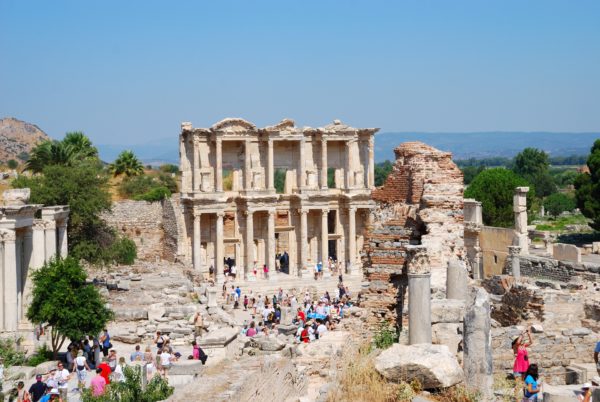
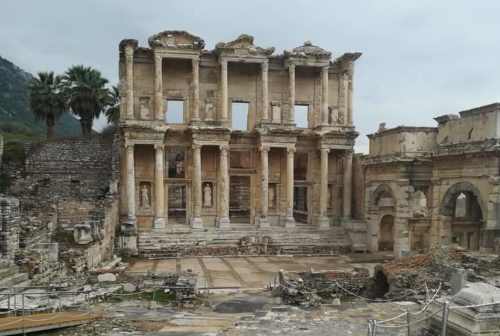
When Paul finally returned to Ephesus on the third missionary journey, around 53 AD, his very first action in the city was a miraculous one.
He encountered twelve disciples — probably converts of Apollos or of the John the Baptist movement — who knew of Jesus only in a partial way. They had received only the baptism of John. They did not know about the Holy Spirit. Paul explained the gospel more fully. He baptized them in the name of Jesus. He laid hands on them.
And when Paul had laid his hands upon them, the Holy Ghost came on them; and they spake with tongues, and prophesied.
This is, by Acts chapter 19, the inaugural miracle of the long Ephesian ministry. The first sign that Paul’s three-year stay in the city was going to be marked by extraordinary spiritual phenomena. Diller ve peygamberlik, tongues and prophecy, on the very first day.
The Handkerchiefs and the Aprons
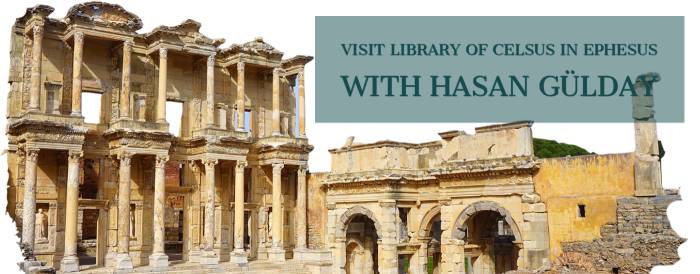
What followed in Ephesus was, according to Acts, one of the most concentrated bursts of miracle activity in the entire New Testament after the ministry of Jesus himself.
Acts chapter 19 describes it briefly but vividly.
And God wrought special miracles by the hands of Paul: So that from his body were brought unto the sick handkerchiefs or aprons, and the diseases departed from them, and the evil spirits went out of them.
The Greek word for special here is ou tas tuchousas, which literally means not the ordinary kind. Even in the language of the text, Luke is signalling that what was happening at Ephesus was unusual even by the standards of apostolic miracles. The handkerchiefs that Paul wore around his head, and the small leather aprons of his tent-making trade, were apparently being passed from his body to sick people in distant houses. The diseases departed. The unclean spirits left.


I want to pause for a moment and admit that this is, even for a believer, a strange passage. The handkerchiefs and aprons miracle has been used and abused throughout Christian history. Medieval relic merchants quoted it to justify the sale of small fabric pieces supposedly touched by saints.
But we should not let the misuses obscure the original text. Luke, the author of Acts, was a careful historian. He had been present in Ephesus, possibly, during part of Paul’s ministry there. The handkerchief and apron miracles are recorded by him in plain prose, without elaboration, as ordinary part of the report of what happened. He did not invent them. He believed they had occurred. The miracles, as far as Luke understood them, were a real feature of the Ephesian ministry.
The Seven Sons of Sceva
The handkerchief miracles produced an unintended side effect. A group of local Jewish exorcists, the seven sons of a man called Sceva, decided to imitate Paul’s methods.
These men went around Ephesus, attempting to perform exorcisms by invoking the name of Jesus, the way Paul had been invoking it. They had no personal commitment to Jesus. They were treating the name as a kind of magical formula, like the famous Ephesia Grammata, the Ephesian magic words for which the city was famous across the Mediterranean.


Acts chapter 19 tells us what happened to them.
And the evil spirit answered and said, Jesus I know, and Paul I know; but who are ye? And the man in whom the evil spirit was leaped on them, and overcame them, and prevailed against them, so that they fled out of that house naked and wounded.
This is one of the most darkly comic moments in the New Testament. The exorcists were beaten up by the man they were trying to exorcise. They ran out of the house naked, with their clothes torn off them. The story spread through Ephesus in a single day. People who had been practicing magic in the city brought their own books of spells to a public square and burned them. Acts gives us the value of the burned books — fifty thousand pieces of silver, the equivalent of fifty thousand days’ wages of a working man. This was probably the largest book-burning of magical literature in the entire ancient Mediterranean world.
I always tell my groups that this story shows something important about the culture of first-century Ephesus. The line between religion and magic, in that society, was very thin. Magicians used the names of gods. Priests used incantations. Pilgrims wore amulets. Christians, when they began invoking the name of Jesus, were entering a marketplace of competing supernatural forces. The Sons of Sceva incident drew the line. The name of Jesus was not a generic magical word. It worked only when used by those who actually belonged to him.


Eutychus at Troas: The Sleeper Who Fell
A few years later, on Paul’s return journey from his three-year Ephesian stay, the team stopped at the small port city of Troas, on the northwest coast of Asia Minor near modern Çanakkale.
Acts chapter 20 describes what happened in unusual detail. Luke himself was present, as part of the missionary team at this point. The narrative reads almost like an eyewitness diary.
The Christian community of Troas had gathered, on the evening of the first day of the week, in an upper room of a house. They were about to share the Eucharistic meal. Paul, knowing he was about to leave the next morning, was preaching. He preached for a long time. The room was hot. The lamps were burning. The smoke was thick. The air, in the small upper room, became heavy.
A young man named Eutychus, whose name in Greek means fortunate, was sitting on the windowsill, perhaps for the cooler air. He fell asleep during the long sermon. He fell out of the window. He fell three storeys to the courtyard below. When the others ran down to him, he was dead.
Acts 20:7-12 NIV
Paul went down. He embraced the young man. Acts records, in plain language.
Trouble not yourselves; for his life is in him. When he therefore was come up again, and had broken bread, and eaten, and talked a long while, even till break of day, so he departed.
The text is restrained. It does not say explicitly that Eutychus was raised from the dead. But the implication is clear. The young man had been dead. Paul embraced him. He was alive. The community, instead of weeping over a corpse, had a meal. The next sermon continued until dawn.
I find this passage quietly extraordinary. Of all the miracles of Paul, the raising of Eutychus is the only resurrection clearly recorded in Acts. It happened in a small upper room, late at night, in a small Asian port town, witnessed by a small group of Christians and one careful historian. The young man called Fortunate lived up to his name. The community, by the end of the night, had broken bread, had eaten, had talked until dawn, and had sent Paul on his way.

The Visions and the Divine Redirects
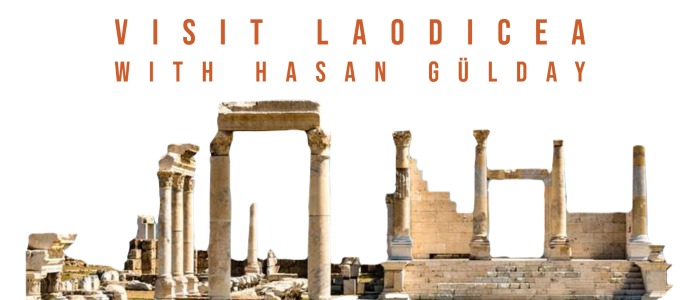
Some of the most consequential miraculous events of Paul’s career in Asia Minor were not healings or exorcisms. They were visions and divine redirects.
On the second missionary journey, around 49 AD, Paul tried to enter the Roman province of Asia. The text says simply that he was forbidden of the Holy Ghost to preach the word in Asia. He turned northward. He tried to enter Bithynia. The Spirit suffered them not. He kept moving westward, looking for an open door, until he reached the coast at Troas.
At Troas, the famous vision came.
A vision appeared to Paul in the night; There stood a man of Macedonia, and prayed him, saying, Come over into Macedonia, and help us.
The next morning, Paul understood. The mission was to cross the Aegean and to go into Greece. The European mission was, in some sense, born by this redirect. The man from Troas would not have gone to Macedonia of his own choosing. The Spirit pushed him.
I want to underline how strange this whole sequence is. The Holy Spirit forbade Paul from preaching in Asia. The same Spirit, three years later, would lead Paul to spend three years in Asia and to found seven churches there. The redirects were not permanent. They were timing decisions. Şimdi değil, in Turkish — not now. The Asian door was being held closed for a few years, and then opened.
The seven letters of the Apocalypse, sent forty years later by the apostle John from Patmos to the seven churches of Asia, would not have existed if Paul’s first attempt to enter Asia in 49 AD had succeeded. Sometimes the divine no is, in the long view, the deeper yes.
The Voyage and the Storm


The last great miraculous narrative connected to Asia Minor in Paul’s career is the voyage to Rome, recorded in Acts chapter 27. The voyage began in Caesarea on the Palestinian coast, but it passed along the southern coast of Asia Minor, with stops at Sidon, then along the coast past Cyprus, then westward to Myra in Lycia, then on toward Crete, where the great storm caught the ship.
For fourteen days the ship was driven across the Mediterranean. The crew threw cargo overboard. They threw the ship’s tackle overboard. They had given up hope.
In the middle of the storm, Paul received an angelic visitation.
There stood by me this night the angel of God, whose I am, and whom I serve, Saying, Fear not, Paul; thou must be brought before Caesar: and, lo, God hath given thee all them that sail with thee.
Paul announced this to the crew and the soldiers and the prisoners. All 276 of them would survive, although the ship would be lost. On the fourteenth night, the ship hit a sandbar near Malta. The hull broke apart. Some swam, some clung to broken planks. Every single person on board reached land alive.
The miracle here is not spectacular. There is no parting of the sea, no sudden calm. There is only the angelic prediction, and then the slow exact fulfilment of the prediction. Söz tutuldu. The word was kept.
John in Ephesus: Canonical and Traditional

Now we come to the apostle John, and to the more difficult question of which traditions about him we can accept as historical.
The canonical New Testament, in the Apocalypse, places John on the island of Patmos in 95 AD, where he received the visions which became the Book of Revelation. The visions themselves are, in the broadest sense, miraculous. The opening of the heavens. The throne. The four living creatures. The Lamb. The trumpets. The seven seals. The vials of wrath. These are visionary experiences of the highest order.


Beyond Patmos, the canonical New Testament does not give us direct accounts of miracles performed by John in Asia Minor. The Gospel of John, the three letters of John, and the Apocalypse all probably come from his Asian period, but they are theological and visionary writings rather than narratives of healing miracles.
For miracles of John in Ephesus, we have to turn to a different source. The Acts of John, written probably in Smyrna or somewhere in western Asia Minor around 150 to 160 AD, fills in what the New Testament leaves out. It is not scripture. It contains theological errors which the early church rightly rejected. But it is old, and it preserves the local Asian memory of how the church of the second century thought about the apostle who had lived among them.
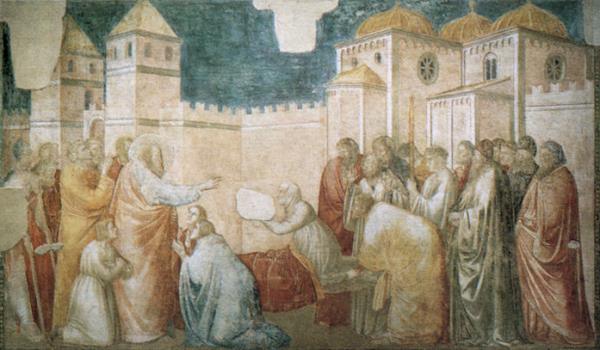
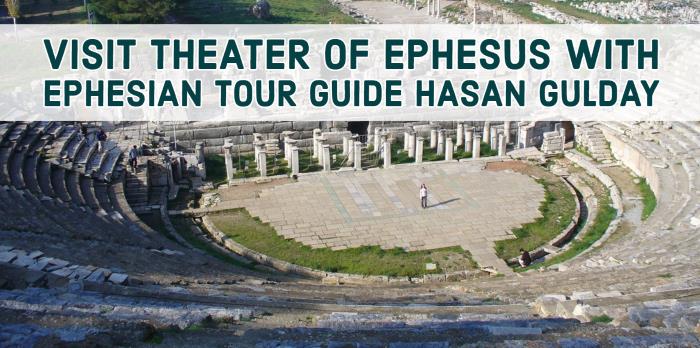
According to the Acts of John, the apostle performed an extraordinary series of miracles during his Ephesian period. He raised a woman named Cleopatra and her husband Lycomedes from the dead. He healed many elderly widows of the city in a public ceremony at the Great Theatre. He raised the priest of Artemis, after the priest had been struck dead during a confrontation. He raised a young woman named Drusiana from her tomb. He travelled to Smyrna and there he healed the son of a man named Antipatros. In total, the Acts of John records eight separate resurrections performed by the apostle.
Some of the stories in the Acts of John are clearly legendary, and some are theologically problematic. The text describes a Christ who does not leave footprints when he walks, who does not blink, whose body is sometimes physically present and sometimes not. This is a Docetic Christology — a denial of the real human nature of Christ — which the wider church correctly rejected.
But the underlying memory of John as a wonder-worker in Ephesus is older than the Acts of John, and it is preserved in many independent traditions. The local Christian community of Ephesus clearly remembered, by the mid-second century, that the apostle who had taught among them had been associated with a series of healings, exorcisms, and remarkable interventions. Hatıra, in Turkish — the memory. The exact memory may have been embroidered. The fact of the memory is real.


The Apostle Philip in Hierapolis
A separate set of traditions, equally old, places the apostle Philip in Hierapolis, on the white travertine terraces above the modern town of Pamukkale.


According to the Acts of Philip, written probably in the late fourth century but drawing on much older oral traditions, Philip performed a series of miracles in Hierapolis before his martyrdom there. He confronted a great serpent that was being worshipped in the city. He healed the bites of poisonous creatures. He converted the wife of the local proconsul through a series of signs. He raised several local people from the dead.
Many of these stories are clearly legendary. The fight with the serpent in particular has the texture of Anatolian folk religion overlaid on a Christian memory. But, as with the Acts of John, the underlying tradition is older than the surviving text. Polycrates of Ephesus, around 190 AD, mentions Philip and his daughters at Hierapolis as established memory. Papias of Hierapolis, around 130 AD, says he had heard miracle stories about Philip’s daughters from old people in the city who had known them in their youth.
The miraculous tradition of Philip in Hierapolis is, therefore, well attested. The exact details are uncertain. The fact of the local memory is firm.
The Martyrdom of Polycarp: The Border of Miracle
A final miraculous tradition I want to mention takes us into the second century, into the time after the apostles. The martyrdom of Polycarp, bishop of Smyrna, in 156 AD.

Polycarp was about 86 years old when he was arrested in his own city for refusing to participate in the imperial cult. He was burned alive in the stadium of Smyrna. The eyewitness account of his death, written within a few years of the event by his own community, contains some of the most remarkable miraculous details in any early Christian martyrology.
When the soldiers tried to nail Polycarp to the stake, he asked them not to. Leave me as I am. He who has given me strength to endure the fire will give me strength to remain in it without your nails. They tied him with ropes instead.
When the fire was lit, the Martyrdom of Polycarp says, the flames did not consume his body. They formed an arch around it, like a sail filled with wind. The body did not burn. It looked, the eyewitnesses said, like bread baking in the oven, or like gold being refined.
The smell coming from the pyre was not the smell of burning flesh. It was a sweet smell, like incense.
Eventually, when the fire had burned for a long time and the body was still untouched, an executioner stepped forward and stabbed Polycarp with a dagger. The blood that came out was so much, the Martyrdom says, that it put out part of the fire.
I will be honest with you about how I read this. I do not know how much of the miraculous detail to take literally. The Martyrdom is a document of faith, written by people who loved Polycarp. The language is heightened. The numbers may have grown in the retelling.
But the broad outline — the calm courage of the old bishop, the refusal to deny Christ, the public death, the deep impression on the city — is well attested. And the fact that the eyewitnesses themselves reported what they saw as something miraculous, in the very year it happened, is itself part of the historical record. They did not invent miracles to glorify Polycarp years later. They reported, in the immediate aftermath, that they had seen something extraordinary.


One Closing Reflection
When you walk through Asia Minor today, the marble streets of Ephesus, the white terraces of Hierapolis, the green ruins of Lystra, the small windswept hill of ancient Troas, you are walking through a landscape of remembered miracles.
Some of the miracles are recorded in the New Testament with restraint and precision. The healing of the lame man at Lystra. The handkerchiefs at Ephesus. The Sons of Sceva. Eutychus at Troas. The vision of the Macedonian man. The angelic appearance during the storm at sea.

Some are preserved in the second-century apocryphal Acts, with more legendary embellishment but with real underlying memories. John raising Drusiana. Philip confronting the serpent at Hierapolis. The miracles of the daughters of Philip remembered by Papias. The fire that did not burn Polycarp.
And some, like the cave of the Seven Sleepers, the survival of Saint John’s bones at Ayasuluk, the apparition of Mary at her house above Ephesus, the medieval pilgrimage miracles at the various shrines, are part of the longer Christian memory of these places, stretching from the apostolic age into the present day.


The land we now call Turkey was, in the first and second centuries, a place where the boundary between the visible and the invisible felt unusually thin. Visions, healings, exorcisms, resurrections, divine redirects, miraculous survivals — these were not abstract theological concepts. They were small daily realities reported by particular people in particular cities at particular times.
I do not ask my pilgrim guests to believe every miraculous tradition uncritically. Some of the stories are clearly legendary. Some are partly historical and partly embroidered. Some are restrained New Testament records of real events that I personally believe to be exactly as described.
But I do ask my guests to remember one thing. The faith that we have today, the Christianity that fills churches on every continent, the Bible that has been translated into thousands of languages, did not begin as an abstract idea. It began as a series of concrete events on actual streets, witnessed by actual people, in cities most of which are still standing in modern Turkey.
The streets are still walkable. The cities are still inhabited. The memories are still preserved in the archaeological remains, in the local traditions, in the texts of the New Testament, and in the folk memory of the Anatolian villages near the great sites.
When you stand on the marble street where the handkerchiefs were carried, or in the upper room where Eutychus fell, or on the road outside Lystra where Paul rose from the stones, or on the windy hill above Smyrna where Polycarp died — you are not only standing on stone. You are standing on memory. The wonders that the apostles worked on this land are, in some quiet way, still here.
Hâlâ buradalar, in Turkish. They are still here.
That is the inheritance of Asia Minor in the apostolic age.
Contact me to learn more on Miracles in Asia Minor During the Apostolic Age in Turkey and to hire a professional, licensed, Biblical Tour guide in Turkey!