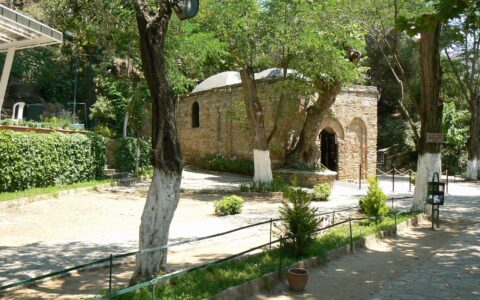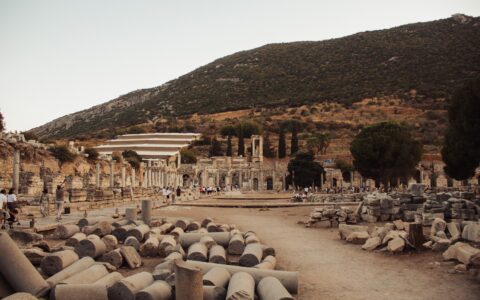
The big archeological news from Ephesus is about a skull. For almost a century it was linked to Arsinoe IV, the sister of Cleopatra, but new tests in 2025 showed it belonged to a boy of 11 to 14 years. So who was buried in the Octagon on Curetes Street is an open question again.
The ancient city of Ephesus has witnessed many important events throughout its thousands of years of history. One of these events is the tragic story of Arsinoe IV, the sister of Cleopatra VII, Queen of Egypt. As an Ephesus archaeological tour guide, I will share the latest discoveries about the skull found in Ephesus.

Fate of Arsinoe
Arsinoe IV was born in Alexandria between 68-63 BC. Her father was Ptolemy Auletes XII of the Ptolemaic Dynasty, who ruled Egypt. There is no definite information about her mother. Arsinoe, who had the same father as Cleopatra, was in constant competition with her sister.
Arsinoe fought against her sister Cleopatra. However, with the support of Caesar, Cleopatra regained her throne and Arsinoe was captured by Caesar and taken to Rome.
In Rome, Arsinoe was paraded in Caesar’s triumphal procession and later exiled to Ephesus. He was assassinated by Mark Antony in Ephesus in 41 BC, at the request of Cleopatra.

Recent Discoveries About Alleged Skull Of Arsinoe
One of the most important issues related to Arsinoe’s life and death in Ephesus is a skull found during excavations in Ephesus in 1926. In 1929, a team led by Austrian archaeologist Josef Keil discovered an octagonal tomb in the ancient city of Ephesus. This tomb was believed to belong to Arsinoe and a female skull was found there. However, in 2025, DNA analysis and modern techniques1 revealed that the remains were not those of Arsinoe, but those of a Roman child aged 11-14 who was struggling with developmental disorders.

The Ancient City of Ephesus and Rumors of Ancient Rome
Arsinoe’s life is full of political intrigue, family rivalries and a tragic ending. Her exile in Ephesus and the controversy surrounding the skull in particular make her story even more intriguing. While recent discoveries2 show that the skull is most likely not Arsinoe’s, this only deepens the mystery and history of Ephesus.
What Is the Octagon of Ephesus?
The Octagon is a tomb monument in the middle of the city, along Curetes Street near the Temple of Hadrian. It is believed to have had an eight-sided burial chamber on a rectangular base, a ring of Corinthian columns and a pyramid-shaped roof. Some say its eight sides recall the lighthouse of Alexandria, which would fit a princess from Egypt.
The tomb was made for a person of very high rank. The skull from it went to Vienna after it was found and is still kept there. Why a tomb with Egyptian looks held a boy with roots in Italy or Sardinia is still open question.
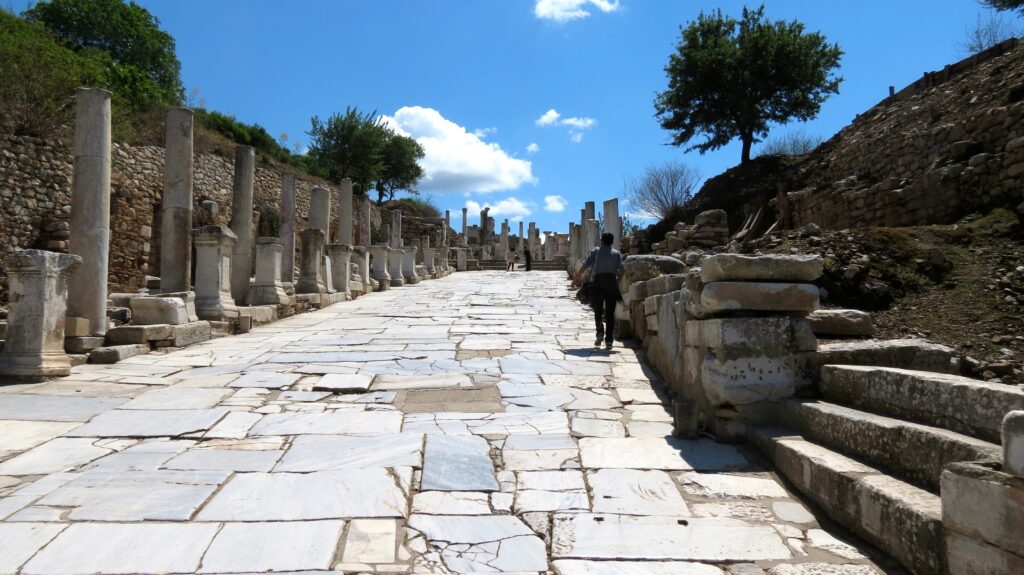
On a walk down from the Upper Gate you pass the Octagon before the Library of Celsus.
Frequently Asked Questions
Is the Octagon of Ephesus really the tomb of Arsinoe IV?
Nobody can say for sure. The bones found in it do not match her, but the tomb was made for someone of very high rank. The search for her real grave can start again.
Was the skull from the Octagon a boy or a girl?
A boy, between 11 and 14 years old. In repeated tests the skull and a thigh bone both showed a Y chromosome. The boy also had serious growth problems.
As an archaeological tour guide, sharing Arsinoe’s story enriches the experience of exploring Ephesus, offering a glimpse into the personal tragedies that shaped the ancient world. Contact me to learn more on mysteries of Ephesus and to hire a professional, archeological tour guide in Ephesus. See you soon, Hasan Gülday.