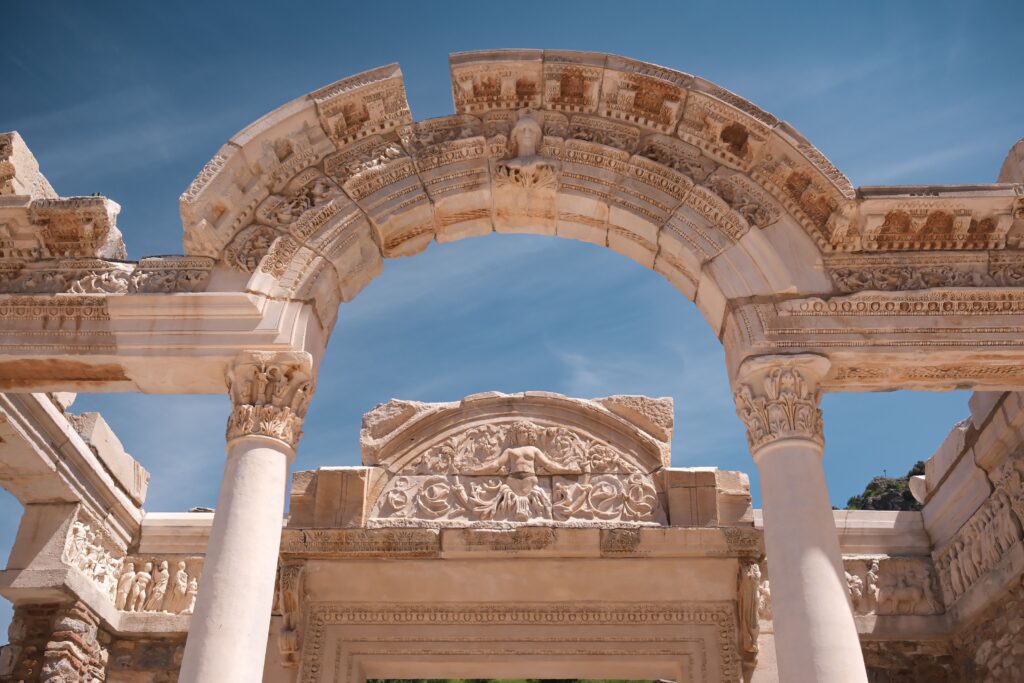
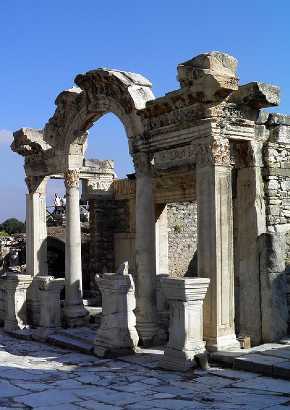
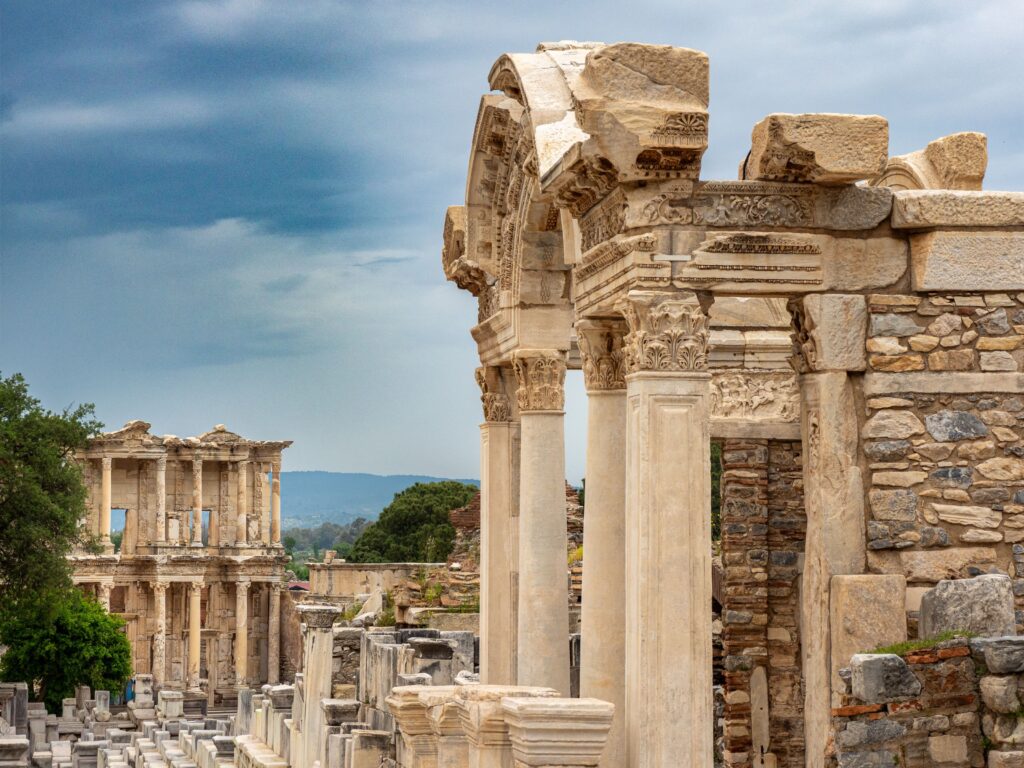
The Temple of Hadrian, located in the middle of the ancient city of Ephesus, was built to honor the Emperor of Rome Hadrianus. It was built between 117-138 AD. It is a little also astonishing structure standing on the left side as you proceed up the marble path from the Celsus library towards the Hercules gate.
The Temple of Hadrian, also known as the Temple of the Divine Hadrian or the Temple of Hadrian and Antoninus Pius, is an ancient Roman temple located in the city of Ephesus in modern-day Turkey. Built in the 2nd century AD, the temple was dedicated to the deified Roman emperors Hadrian and Antoninus Pius. It is one of the best-preserved Roman temples in the world and a major tourist attraction in Turkey.
The Temple of Hadrian is located in the city center of Ephesus, near the Library of Celsus and the Great Theater. It is situated on a rectangular platform and is surrounded by a colonnade of Corinthian columns. The temple’s facade is adorned with reliefs and statues, including a large statue of Hadrian in a toga, seated on a throne. The reliefs depict various scenes from Greek mythology, including the Labor of Hercules and the story of Perseus and Andromeda.
The interior of the temple is divided into three main sections: the cella, the pronaos, and the opisthodomos. The cella, or main room, was used for the cult statue of Hadrian and was adorned with marble and frescoes. The pronaos, or front porch, was used for ceremonies and rituals, while the opisthodomos, or rear porch, was used for storing votive offerings.
The Temple of Hadrian was an important center of worship in the Roman Empire and played a significant role in the religious and cultural life of Ephesus. It was visited by pilgrims from all over the Roman world and was considered a symbol of the city’s wealth and power.
| What | Small Roman temple in the Corinthian order, with a curved arch over the porch |
|---|---|
| Built | Early 2nd century AD |
| Where | Curetes Street, across from the Terrace Houses |
| Rebuilt | 1957 and 1958, from its own fallen blocks |
About Emperor Hadrian

Emperor Hadrian was an emperor who constantly traveled and preferred to determine and solve problems on his own rather than running his empire from the far-away capital, Rome city. Emperor Hadrian took over the empire from warrior emperor Trajan, an emperor who made the borders of the Roman Empire stretch from North England to the gulf. During his 21-year rule, Hadrian followed more peaceful ways to guard these broad borders. He preferred to determine and solve problems on his own by making trips instead of managing the country from the capital. Many buildings and sculptures were made in his honor before or after these visits. Many of these monuments have survived to the current day. These works are exhibited in many museums in Europe, especially in Germany in the UK, and also in Turkey.
Guide to the Temple of Hadrian in Ephesus, Turkey
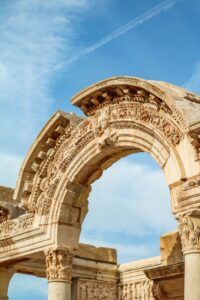
Despite its age, the Temple of Hadrian has been remarkably well-preserved over the centuries. It was damaged by earthquakes and looting in the past, but much of its original architecture and decoration has survived. Today, the temple is a major tourist attraction in Ephesus and is considered one of the most important ancient ruins in Turkey. It is a testament to the art, religion, and culture of the Roman Empire and a must-see destination for anyone interested in ancient history.
The temple you see today was found in 1956, when Austrian archaeologists were clearing Curetes Street. In those years the excavations in Ephesus tried to open whole streets for the visitors, and many stones of the temple were still laying where they had fallen.
So in 1957 and 1958 the team put the Temple of Hadrian in Ephesus back together with its own blocks. This kind of work is called anastylosis. Around 2010 the whole building was scanned in 3D, and between 2012 and 2014 restorers made the old repairs stronger.
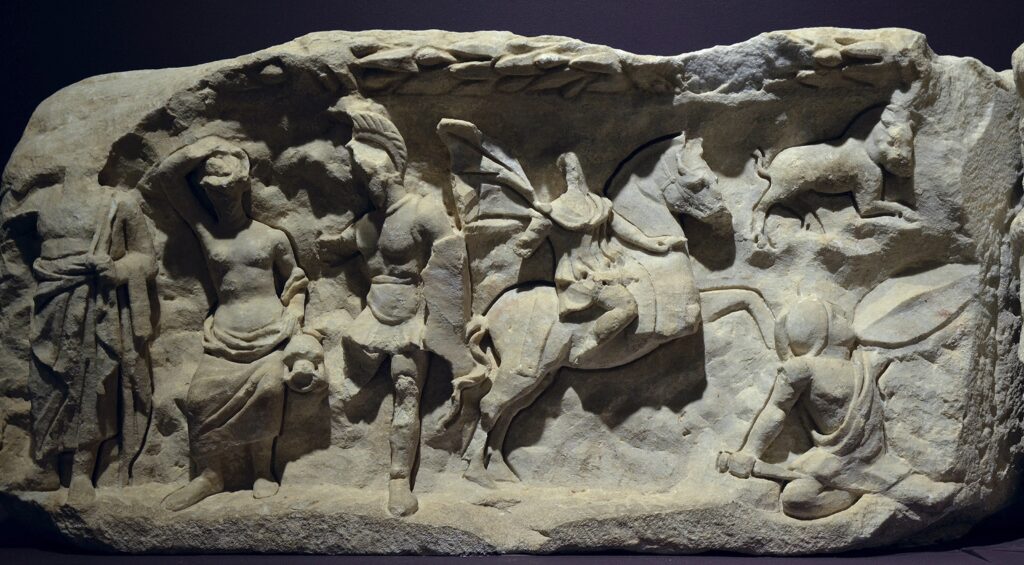
The Temple of Hadrian in Ephesus was built to honor the emperor arriving in Ephesus. The Temple of Hadrian in Ephesus was built in the Corinthian order. There are interesting reliefs on the door beam depicting the founding legend of Ephesus. King Androklos hunts the boar. A meeting of the Amazons and gods is depicted. The temple was restored because it was partially demolished in the 4th century, while four reliefs were added, adorning the inside walls of the portico. Today originals of temple reliefs are in the museum of Ephesus in Selcuk and plaster molds are placed in their original place in Ephesus.
Who Built the Temple of Hadrian?
The Temple of Hadrian was built by a rich Ephesian, Publius Quintilius Valens Varius, who paid for the temple, its decoration and its cult statue from his own money together with his wife and his daughter Varilla. His name is written on the architrave above the arch.
Today it is believed that the temple was finished in 117 or 118 AD. Varius promised the building in the last years of Emperor Trajan, but Trajan died in 117 and the new emperor Hadrian got his name on it. At the same time Varius also built the baths behind the temple, which we know today as the Baths of Scholastica.
Newer research links the temple with the processions for Artemis, which passed along Curetes Street right in front of it. The four inscribed bases in front of columns were added in late antiquity. They carried statues of the four emperors who ruled together at the end of the 3rd century, Diocletian, Maximian, Constantius I and Galerius. Later the statue of Maximian was replaced with one of the father of Emperor Theodosius I.
Frequently Asked Questions
Where is the Temple of Hadrian in Ephesus?
It stands on Curetes Street, between the Hercules Gate and the Library of Celsus, across from the Terrace Houses. Most tours start at the Upper Gate, so you reach it on the way down.
Is the Temple of Hadrian the same as the Gate of Hadrian?
No, they are two different monuments. The Gate of Hadrian is an arched gateway at the lower end of Curetes Street, right beside the Library of Celsus. The temple stands higher up the same street.
Why does the Temple of Hadrian have an arch?
The two middle columns carry a curved arch instead of a straight beam. It is often called a Syrian gable, a form known from eastern Roman provinces, and it probably made the small entrance look taller and grander.
What do the reliefs on the Temple of Hadrian show?
The frieze runs around the inside of the porch and tells the founding story of Ephesus. On the first block Androklos rides after the wild boar, then come the gods and the Amazons, with one scene at a festival of Dionysos. The fourth block is later in style and is usually read as Emperor Theodosius I with his family among the gods. The blocks on the temple are copies, the originals are in the Ephesus Museum in Selçuk.
Who are the two women carved on the front of the Temple of Hadrian?
The bust on the keystone of the arch is Tyche, the goddess of good fortune who looked after the city. Behind her, in the half circle over the inner door, a woman grows out of acanthus leaves. Most people call her Medusa, and like Medusa heads on other Roman buildings she was there to keep bad luck away from the door. When I stop here with my guests, I ask them to look up and find her.
When was the Temple of Hadrian built and when was it rebuilt?
It was finished in AD 117 or 118, in the first year of the rule of Hadrian, and repaired in the 4th century after heavy damage, probably from an earthquake. The ruin came to light in 1956 under the rubble of Curetes Street. It was put back together from its own blocks in 1957 and 1958, and the old repairs were made stronger between 2012 and 2014. So the building you photograph today stands on its own Roman stones.
Who was Androklos on the Temple of Hadrian frieze?
Androklos was the legendary founder of Ephesus, a son of King Kodros of Athens. The oracle told him a fish and a boar would show him the place for his city, and the frieze shows the moment he catches up with the boar. The whole story is in my post on Androclos, the founder of Ephesus.
The Temple of Hadrian is a must-see on any Ephesus tour. I liked to stop at this attraction in every Ephesus tour I organize. You can always write to me if you need to learn more about the Temple of Hadrian in Ephesus or book a professional licensed tour guide to Ephesus ancient city and temple of Hadrian in Ephesus. See you soon, Hasan Gülday.



1 comment