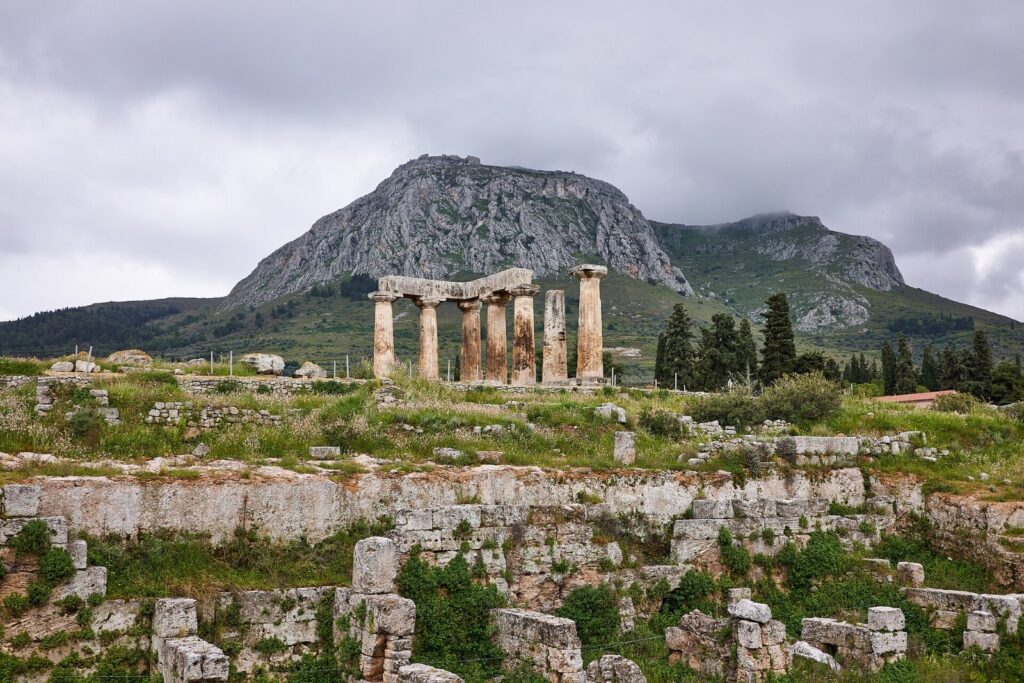
Corinth vs Ephesus is a comparison of two great Roman cities of Apostle Paul. Corinth sat on the narrow isthmus of Greece with two harbors and was the capital of the province of Achaia. Ephesus, in today’s Turkey, was the great port and capital of the province of Asia, home of the Temple of Artemis. Paul stayed a year and a half in Corinth and about three years in Ephesus.
Add Tours Around Turkey as a preferred source on Google
My guests often ask me about Corinth while we stand in Ephesus. They know both names from Bible and want to know how the two cities compare. Let’s have a look, from the harbors to the letters.
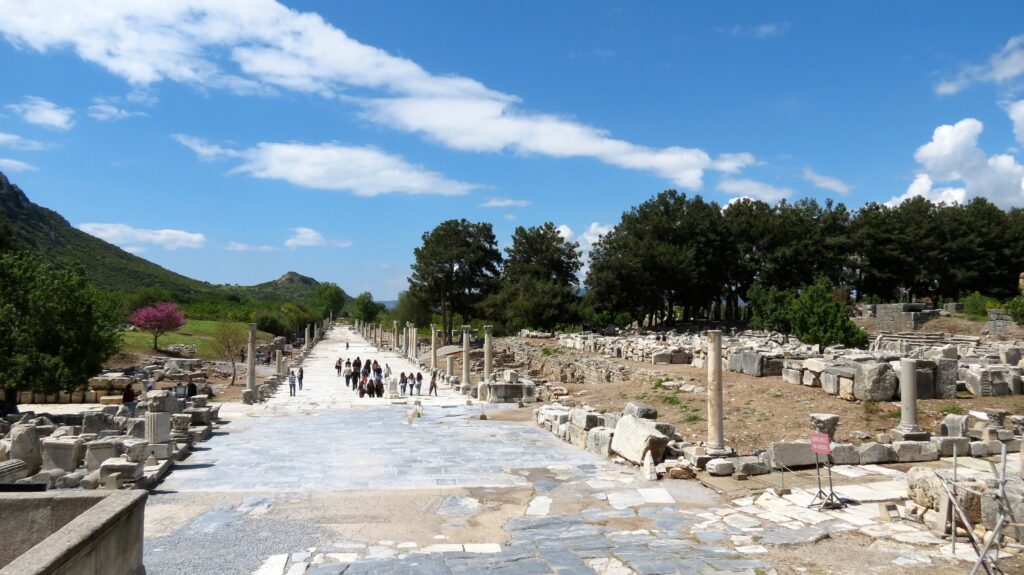
Corinth vs Ephesus at a Glance
Here are the two cities side by side.
| Topic | Corinth | Ephesus |
|---|---|---|
| Country today | Greece | Turkey, near Selçuk |
| Setting | Isthmus between two seas | River mouth on the Aegean |
| Harbors | Lechaion and Cenchreae | One river harbor, now silted |
| Roman status | Colony from 44 BC, capital of Achaia | Capital of the province of Asia |
| Famous temple | Temple of Apollo | Temple of Artemis |
| Famous games | Isthmian Games | Festivals of Artemis |
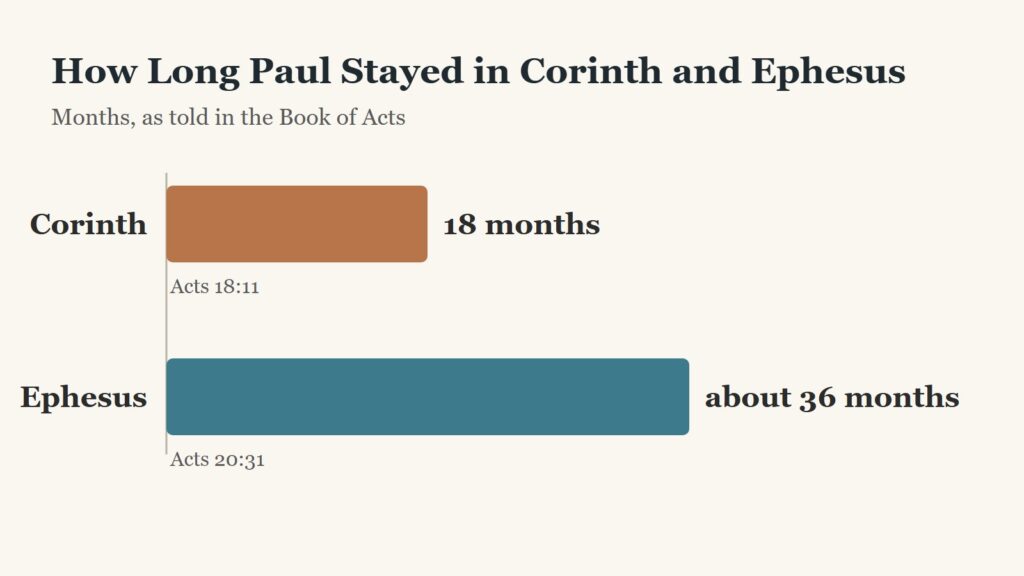
| Paul’s stay | 18 months | About 3 years |
| UNESCO list | No | Yes, since 2015 |
Geography and Harbors
Corinth controlled the isthmus, the thin neck of land between mainland Greece and the Peloponnese. It had two harbors: Lechaion on the Gulf of Corinth to the west and Cenchreae on the Saronic Gulf to the east. Around the 6th century BC the Corinthians built the diolkos, a paved stone track for dragging ships and cargo across the land.
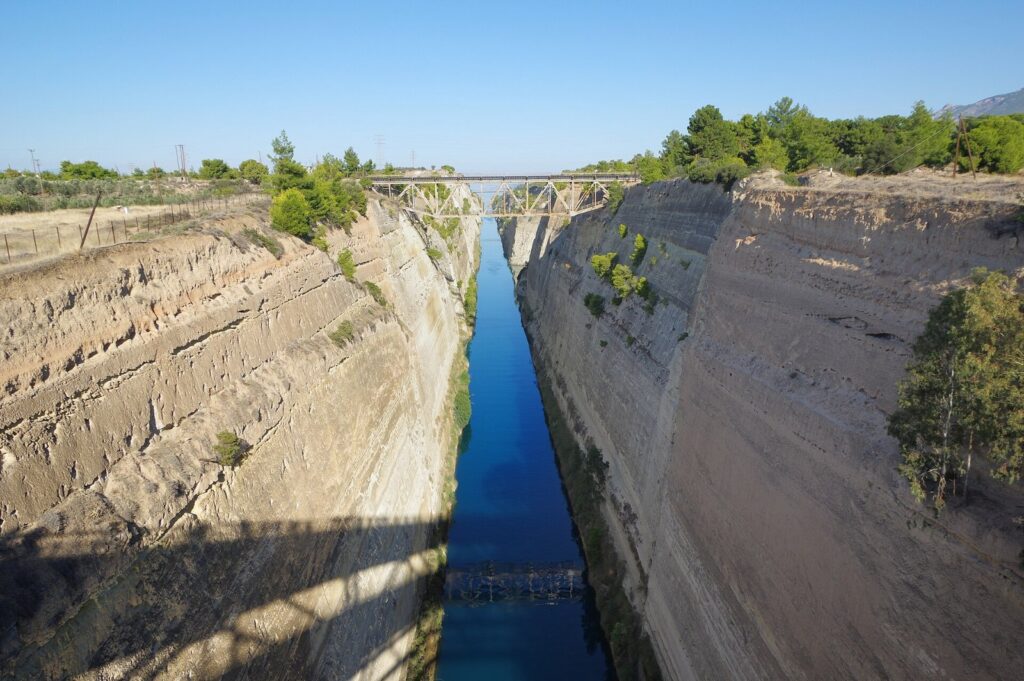
The ancient dream of a channel came true much later. The Corinth Canal opened in 1893 and cuts straight through the isthmus. Ephesus had a different story. It stood at the mouth of the Cayster River, and the river kept filling its harbor with silt. Over the centuries the sea moved away, and the ruins are now several kilometers inland.
I like to stop my guests on Harbor Street and tell them that ships once tied up at the end of this road, today you see fields and trees there. By the way, we call the Cayster the Küçük Menderes in Turkish, the Little Meander.
History, Temples and Games
Rome destroyed old Greek Corinth in 146 BC. In 44 BC Julius Caesar refounded it as a Roman colony, and it became the capital of the province of Achaia. Its first official inscriptions were in Latin. Ephesus was an old Ionian Greek city that became the capital of the Roman province of Asia, and Greek stayed its language.
In Corinth the Temple of Apollo still has seven standing columns, and a temple of Aphrodite stood on the high rock of Acrocorinth. Nearby, at the sanctuary of Poseidon, Corinth hosted the Isthmian Games every two years. Corinthian bronze and painted pottery were known all over Mediterranean.
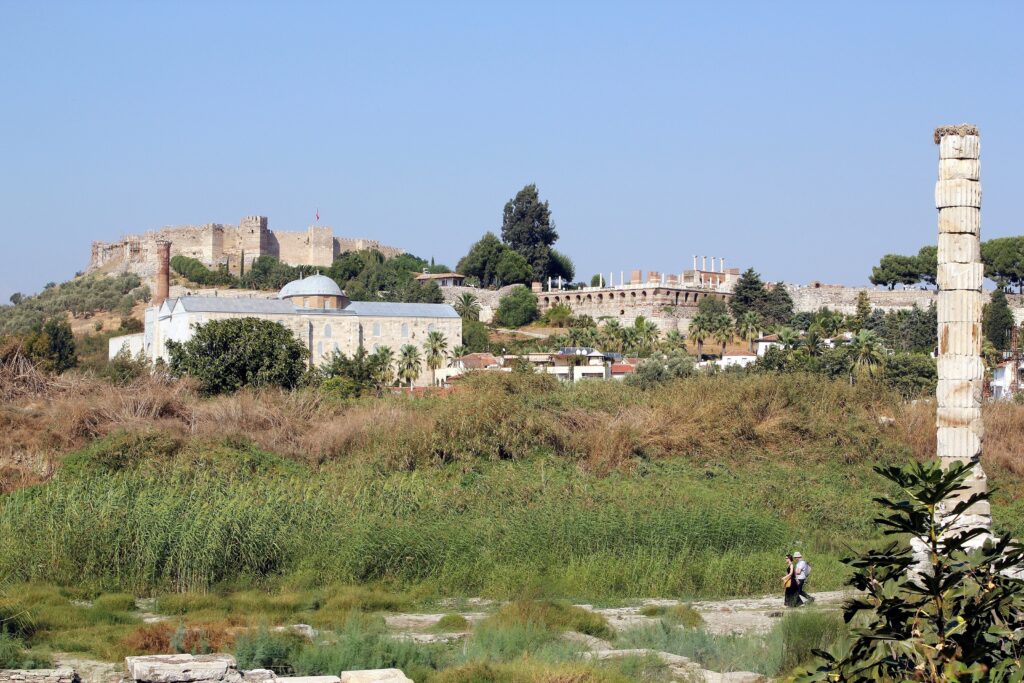
Ephesus had the Temple of Artemis, one of the Seven Wonders of the Ancient World. Its silversmiths made small shrines of the goddess (Acts 19:24), and its port brought trade from whole province. The Great Theater, it is believed, held about 24,000 people.
Corinth and Ephesus in the Bible
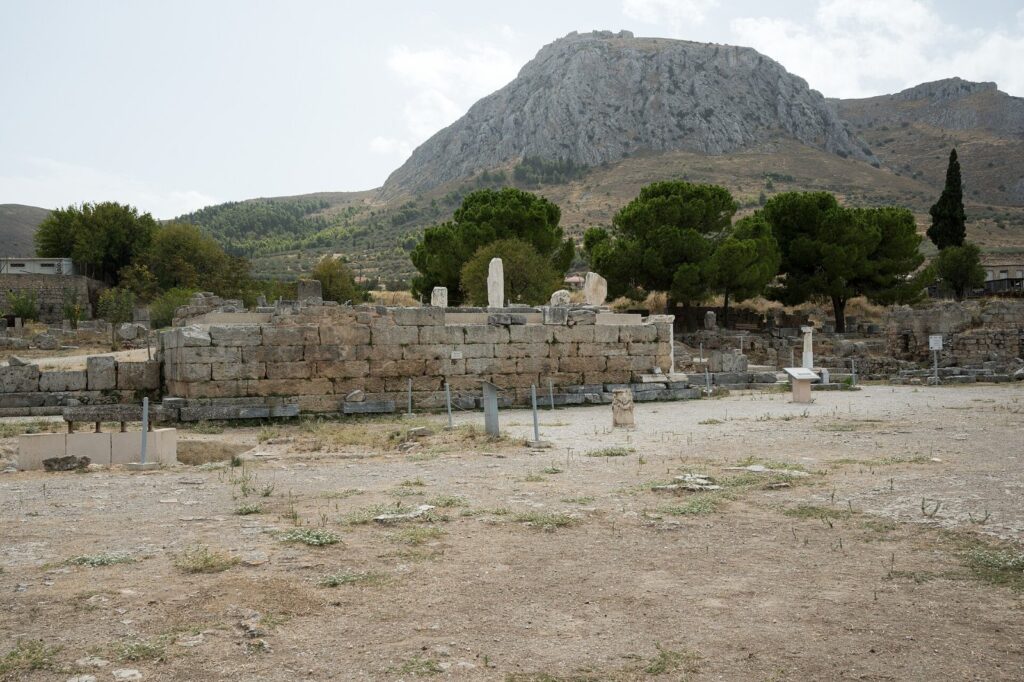
Paul came to Corinth from Athens (Acts 18:1). There he met Aquila and Priscilla, who had left Italy when Emperor Claudius ordered the Jews out of Rome (Acts 18:2). They were tentmakers like him, so he lived and worked with them (Acts 18:3). He stayed a year and six months, teaching the word of God (Acts 18:11).
His opponents brought him before Gallio, the proconsul of Achaia, at the judgment seat, the bema (Acts 18:12). Gallio said the case was about their own law and sent them away (Acts 18:14-16). A stone found at Delphi dates Gallio’s year in office to about AD 51 or 52, one of the firmest dates in Paul’s life.
After this Paul sailed from Cenchreae with Aquila and Priscilla and left them in Ephesus (Acts 18:18-19). Apollos came to Ephesus next, and the couple taught him the way of God more perfectly (Acts 18:26). Then he crossed to Corinth (Acts 19:1). Paul later wrote, “I have planted, Apollos watered” (1 Corinthians 3:6). My article on Aquila and Priscilla in Ephesus tells the couple’s story.
In Ephesus Paul taught three months in the synagogue and two years in the school of Tyrannus (Acts 19:8-10), about three years in all (Acts 20:31). That is about 36 months, against 18 in Corinth. The silversmith Demetrius stirred up the craftsmen, and the crowd filled the theater shouting “Great is Diana of the Ephesians” (Acts 19:28). The town clerk calmed them and sent them home (Acts 19:35-41).
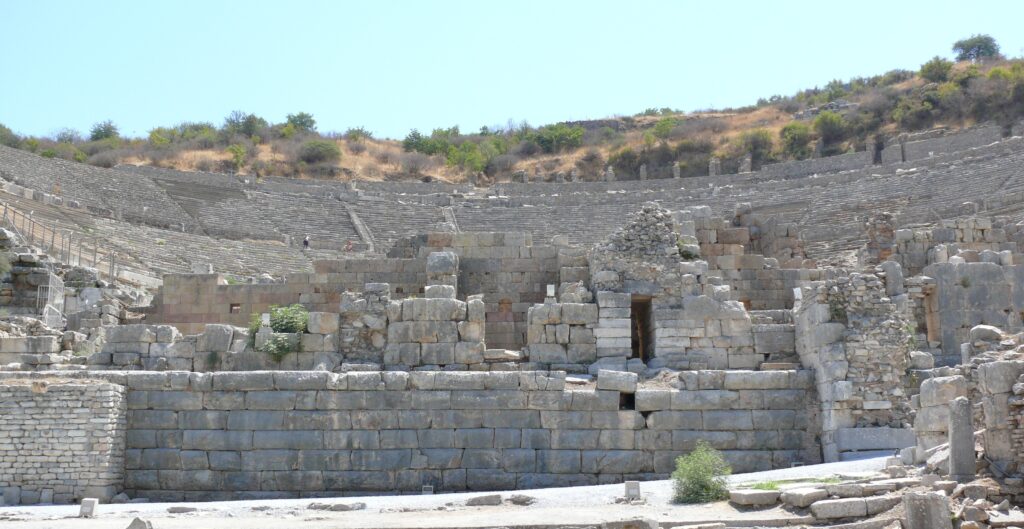
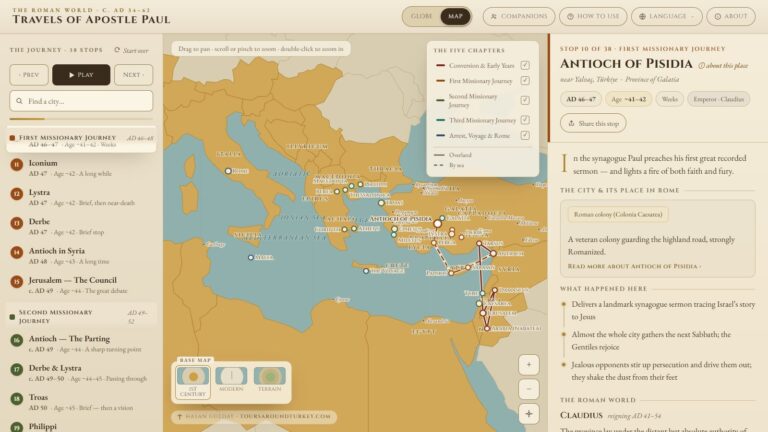
In Corinth a Roman governor ended the trouble at the bema, and in Ephesus a city official ended it in the theater. I tell the places of this story in Apostle Paul in Ephesus, and you can follow his routes on my map of Paul’s missionary journeys.
| In the Bible | Corinth | Ephesus |
|---|---|---|
| Paul arrives | From Athens (Acts 18:1) | From Cenchreae (Acts 18:19) |
| Length of stay | 18 months (Acts 18:11) | About 3 years (Acts 20:31) |
| Aquila and Priscilla | Tentmaking with Paul (Acts 18:3) | Church in their house (1 Cor 16:19) |
| Apollos | Watered what Paul planted (1 Cor 3:6) | Taught by the couple (Acts 18:26) |
| Trouble | Before Gallio (Acts 18:12) | Riot of the silversmiths (Acts 19:28) |
| Official | Proconsul at the bema | Town clerk in the theater |
| Letters | 1 and 2 Corinthians | Ephesians, Revelation 2:1-7 |
The Letters and the Church Leaders
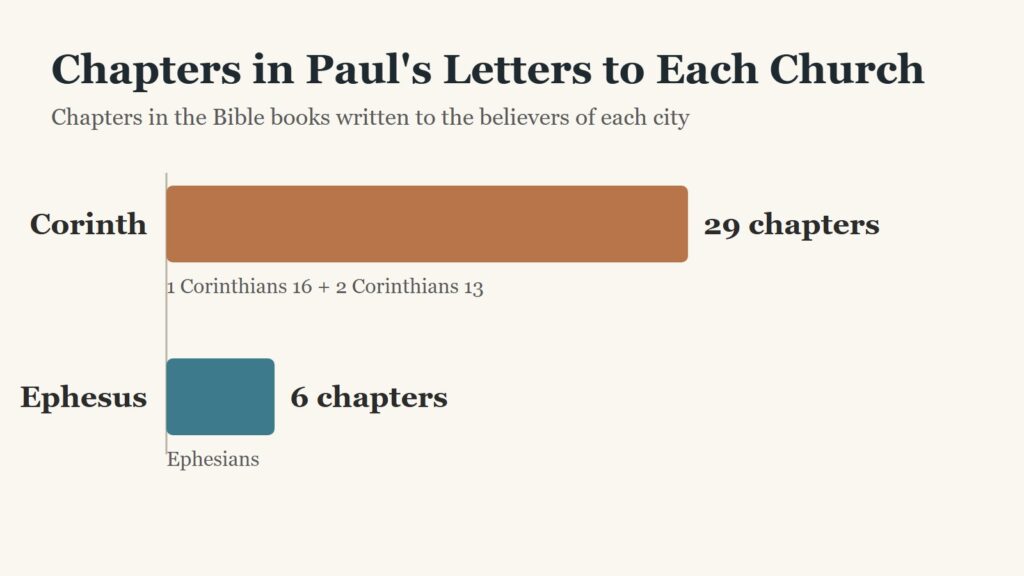
The two letters to Corinth are long: 1 Corinthians has 16 chapters and 2 Corinthians has 13, so 29 in all. Ephesians has 6. And 1 Corinthians was written in Ephesus. Paul says, “I will tarry at Ephesus until Pentecost” (1 Corinthians 16:8), and adds that a great door was opened to him there (16:9).
It is thought that Paul wrote Romans from Corinth, where Gaius was his host (Romans 16:23). Ephesus has more in the rest of the New Testament. Timothy stayed there (1 Timothy 1:3), the first of the seven letters of Revelation goes to its church (Revelation 2:1-7), and tradition says Apostle John lived his last years in Ephesus.
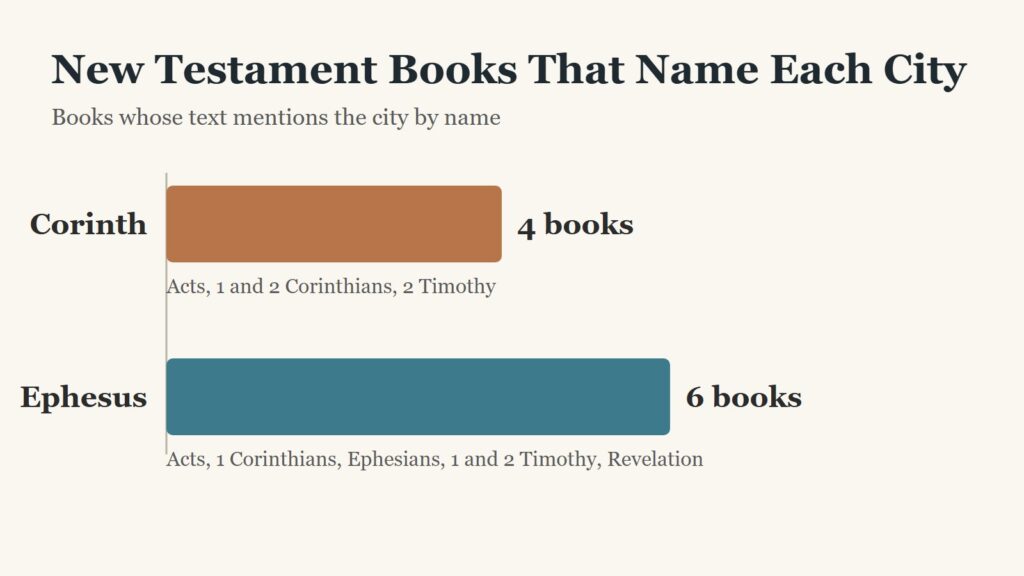
When I count the books that name each city, Ephesus is in six: Acts, 1 Corinthians, Ephesians, 1 and 2 Timothy and Revelation. Corinth is in four: Acts, 1 and 2 Corinthians and 2 Timothy. You can read more in the letter to the church of Ephesus in Revelation and in how Timothy died in Ephesus.
Both churches have names we know. In Corinth: Crispus, the ruler of the synagogue (Acts 18:8), Gaius and the household of Stephanas (1 Corinthians 1:14-16), Erastus, the chamberlain of the city (Romans 16:23) and Phoebe of Cenchreae (Romans 16:1). In Ephesus: Tychicus (Ephesians 6:21), Trophimus the Ephesian (Acts 21:29) and Onesiphorus (2 Timothy 1:16-18).
Visiting Corinth and Ephesus Today
Ancient Corinth lies below Acrocorinth, with the Temple of Apollo, the bema, the Lechaion Road and a museum. Ephesus is a long walk through a Roman city, with marble streets, the Library of Celsus and the Great Theater. Most visits start at the Upper Gate and walk downhill.
| Visiting today | Corinth | Ephesus |
|---|---|---|
| Nearest town | Archaia Korinthos | Selçuk |
| Main temple | Temple of Apollo | Temple of Artemis site |
| Paul’s place | The bema | The Great Theater |
| Harbor today | Canal and coast nearby | Dry land inland |
| Bible place nearby | Cenchreae | Basilica of Saint John |
| UNESCO list | No | Yes, since 2015 |
In the Great Theater I often open the Bible with my guests and read Acts 19 aloud. The words feel different when you sit on same stone seats. Greece and Turkey together tell much of Paul’s story, as I also wrote in Christian Turkey vs Christian Israel too.
Frequently Asked Questions
Are Ephesus and Corinth the same place?
No. Corinth is in southern Greece, on the isthmus near the modern town of Corinth. Ephesus is in western Turkey, beside the town of Selçuk in İzmir Province.
How far is Corinth from Ephesus?
About 390 kilometers (about 240 miles) in a straight line across the Aegean Sea. In Paul’s time the trip was made by ship, from Cenchreae, the eastern harbor of Corinth, to the harbor of Ephesus (Acts 18:18-19).
Hire Ephesus Tour Guide
I am a nationally licensed Turkish tour guide based in Kuşadası, nearby Ephesus. My day guiding is in Ephesus, İzmir and Pamukkale, and on a longer journey my national license lets me join you as your personal guide in other regions of Turkey.
You can see my guiding rates and guiding areas, or write to me through my contact page to ask about my availability.
I hope we will read Acts 19 together in the Great Theater of Ephesus one day. Write to me with your questions about Paul and his cities. See you soon, Hasan Gülday.