How did Timothy die? The Bible does not say. A later text, the Acts of Timothy, tells that Saint Timothy, the companion of Apostle Paul and the first bishop of Ephesus, was beaten with clubs and stones around 97 AD, under Emperor Nerva, when he tried to stop a masked pagan procession called the Katagogia. Scholars treat this as tradition, not as proven history.
Add Tours Around Turkey as a preferred source on Google
Ephesus had many festivals in its long history. Artemis had hers, the emperors had theirs, and later the Christians had their own feasts too. One of these festivals is remembered mostly because of a death. When I guide in Ephesus Ancient City, guests often ask me what happened to Timothy after letters of Paul end.
Let’s have a look at his life, the story of his death, the festival itself, and the places in Ephesus where you can still feel this story today.
Who Was Saint Timothy?
Timothy came from Lystra, a small town of Lycaonia in central Anatolia. Its site lies about 30 kilometers south of Konya, near the village of Hatunsaray. His name is Greek and means “honoring God”. Timothy in the Bible first appears in Acts 16:1, which calls him “the son of a Jewess who believed; but his father was a Greek” (WEB).
His faith came from women of his family. Paul later wrote about the sincere faith “which lived first in your grandmother Lois, and your mother Eunice” (2 Timothy 1:5, WEB). Timothy had known the Scriptures since his childhood, even though his father was not a Jew.
When Paul came back in Lystra on his second journey, the believers of Lystra and Iconium spoke well of the young man. Paul wanted to take him along. First, however, he circumcised him “because of the Jews who were in those parts; for they all knew that his father was a Greek” (Acts 16:3, WEB).
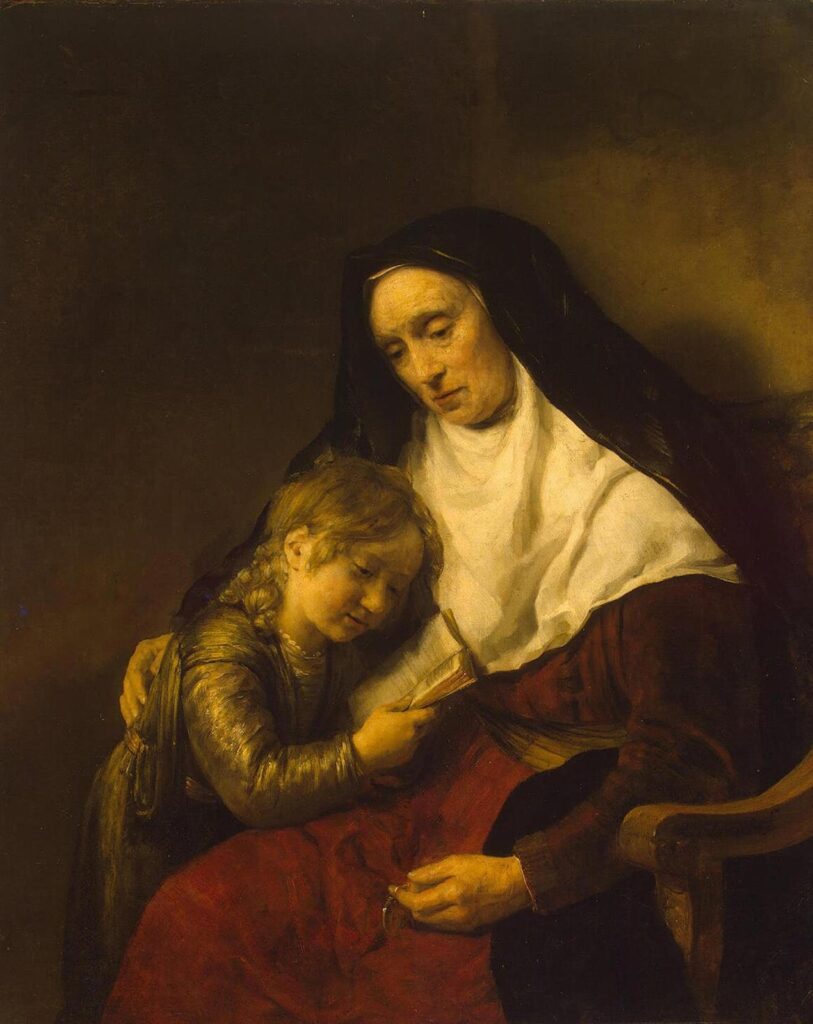
This surprises many readers because apostles had just agreed in Jerusalem that Gentile believers did not need circumcision. Timothy’s case was different. His mother was Jewish, and Paul wanted the Jews they met on the journey to accept him.
Timothy traveled with Paul and Silas to Macedonia and Greece. Paul sent him back to Thessalonica to see how was the young church doing (1 Thessalonians 3:1-6), and later to Corinth. His name stands next to Paul’s at the start of six letters: 2 Corinthians, Philippians, Colossians, 1 and 2 Thessalonians and Philemon.
Paul loved him like a son. To the Philippians he wrote, “I have no one else like-minded, who will truly care about you” (Philippians 2:20, WEB). He also asked the Corinthians to make sure that Timothy was “with you without fear” (1 Corinthians 16:10, WEB). At the end of the Letter to the Hebrews we even learn that Timothy had been set free, most likely from prison (Hebrews 13:23).
Timothy, the First Bishop of Ephesus
Ephesus enters Timothy’s life during Paul’s long stay in the city in the mid-50s AD. From Ephesus, Paul sent “Timothy and Erastus” ahead into Macedonia while he stayed in Asia for a while (Acts 19:22, WEB). YOu can read the whole story in my article on Apostle Paul in Ephesus.
Later Paul reminded to him: “As I urged you when I was going into Macedonia, stay at Ephesus that you might command certain men not to teach a different doctrine” (1 Timothy 1:3, WEB). So Timothy stayed behind as the leader of the Ephesian Christians.
The two letters to Timothy belong to the so-called Pastoral Letters, together with the letter to Titus. They give advice about leaders, widows, false teachers and prayer, and one famous line, “Let no man despise your youth” (1 Timothy 4:12, WEB). I wrote more about them in my article on the letters of Paul to the churches of Asia Minor.
Many modern scholars think that a follower of Paul wrote these letters after his death. Others keep the traditional view that Paul wrote them himself. Either way, the early church read them as letters to the man who was leading church of Ephesus.
In the early 4th century the church historian Eusebius wrote that “Timothy, so it is recorded, was the first to receive the episcopate of the parish in Ephesus” (Church History 3.4.6). This is the oldest clear statement that Timothy was the first bishop of the city. However, the New Testament says nothing about how his life ended. For that we have to turn to a much later book.
How Did Timothy Die in the Acts of Timothy?
The Acts of Timothy is a short text in Greek, written by an unknown Christian of Ephesus. It also survives in a Latin translation. It tells that Paul made Timothy bishop of Ephesus in the reign of Nero, that Saint John came to the city later, and that Emperor Domitian exiled John to the island of Patmos.
While John was away, Timothy led the church. The text says that remains of the old religion still lived in the city. On certain days the people held a festival called the Katagogia. Revelers covered their faces with masks and carried clubs and images of the gods in their hands.
Singing their songs, they attacked free men and women, killed people and shed much blood in the finest parts of the city, as if it were a holy duty. In the 9th century the patriarch Photius of Constantinople read the Greek text and summed it up in his Bibliotheca. He called it a “devilish and abominable festival”.
Timothy tried many times to talk them out of this madness, they did not listen. On the day of the festival he went out of his own will and stood in the middle of the gate. He called on the men of Ephesus to leave the madness of the idols and to know the true God. The angry revelers fell on him with their clubs and stones and struck him down.
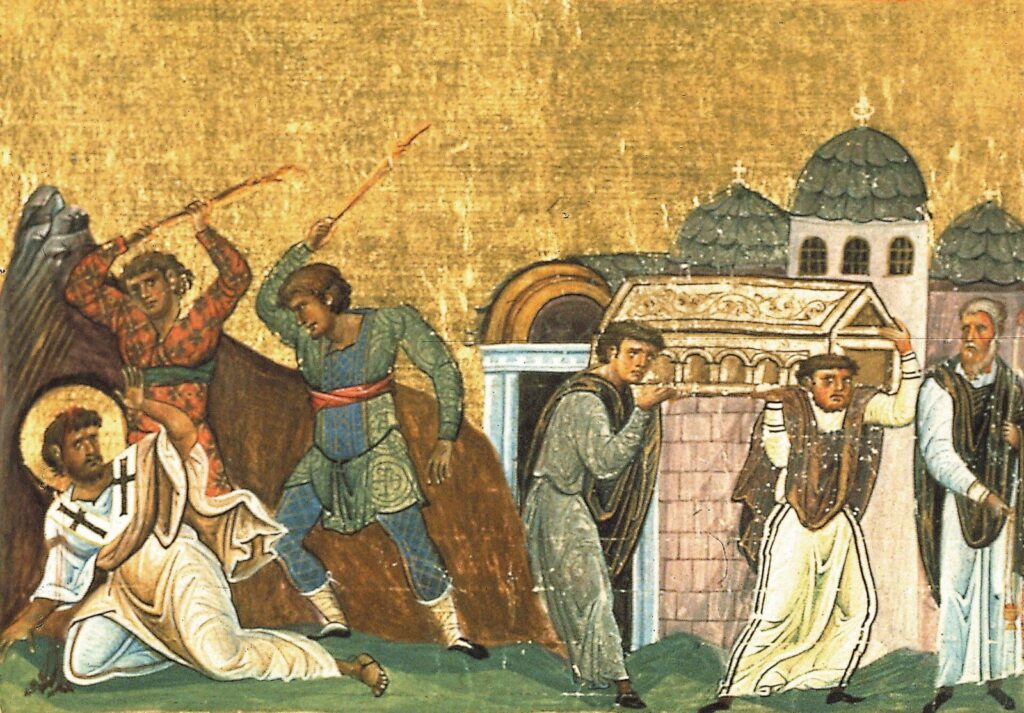
The Christians lifted him while he was still alive and carried him away to a hill. There he died in peace, and they buried him at a place the text calls Pion, where, the writer says, his martyr shrine still stood in his own day.
The last lines give the date. Timothy died three days after the Katagogia, on 22 January, under Emperor Nerva, when a man named Peregrinus was proconsul of Asia. Nerva ruled from 96 to 98 AD, and this is where the usual date of 97 AD comes from. You can read about that short reign in my article on Nerva and the Christians after Domitian.
The same text adds that John came back from Patmos under Nerva, found Timothy already dead, and led the church of Ephesus himself until the time of Trajan.
How Reliable Are the Acts of Timothy?
Here I have to be honest with you. The Acts of Timothy are not an eyewitness report. The Latin version says that Polycrates of Ephesus, the bishop of the city around 190 AD, wrote it from the words of people who saw the events. The Greek manuscripts do not carry his name at all.
The Bollandists, the Jesuit scholars who printed the Latin text in their Acta Sanctorum in 1643, already noticed this. So the name of Polycrates was most likely added later to make the story look older.
In 1877 the German scholar Hermann Usener published the first full Greek text, from a manuscript of the 11th or 12th century in Paris. Usener dated the Acts between about 320 and 340, before the relics left Ephesus in 356, and he believed that an old history of the Ephesian church stood behind them.
Theodor Zahn disagreed in 1878. The text calls Lycaonia a province, but Lycaonia became a separate province only around 370. Zahn also argued that no older tradition about Timothy’s life existed at all. Today most scholars place the Acts in the 5th century. The historian Ronald Syme also judged that the two proconsuls named in the text, Maximus and Peregrinus, are fictitious.
In 1884 Richard Lipsius pointed out that the writer was clearly a man of Ephesus. He knew the hill of Pion, the Katagogia, its date and its customs, and the local Asian calendar. For Lipsius the note about the festival was the one valuable detail of the whole text.
However, Lipsius saw another possibility too. Timothy’s feast day in Ephesus fell on 22 January, only a few days after the festival. A writer could have built his story from these two dates. A modern English translation by Cavan Concannon appears in the collection New Testament Apocrypha: More Noncanonical Scriptures.
So the answer to how did Timothy die is a tradition with a real Ephesian background, not a proven fact. This is exactly how I tell it to my guests.
What Was the Katagogia Festival?
The Greek word katagogia means “bringing down” or “bringing back”, and the standard Greek dictionary explains it as a “festival of the return” of a god. The word was used in more than one place. At Eryx in Sicily, for example, people were celebrating departure and the return of Aphrodite.
In Ionia, the region of Ephesus, the word belongs to Dionysus. In nearby Priene, an inscription of the 2nd century BC records the sale of the priesthood of Dionysus Phleos. The buyer also became priest of “Dionysus Katagogios”, and “during the Katagogia, he shall lead those who bring Dionysus in”, wearing a golden wreath (CGRN 176).
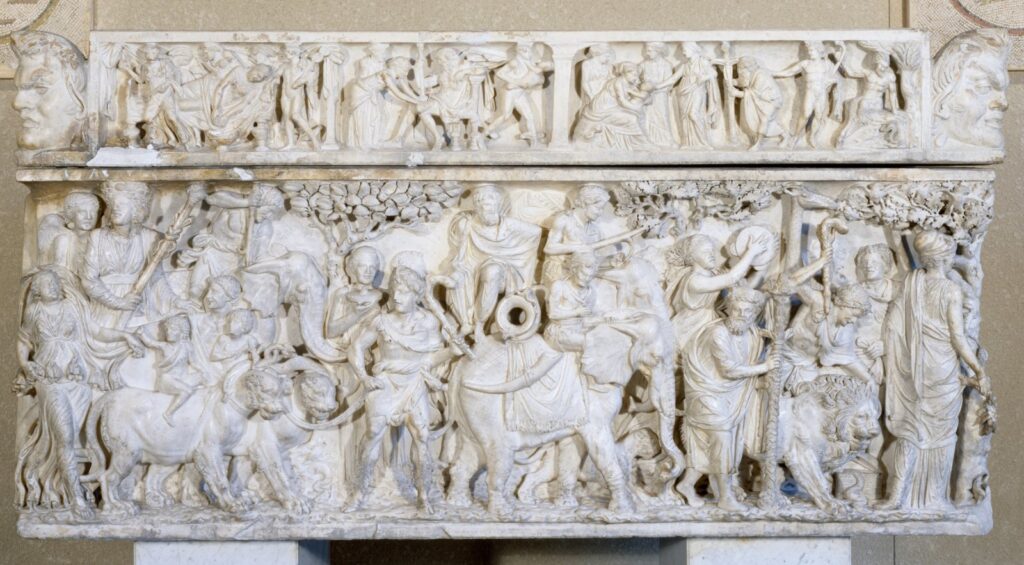
In Athens, the rules of a Dionysus club called the Iobacchoi, carved around 164 AD, tell the priest to pour “one libation of the Festival of Return (Katagogia)”. So the Katagogia was a known feast of Dionysus in the Greek world of Timothy’s time and after.
How did it look like? The editors of the Priene inscription explain that the image of the god, a mask or a statue, was brought into the city in a procession, possibly on a ship set on wheels.
The date is less clear. Counting back from the Acts, the Ephesian Katagogia fell around 19 or 20 January. Other scholars place the Ionian Katagogia in the spring. Usener found other examples of rough and even bloody festival customs in antiquity, but a Christian writer also had good reasons to paint the feast as dark as possible.
Dionysus and Artemis in Ephesus
Many retellings say that Timothy died during a procession of Artemis, or Diana as the Romans called her. The Acts themselves do not name the god. According to Lipsius, the Roman Martyrology, the Catholic list of saints first printed in the late 16th century, was the first to call it a festival of Diana, probably because of the silversmiths’ riot of Acts 19.
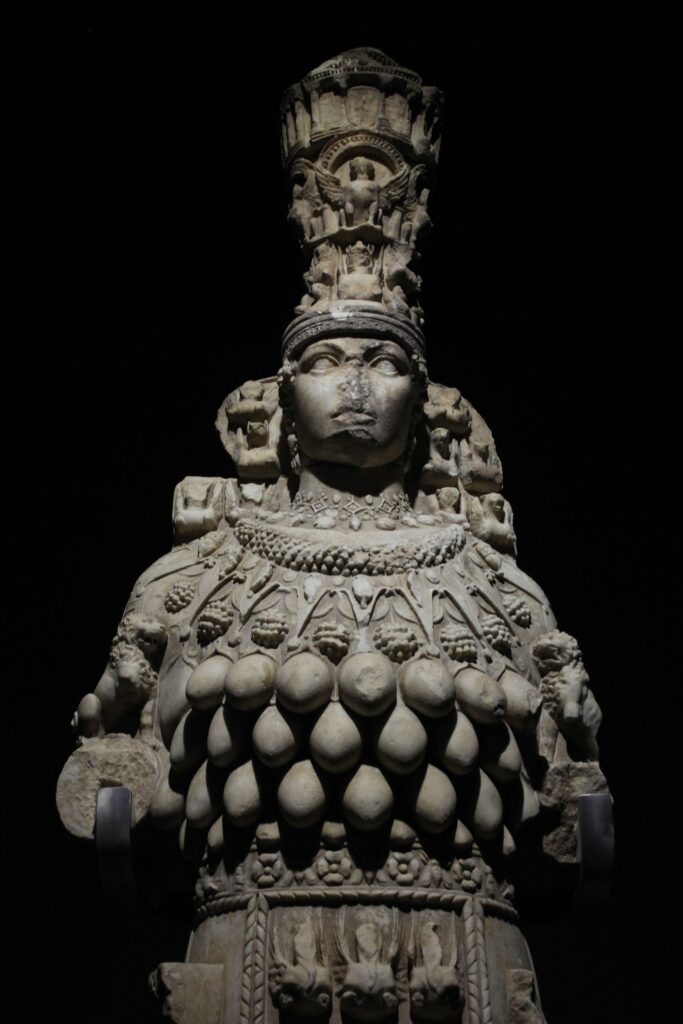
Artemis was everywhere in Ephesus, of course. Her temple was one of the Seven Wonders, and her birthday was celebrated with great festivals, which I described in my article about the ancient Artemis Ephesia festival. Still, scholars link the Katagogia with Dionysus, and Ephesus gives good reasons for that.
When Mark Antony entered Ephesus in 41 BC, women dressed as Bacchants and men and boys dressed as satyrs and Pans walked in front of him, and the people hailed him as Dionysus (Plutarch, Life of Antony 24). By the way, it was the same Antony who later came back here with Cleopatra.
Inscriptions tell us more. Under Emperor Hadrian, the “initiates before the city” set up an altar, found in the area of the Artemis temple, honoring Hadrian as enthroned together with Dionysus. Another inscription names a lifelong priest of Dionysus Phleos, the same Dionysus whose priest led the Katagogia at Priene. Other initiates served “the ancestral god Dionysus of Koressos”.
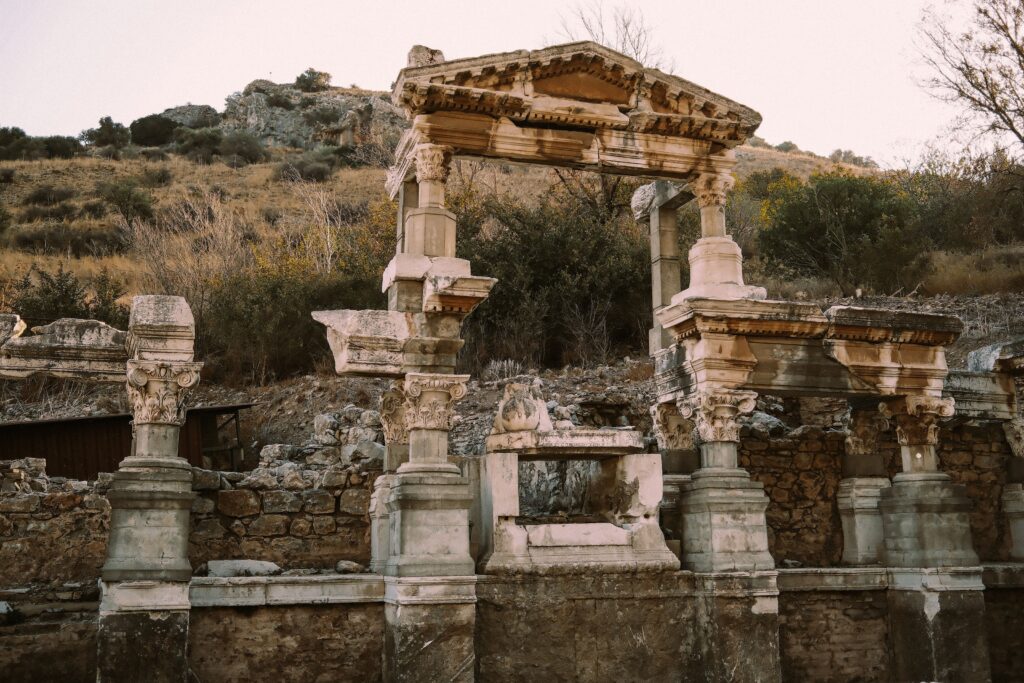
Dionysus also had a place on the main street too. The Fountain of Trajan on Curetes Street was built between 102 and 114 AD, only a few years after the date the Acts give for Timothy’s death. Fragments of statues show that Dionysus and Aphrodite stood there, while the building inscription honors Ephesian Artemis and the Emperor. In Ephesus the gods lived side by side.
Relics and Feast Day of Saint Timothy
The Acts say that Timothy was buried at Pion. Pion is the ancient name usually given to Panayır Dağı, the hill behind the Great Theater, which I described in my article on Panayır Mountain. However, no grave of Timothy has been found there or anywhere else in Ephesus.
The relics did not stay in Ephesus. In 356 AD Emperor Constantius II had them brought to Constantinople, they were placed in the Church of the Holy Apostles together with the relics of Andrew and Luke. What remained of that church was demolished in 1461 and 1462, and Sultan Mehmed II built the Fatih Mosque on its site in Istanbul.
Then the trail moves to Italy. In 1945, during restoration work in the crypt of Termoli Cathedral on the Adriatic coast, workers found relics laying under a marble slab. Its inscription, dated 1239, said that the body of blessed Timothy, disciple of the apostle, rested there.
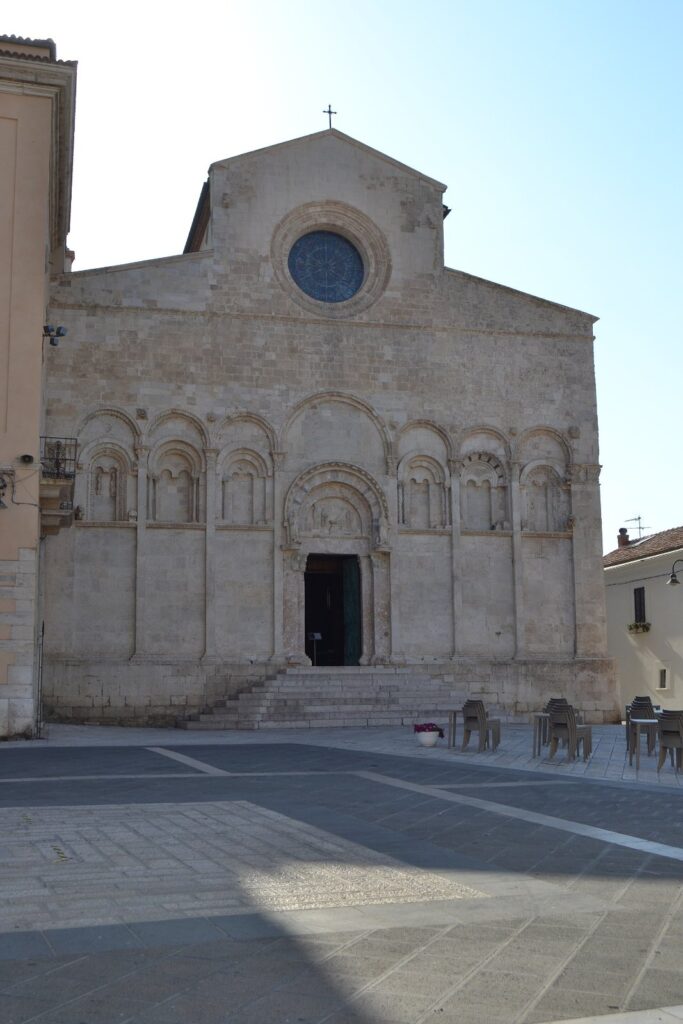
How the bones came from Constantinople to Termoli is not documented. A local tradition says that a count brought them back from the crusades. Saint Timothy is a patron of Termoli today, and in January 2020 the relics were taken to Rome for the Week of Prayer for Christian Unity.
The Orthodox Church remembers Timothy on 22 January, the date given in the Acts. The Catholic Church celebrates Timothy and Titus together on 26 January, the day after the feast of the Conversion of Saint Paul. Anglicans and many Lutherans also keep 26 January.
Timothy’s Ephesus Today
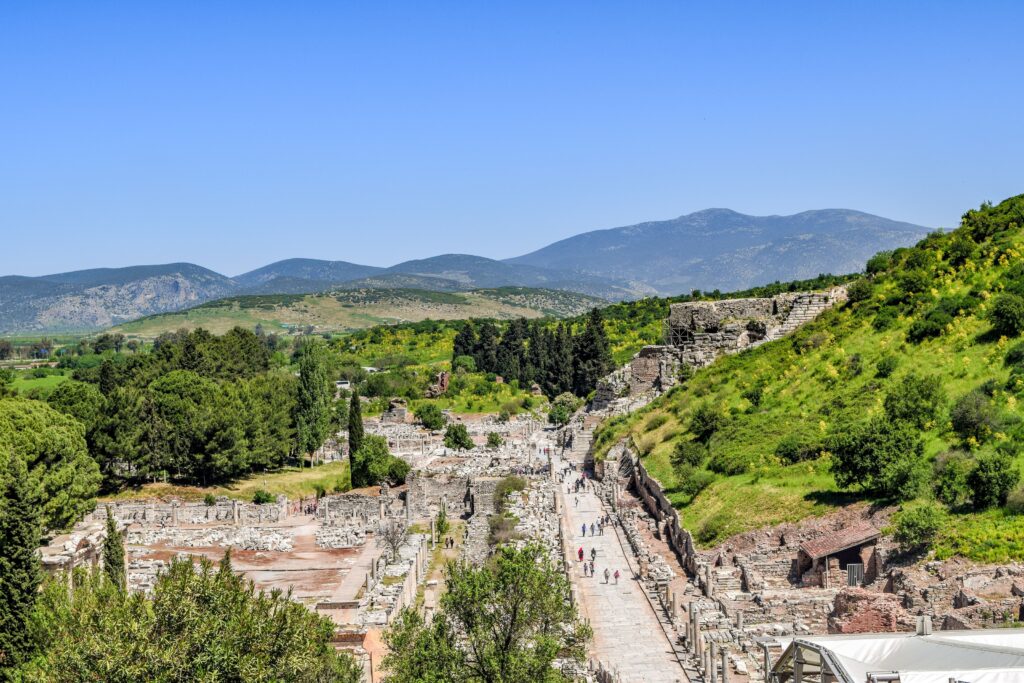
There is no tomb of Timothy to visit, and nobody knows where it was. But you can walk through his city. Most tours of Ephesus Ancient City start at the Upper Gate, also called the Magnesian Gate, and walk down to the theater. My article on the Upper Gate or Lower Gate explains the difference.
That direction has a history. In 104 AD a rich Roman named Gaius Vibius Salutaris gave the city about thirty gold and silver images of Artemis, of the emperor and of the Ephesian people, to be carried in processions. The route is written in the inscription: from the Artemis temple through the Magnesian Gate, past the Upper Agora, down the Embolos, across the Lower Agora and into the theater.
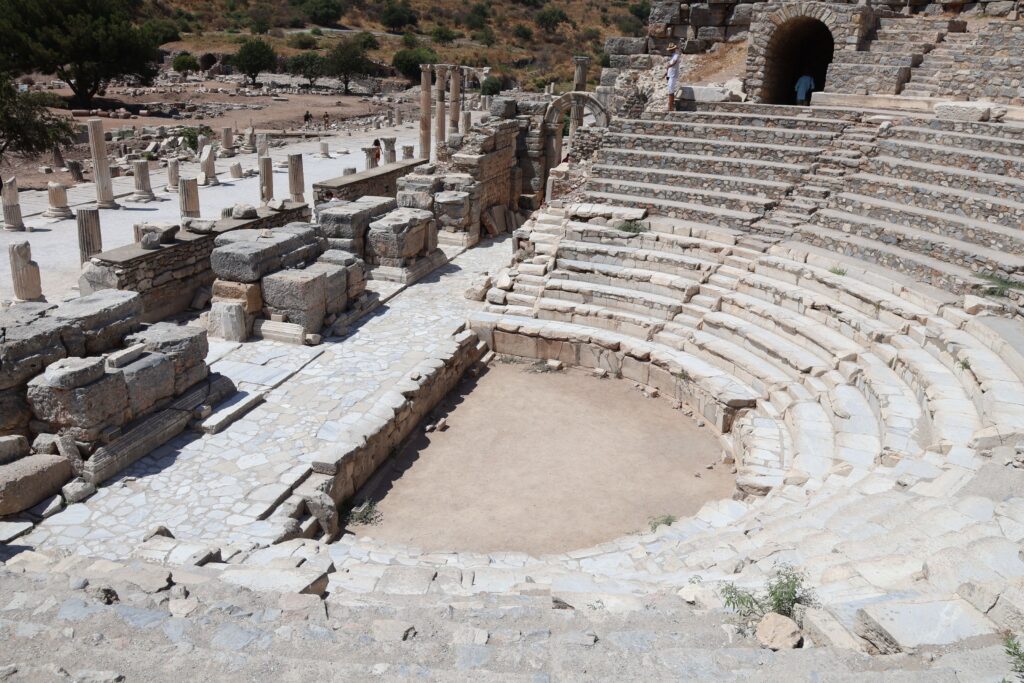
From the theater the procession went back to the temple by the Koressian Gate. One scholar estimated that it took place as often as every two weeks. It was a procession of Artemis, not the Katagogia, but it shows us how a festival crowd moved through the streets in Timothy’s century.
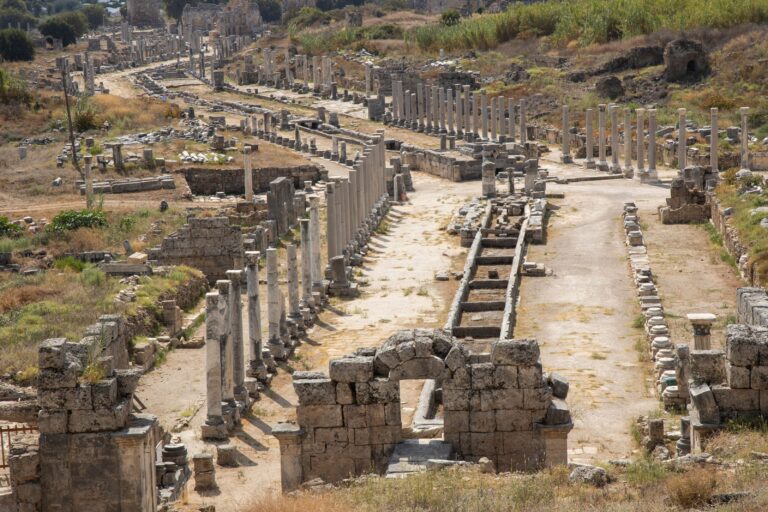
The Embolos is today’s Curetes Street, with the Fountain of Trajan, the Temple of Hadrian and the Library of Celsus at its lower end. When the Acts speak of blood in “the finest parts of the city”, it is easy to picture this marble street full of masked revelers.
At the end of Marble Street you reach the Great Theater. The Salutaris inscription was carved on its wall, and Acts 19 tells how the crowd shouted for Artemis here against Paul’s friends. Greek theater itself was born in the festivals of Dionysus. You can read more in my article on the Great Theater of Ephesus.
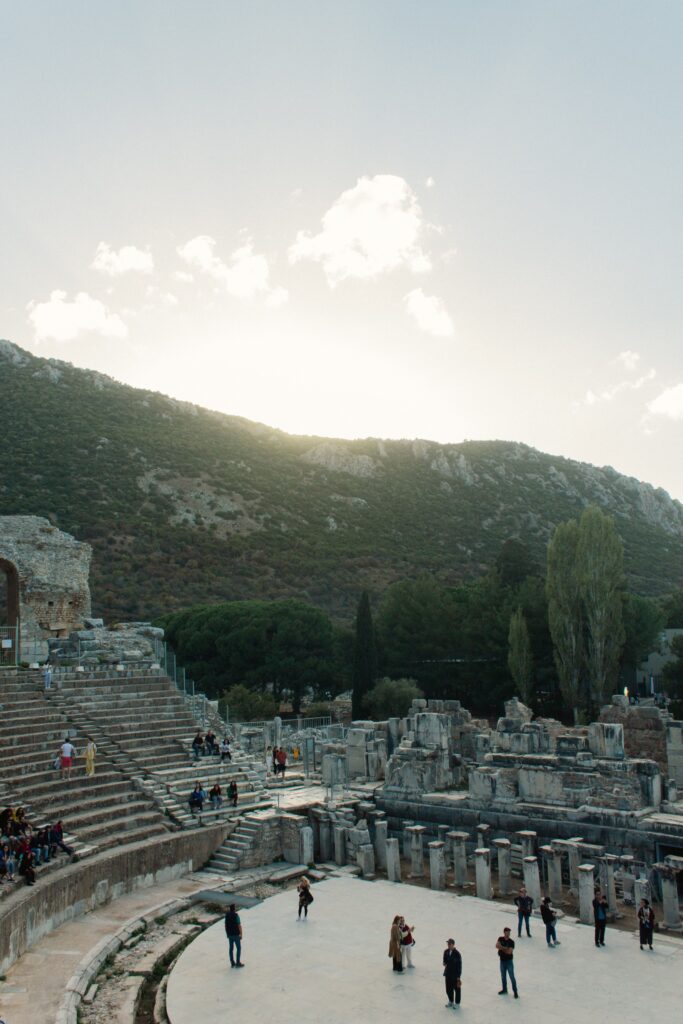
Above the theater rises Panayır Dağı, the hill usually identified with the Pion of the Acts. When I guide my guests down Curetes Street, I like to stop for a moment and tell them about the young man from Lystra and the festival that, according to tradition, ended his life.
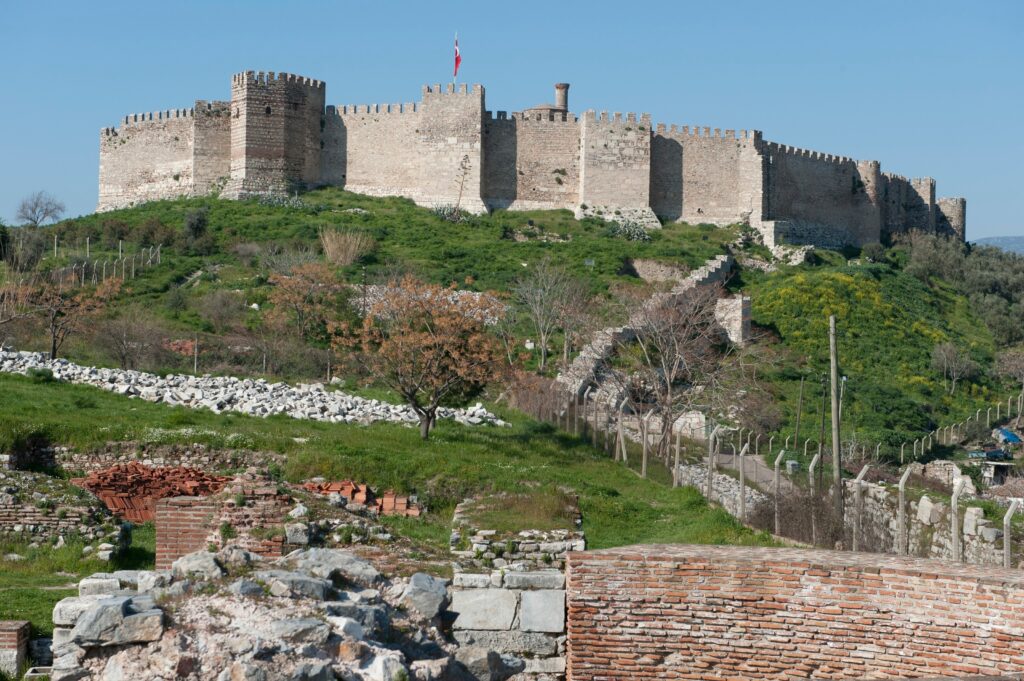
The story continues in Selçuk. The Acts say that John returned from Patmos under Nerva and led the church after Timothy’s death. His tomb lies in the Basilica of Saint John nearby Ephesus, on Ayasuluk Hill. The Ayasuluk Fortress above the basilica is open to visitors too.
You can also find Timothy among the martyrs and important figures of the Seven Churches, where I tell the stories of the other early Christians of this region.
Frequently Asked Questions
Who was the first bishop of Ephesus?
By church tradition, the first bishop of Ephesus was Timothy, the companion of Apostle Paul. Eusebius recorded this in the early 4th century, and the Acts of Timothy say that Paul ordained him under Nero. The New Testament itself only says that Paul asked Timothy to stay in Ephesus (1 Timothy 1:3).
Where is Saint Timothy buried?
The Acts of Timothy say he was buried at Pion in Ephesus, but no grave has been identified there. His relics were moved to Constantinople in 356 AD. Since 1945 relics believed to be his have been known in Termoli Cathedral in Italy, under a slab dated 1239.
When is Saint Timothy’s feast day?
The Orthodox Church celebrates Saint Timothy on 22 January. The Catholic Church, Anglicans and many Lutherans celebrate him together with Titus on 26 January.
What is Saint Timothy the patron saint of?
Saint Timothy is invoked against stomach and intestinal troubles, probably because of Paul’s advice to “use a little wine” for his stomach (1 Timothy 5:23). He is also a patron saint of the Italian city of Termoli.
Hire Biblical Tour Guide in Ephesus
I’m a nationally licensed Turkish tour guide based in Kuşadası, nearby Ephesus. My day guiding is in Ephesus, İzmir and Pamukkale. A day in Ephesus can follow Timothy’s story from the Upper Gate down Curetes Street to the Great Theater, and then to the Basilica of Saint John in Selçuk.
You can see my guiding rates and guiding areas, or write to me through my contact page to ask about my availability.
I hope we will walk down the old Embolos together one day and talk about Timothy, Dionysus and Artemis. You can always write to me with your questions about Saint Timothy and the Katagogia. See you soon, Hasan Gülday.