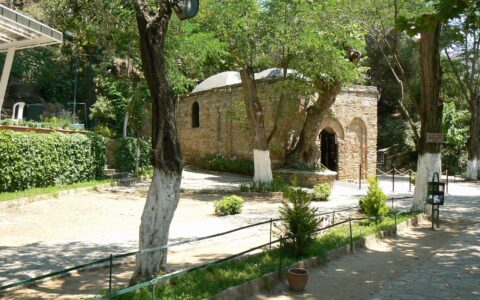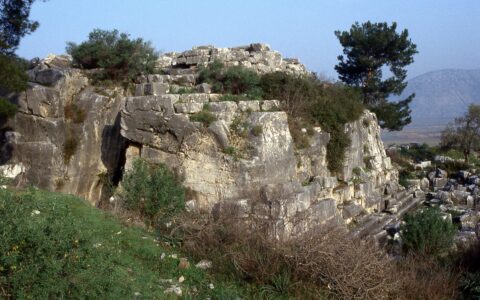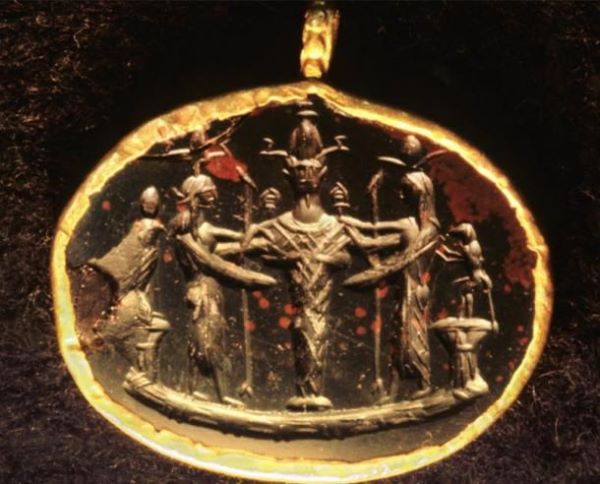
Maximus the Magician from Ephesus was the leading advisor and magician of Emperor Julian (331 – 363). Maximus was born to a wealth family in Ephesus and got his training in philosophy. He was a master on Ephesia Grammata. He had various works such as On Insoluble Contradictions, On Numbers and On Forecasts.
Emperor Julian in Ephesus
Julian, the last Roman emperor who worshipped the old gods, came to Ephesus as a young prince of about twenty to study with Maximus. The year was 351. He had first gone to Pergamon, to the school of Aedesius, and one teacher there, Eusebius of Myndus, warned him against the showy rites of Maximus in Ephesus. The warning worked the other way, Julian packed his books and came to Ephesus at once.
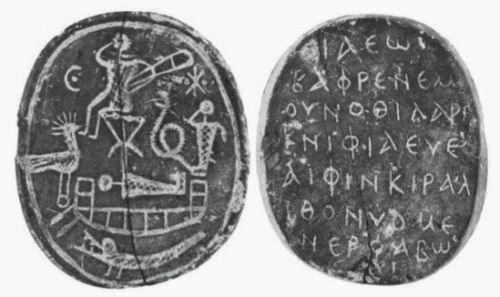
He stayed about one year, from the spring of 351 to the spring of 352. Maximus taught him Neoplatonic philosophy and also theurgy, the rites that were believed to bring the gods close. The Ephesia Grammata on the amulet above belong into the same world. Julian later wrote that he had spent twenty years on the Christian way and twelve on the way of Helios, so Ephesus is where he counted his new life from.
Julian never came back to Ephesus. In 355 his cousin Constantius made him Caesar and sent him to Gaul, and from Gaul he kept writing to Maximus. In one letter, written on his march east in 361, he told his old teacher that he now worshipped the gods openly and that the soldiers with him did the same.
Maximus at the Court of Julian
When Constantius died in November 361 and Julian became the only emperor, he called Maximus to Constantinople. Maximus came, although the omens he read before the journey were bad. People say he answered that a wise man can press the gods for a better sign. Ammianus tells that Julian jumped up in the middle of a Senate meeting and ran to the door to embrace him. His old classmate Priscus came too, and Maximus’ brother Nymphidianus, also from Ephesus, became emperor’s secretary for Greek letters.
For the next two years Maximus was always near the emperor, in Constantinople, in Antioch and on the Persian campaign of 363. When Julian was wounded in Mesopotamia on June 26, 363, he spent his last hours talking about the soul with Maximus and Priscus. Maximus outlived his pupil by nine years and died in 372.
What Julian Did for Ephesus
Julian ruled for about twenty months, so his gifts were laws more than buildings. In 362 he ordered the old temples opened again across the empire and their lands and incomes given back. A city like Ephesus, with the sanctuary of Artemis and dozens of smaller shrines, was exactly the kind of place this law was written for. He also brought men from our coast to his court, Maximus and his brother from Ephesus and the doctor Oribasius from Pergamon.
His religion did not outlast him. The emperors after 363 were Christians, and within a few decades the temples of Ephesus closed for good and the city built its great churches instead. When I stand with my guests in the Church of Mary, where the Council of 431 met, I like to say that the whole story of that change happened inside this one city. By the way, I wrote about the magic side of the city in my post on magic in ancient Ephesus and Asia Minor.
Frequently Asked Questions
Did Emperor Julian study in Ephesus?
Yes. In 351, before he was Caesar, Julian came from Pergamon to Ephesus and studied with Maximus for about a year. Here he learned Neoplatonic philosophy and the rites of theurgy, and here he turned to the old gods.
Who was the teacher of Julian the Apostate?
Julian had several teachers, but the one who marked him most was Maximus of Ephesus. Before him Julian studied with Aedesius and Eusebius of Myndus in Pergamon, and as a boy he had a tutor called Mardonius.
What happened to Maximus of Ephesus after Julian died?
He kept his place for a short time under the next emperor, Jovian, then lost it. He was fined, sent back to Asia and later allowed to teach again. In 372, under Emperor Valens, he was executed in Ephesus.