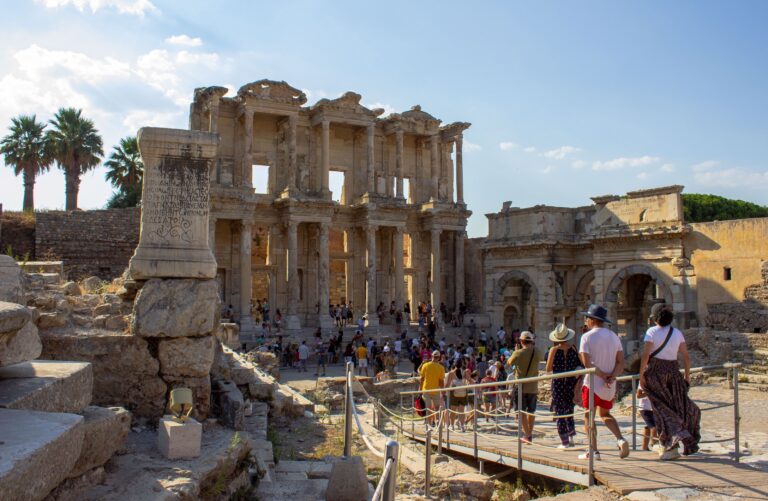
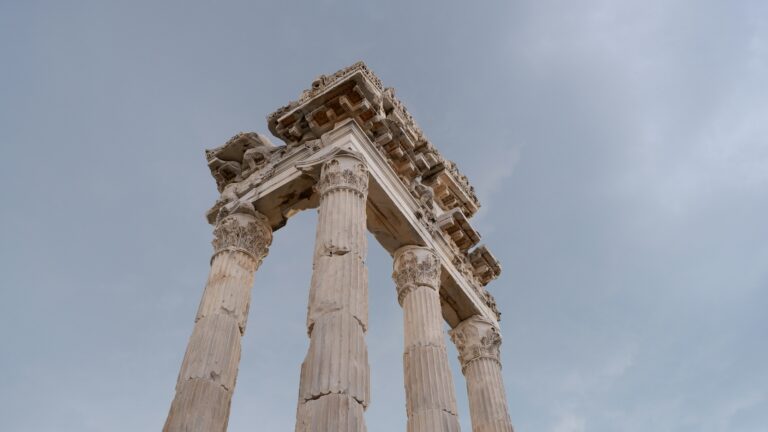
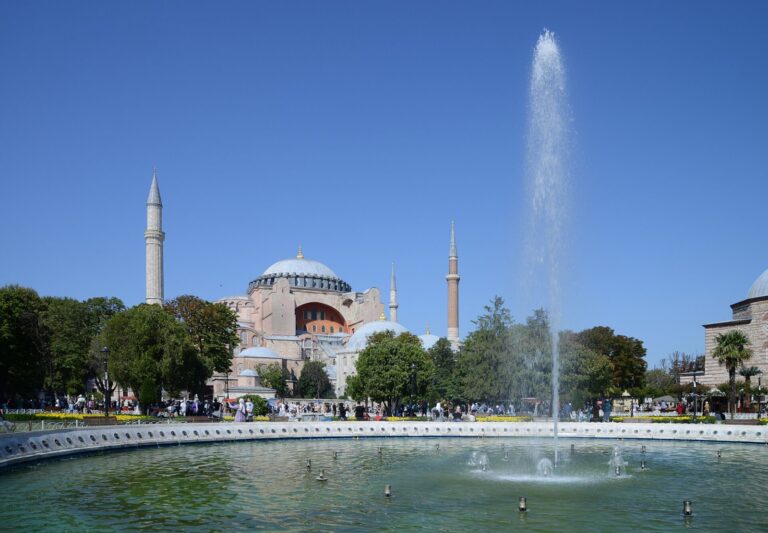
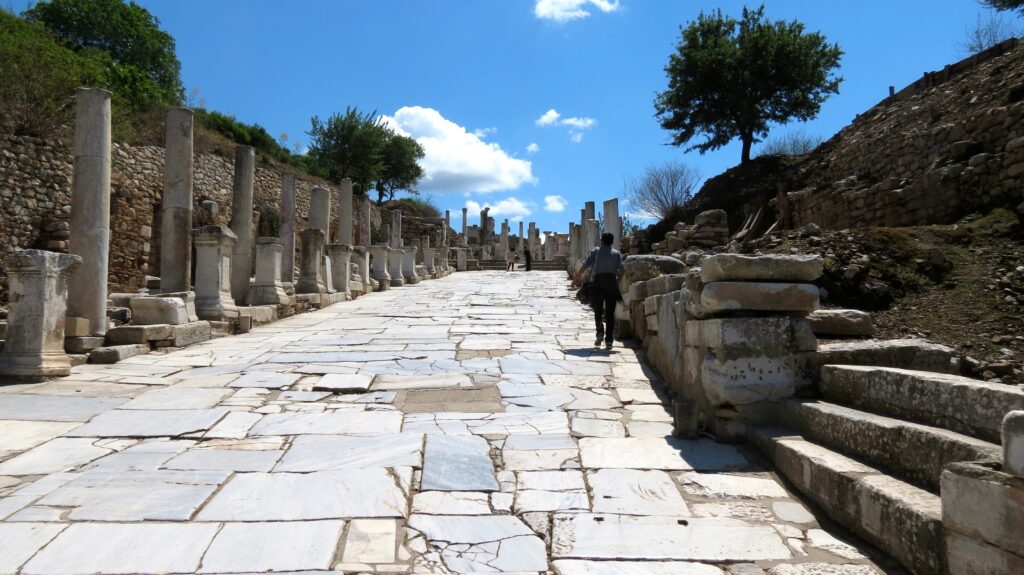
Curetes Street is the main street of ancient Ephesus. It runs about 216 meters from the Hercules Gate down to the Library of Celsus and drops about 20 meters on the way. Its ancient name was probably Embolos, and the modern name comes from the Curetes, a priestly group of Ephesus. Most tours walk it from top to bottom.
Add Tours Around Turkey as a preferred source on Google
Name and History of Curetes Street
The Greek word embolos means wedge, and the street lies like a wedge in the valley between Bülbül Mountain and Panayır Mountain. It does not follow straight grid of the Roman city. It is believed the road is older than the grid, because the procession of Artemis, the main goddess of Ephesus, walked here. I tell about such a procession in my article on Saint Timothy and the Katagogia festival.
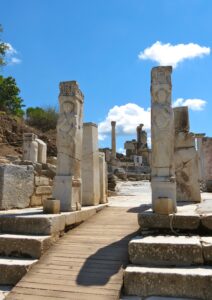
The street starts at the Hercules Gate, named after the reliefs of Hercules on its two pillars. This gate narrowed the street, so wagons could not enter anymore, the street became a walking street. In the beginning it was only a gravel road. It got marble paving at least from the time of Emperor Domitian, at the end of the 1st century AD.
The name Curetes is modern. When the street was dug out, big column drums with long lists of the Curetes were found in a hall on the north side. They had been taken from the Prytaneion, the town hall of Ephesus on the State Agora, the civic square above this street. The Romans added fountains, tombs, gates and statues, so myth, memory and imperial power all stood side by side here.
What You Pass on Curetes Street
Walking down from the Hercules Gate, you pass six main stops, in rough order.
- The Hercules Gate at the top
- The Fountain of Trajan on the north side
- The Temple of Hadrian, also on the north side
- The Terrace Houses and the Stoa of the Alytarch on the south side
- The Hexagon, the Octagon and the Heroon of Androclos on the south side
- The Gate of Hadrian and the Library of Celsus at the bottom
Stoa of the Alytarch on Curetes Street
The Stoa of the Alytarch is a covered hall on the south side of the street, built in the early 5th century AD in front of Terrace Houses 1 and 2. It is 58 meters long, with 19 columns on the street front and twelve small rooms at the back, probably shops. Its mosaic floor is probably the richest on the whole street.

The name comes from an inscription on a stone beam which mentions the work of an alytarch. His name is lost. An alytarch was an official of the games. At Olympia he led the police, and in Ephesus the office grew into helping to run the games.
The hall also shows how the houses on the slope met the street in late antiquity. The stair lane between the two houses could only be entered through the stoa. The Terrace Houses behind it are not wheelchair accessible. My article on the layout of the Terrace Houses shows what is inside.
The Hexagon and the Small Monuments
The Hexagon is a small six-sided monument on the south side of Curetes Street, about 5.6 meters wide, built in the second half of the 1st century BC. Nobody knows who built it or whom it honored. Only its low base is left today.
In late antiquity people built over the Hexagon, and it became a fountain and in the end a workshop with marble basins. The last use dates to the 6th century. Next to it stand the Octagon, a tomb with the remains of a young woman, and the Heroon, believed to be the shrine of Androclos, the founder of Ephesus.
Statues of Governors on Curetes Street
In late antiquity Curetes Street was a gallery of statues of emperors, governors and benefactors. Most statues are gone, but many stone bases with inscriptions are laying around, and some bases were reused from older monuments. Ephesus was hit by earthquakes in the 3rd and 4th centuries, and the street was repaired more than once.
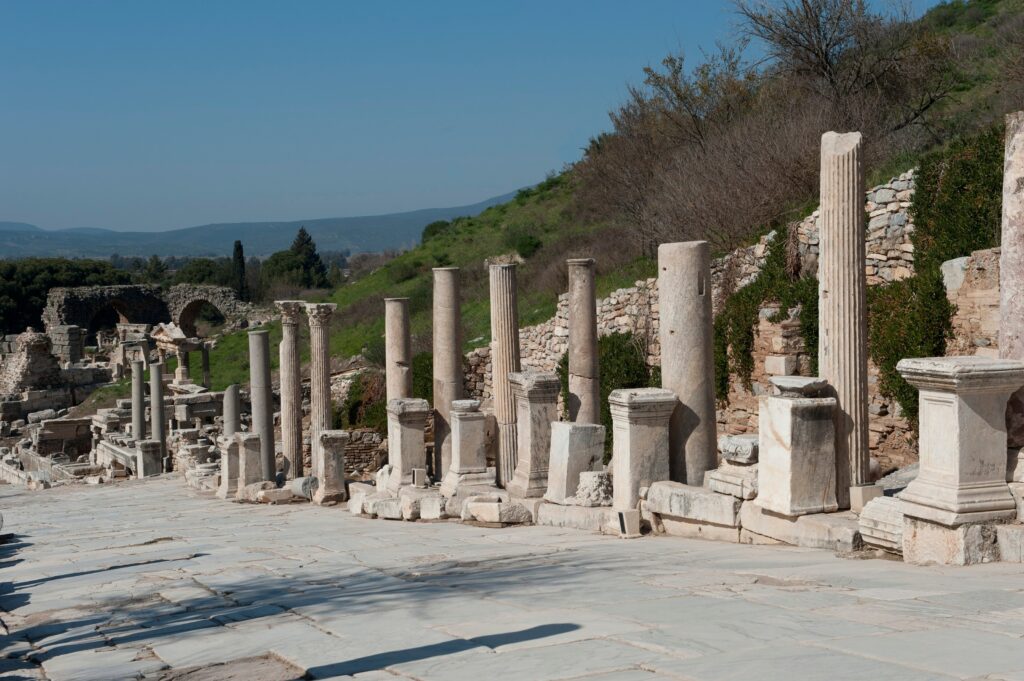
Infront of the Stoa of the Alytarch stood a row of seven pedestals. Three bases are known by name, from around AD 410: Stephanos, Probus and Messalinus. Probus is honored by building a granary, and Messalinus was a proconsul, the governor of the province of Asia. Stephanos is probably the same man who turned the front of the Library of Celsus into a fountain.
A letter of three emperors from AD 371, carved on the Octagon, tells the governor to spend the emperor’s money on repairing the city, as it was meant. Near the Hercules Gate stood an equestrian statue, probably of Emperor Theodosius I, and a row of Victory statues around his wife Aelia Flaccilla.
Eutropios and the Paved Streets of Ephesus

Eutropios was a man of Ephesus who probably served as governor of Asia in the 5th century. His marble head, only about 30 centimeters high, was made around AD 425 to 450. Stone bracket found nearby has an inscription that thanks him for adorning his hometown with streets paved nicely with stone. It begins with a cross, so he was a Christian.
The head was found lying on the Marble Street, which meets the foot of Curetes Street, under the fallen south wall of the theater. Today it is in the Kunsthistorisches Museum in Vienna.
Frequently Asked Questions
How long is Curetes Street in Ephesus?
It is about 216 meters long and drops about 20 meters from the Hercules Gate to the Library of Celsus. The street is steep, and the marble can be slippery when wet, so wear shoes with a good grip.
Why is it called Curetes Street?
It is named after the Curetes, a priestly group of Ephesus whose members are listed on column drums found along the street. The ancient name of the street was probably Embolos.
Is Curetes Street wheelchair accessible?
Not really. The street is steep with uneven paving, and the Terrace Houses are not wheelchair accessible. My article on Ephesus with a wheelchair, walker or limited mobility explains the route that works.
Hire Ephesus Tour Guide
I’m a nationally licensed Turkish tour guide based in Kuşadası, nearby Ephesus. My day guiding is in Ephesus, İzmir and Pamukkale. Most of my Ephesus walks start at the Upper Gate, so we walk down Curetes Street at an easy pace.
You can see my guiding rates and guiding areas, or write to me through my contact page to ask about my availability.
I hope we will walk down Curetes Street together one day. You can always write to me with your questions about Ephesus. See you soon, Hasan Gülday.