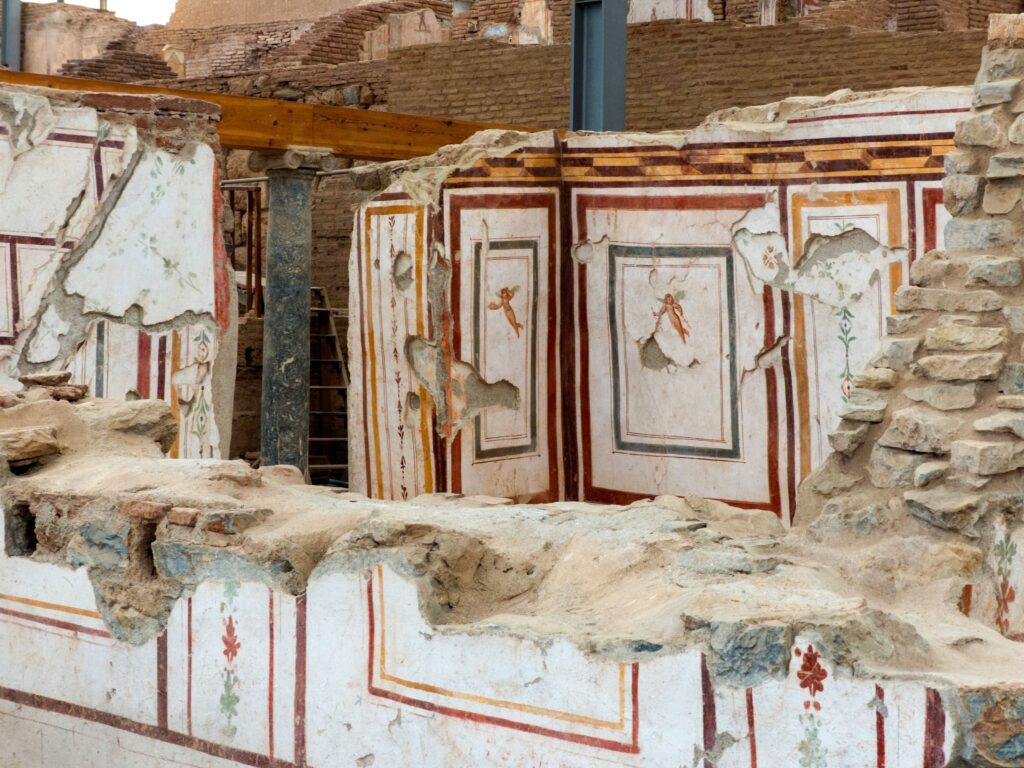
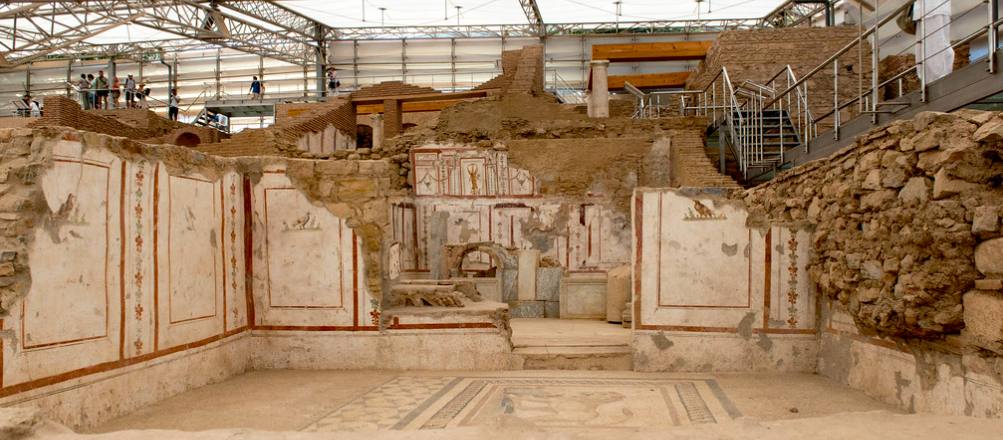
Who lived in the Terrace Houses of Ephesus? Rich families did: city officials, priests and Roman knights. The best known owner is Gaius Flavius Furius Aptus, a priest of Dionysus who lived in residential unit 6 in the second century AD. His house had marble halls, family shrines, running water and walls painted with costly red.
Ephesus hosts a big variety of buildings but the Terrace Houses are the place where you see how the rich lived at home. I explained the rooms in my article on the layout of the Ephesus Terrace Houses. This time let’s have a look at the people, and at the things they cared about.
Who Owned the Terrace Houses?
Rich Ephesian families owned them, the kind that held city offices and gave gifts to the city. The two blocks, Terrace House 1 and Terrace House 2, stand on slope beside Curetes Street, a short walk from the library, the theater and the agora. Residential unit 2 is thought to be the town house of Gaius Vibius Salutaris, a Roman knight famous for his gift of statues in AD 104, which I tell in my article on the Great Theater.
The owners did not live alone. Slaves, guests and clients came and went, and children grew up there: somebody practiced the alphabet low on the plaster, and birth announcements were scratched into the walls. Along the street outside, shopkeepers lived in small shops with a sleeping loft.
The House of Furius Aptus
Residential unit 6 was a city palace of about 950 square meters, with its own entrance from Curetes Street. Its owner, Gaius Flavius Furius Aptus, was a city official and a priest of Dionysus. He enlarged the house around AD 120 and again around AD 150, and his son became a Roman senator.
The big halls had walls covered with marble. Green-striped slabs from Euboea in Greece were hung on the walls, and they were cut one after another from the same block, so the patterns match like pages of an open book. Marble from Dokimeion in Phrygia, known for its purple veins, came in blocks too, and one plaque still has a Latin delivery address on its back. Restorers later made a great job and put the broken slabs together again.
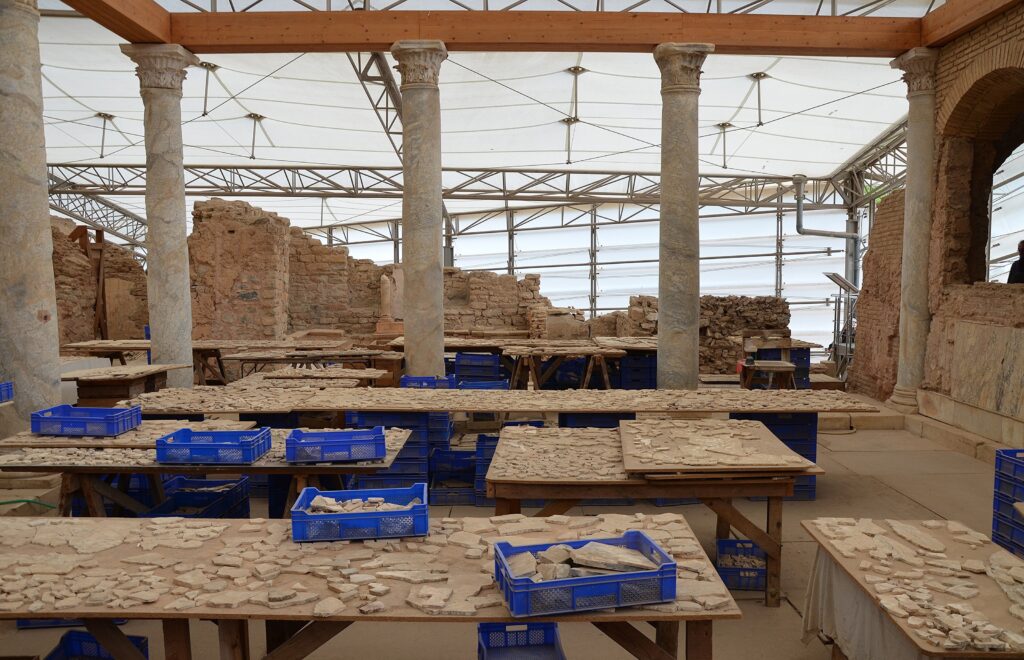
Dionysus is everywhere in this house, in statues, mosaics and wall paintings. A statue base in the big courtyard names Aptus as his priest, and the halls were probably used for the banquets of a Dionysus club. A clay jug from the house is scratched with a line that I like very much:
I read it as a small protest from somebody in the household. Not everybody in a rich house was happy to be there.
Household Shrines in the Terrace Houses
Families worshipped at home, in niches, small rooms and courtyards. Rings found in the houses show Aphrodite, Athena, Apollo and Isis, probably the gods of their owners. In unit 4 a small room was kept only for the household cult, with two reliefs of a funeral banquet and a painted snake.
The family remembered its dead as well. In unit 6, a small portrait of a woman stood near a niche with a lamp, a jar and an incense burner of Sarapis, so the family probably burned incense and poured wine for her. In unit 7, an altar and an offering table faced to a niche with busts of Emperor Tiberius and his mother Livia.
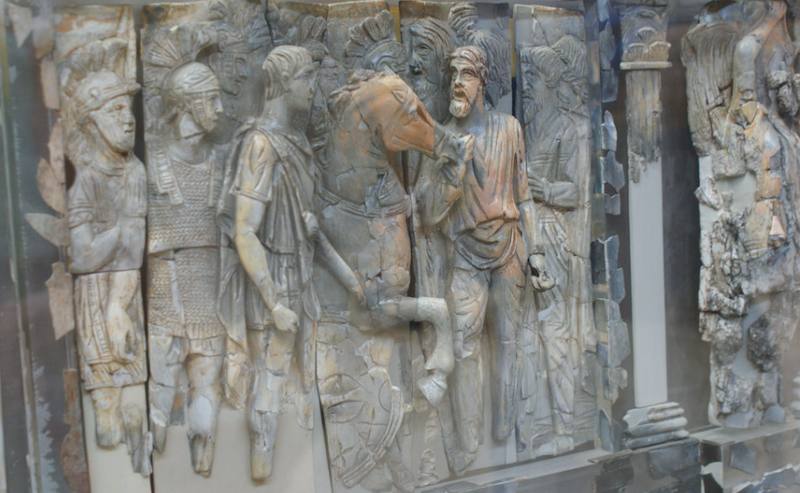
Unit 2 had a small room with an ivory frieze of Emperor Trajan, portrait statues and reliefs, a place that kept the memory of the family’s own history alive.
Water in the Terrace Houses
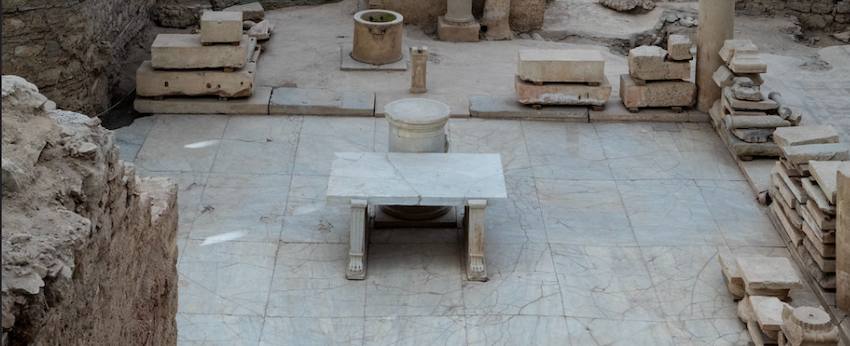
Running water was a luxury, the Terrace Houses had plenty of it. Clay pipes ran inside the walls and under the floors, fed by the city aqueducts that I describe in my article on the aqueducts of Ephesus. There were fountains in the courtyards, in the private baths and even in the dining rooms, and rainwater ran into the main sewer under Curetes Street. Unit 6 had its own heated bath, and the private latrines had several seats.
Red Paint and Window Glass
Some of the red on the walls is cinnabar, one of the rarest and most expensive pigments of the Roman world. Roman writers name the Cilbian fields near Ephesus and the mines of Almadén in Spain as important sources, and the red mineral was heated before use. The cinnabar in the Terrace Houses seems to have been prepared the same way, and some of it probably came from western Turkey or the Balkans.
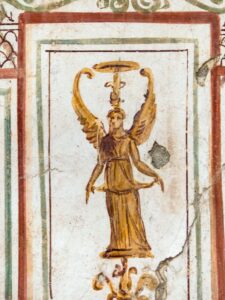
Painters did not always use it the same way. In one room the wall has a thick layer of pure cinnabar, in another it is mixed with cheaper red ochre. So a wall with cinnabar was a clear sign of money.
Windows also had glass too. In unit 7 the wooden window frames were found burned, and small pieces of thin glass, pale green, colorless or light blue, still lay on the sill. Roman panes were cut from blown glass cylinders, so they were not perfectly clear, and they gave a soft, scattered daylight. The raw glass came from the Near East in chunks, and workshops in the empire cut it into panes.
Frequently Asked Questions
Who owned the Terrace Houses in Ephesus?
Rich Ephesian families owned them: city officials, priests and Roman knights. In Terrace House 2 we know two owners, Gaius Vibius Salutaris, probably in unit 2, and Gaius Flavius Furius Aptus in unit 6.
How old are the Terrace Houses in Ephesus?
Terrace House 2 was built in the early first century AD, in the time of Emperors Augustus and Tiberius, and it was rebuilt several times. A strong earthquake in the late third century destroyed it.
Are the Terrace Houses in Ephesus worth visiting?
Yes, I think so, if you enjoy seeing how rich Ephesians lived, with painted walls, mosaics and marble. They have their own ticket and a walkway with many steps, so they are not wheelchair accessible, as I explain in my article on Ephesus with a wheelchair.
Hire Ephesus Tour Guide
I’m a nationally licensed Turkish tour guide based in Kuşadası, nearby Ephesus. My day guiding is in Ephesus, İzmir and Pamukkale, and if you wish I walk into the Terrace Houses with my guests and tell the stories of Aptus and his family while we look at their rooms.
You can see my guiding rates and guiding areas, or write to me through my contact page to ask about my availability.
I hope we will walk down Curetes Street together. You can always write to me with your questions about the Terrace Houses and the daily life of Ephesus. See you soon, Hasan Gülday.