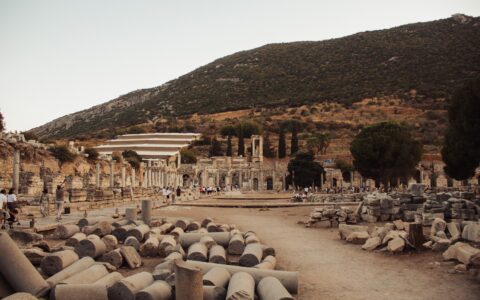
Apelles of Ephesus is the painter of Alexander the Great. In the 4th century BC he became the court painter of Philip II and then of Alexander, and the old stories rank him above all other painters. Not one of his paintings has survived, but the stories about him are still told.

Apelles was one of the most famous painters of his time. He was born in the city of Colophon in the fourth century BC. Colophon city was a neighboring town of Ephesus which could be considered capital of the art in its time.

Apelles left his hometown and moved in to Ephesus. He spent his youth in Ephesus being taught by the famous Ephorus of Ephesus. After creating masterpieces like ”The procession of the high priest of Artemis at Ephesus”, he attracted the attention of Philip II who was the father of Alexander the Great. He went on his studies and creations in Macedonia.
What Did Apelles Paint for Alexander the Great?
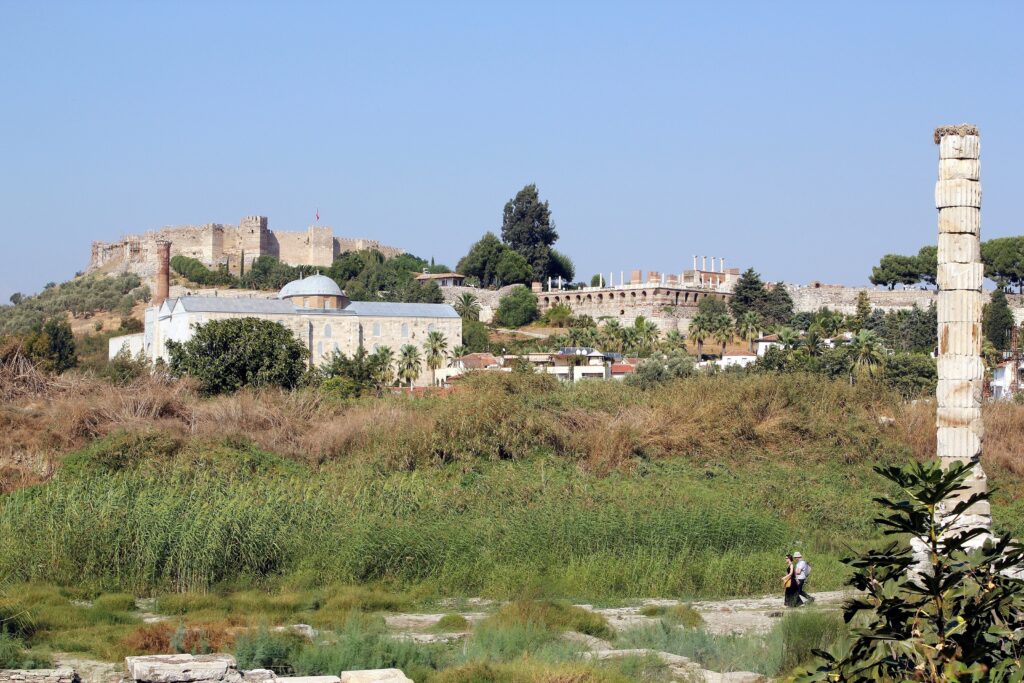
Apelles painted many portraits of Alexander the Great, and the most famous one showed the king holding a thunderbolt like Zeus. It was made for the Temple of Artemis in Ephesus, the temple that Dinocrates helped to rebuild in those years.
The old story says Alexander paid twenty talents of gold for it, a huge sum. People also said the thunderbolt looked as if it came out of the picture. When I stand at the last column of the temple with my guests, I tell them that this famous painting once hung somewhere around here.
Which Stories Are Told About Apelles?
The best known stories about Apelles are about a daily line, a cobbler and a contest of lines, and people still tell them until today. They say he never let a day pass without drawing at least one line, because a painter must practice every day.
Another story is about a cobbler. Apelles put his finished pictures in front of his shop and hid nearby to hear what people said. Cobbler saw a mistake in the sandal, and Apelles fixed it that night.
Next morning the cobbler was proud, and he started to criticize the leg too. Then Apelles came out and said that a cobbler should not judge above the sandal. This is the old source of our saying that a cobbler should stick to his last.
Apelles also visited the painter Protogenes on the island of Rhodes, but he was not at home. So Apelles drew one very fine line on a panel and left. Protogenes came back and drew a finer line over it. Then Apelles returned and drew a third, even thinner line between the two. Protogenes accepted that he was beaten.
It is also told that Alexander gave Campaspe, a woman he loved, to Apelles when he saw that the painter had fallen in love with her.
Why Are the Paintings of Apelles Lost?
The paintings of Apelles are lost because ancient painters worked on wooden panels and walls, and these do not last. Wood rots, a fire can burn a whole building in one night, and old pictures were moved and damaged. Today we know his art only from stories and from later copies.
His most famous work, Aphrodite rising from the sea, stayed on the island of Kos for about three hundred years. Then Emperor Augustus took it to Rome. By the time of Emperor Nero it was so damaged that a copy was put in its place. Parrhasius of Ephesus, another painter from this area, lost his paintings in the same way.
Frequently Asked Questions
Was Apelles from Ephesus, Colophon or Kos?
Old stories give him different hometowns, Colophon, Kos and Ephesus. He trained in Ephesus, so he is often called Apelles of Ephesus, and many books call him Apelles of Kos.
What does nulla dies sine linea mean?
It is Latin for “no day without a line”. The saying is linked to Apelles, who drew every day to keep his hand sure. Today people use it for any daily practice, from drawing to writing.
Why did Apelles paint Alexander with a thunderbolt?
The thunderbolt belongs to Zeus, so the picture showed Alexander like a god among men. It was a flattering image, since Alexander liked to be seen as a son of Zeus, and it was placed in the Temple of Artemis in Ephesus.