Hermione of Ephesus was not born in ancient Ephesus city. We know this since she was known to arrive to Asia Minor then to Ephesus looking for Saint John the Evangelist. She was probably from middle eastern origin.
Add Tours Around Turkey as a preferred source on Google
Hermione learned that Saint John was already passed away after arriving to Ephesus. She eventually became a disciple of Petronius who was a companion of Apostle Paul.

She started to live in Ephesus and performed several miracles on healing. Emperor Trajan stopped at Ephesus during his campaign against the Parthian Empire which resulted with the annexation of The Roman province of Mesopotamia and Roman Armenia. Emperor Trajan called Hermione of Ephesus and wanted her to deny Christianity. She refused to do so even after severe torturing.
Hermione built a hospice in Ephesus after Emperor Trajan left and went on healing people. When Emperor Hadrian of the Roman Empire heard of her talents, he called her to assist the Empire in the war. She refused his offer and wanted to convert into Christianity. This action of her resulted with the martyrdom of Hermione on the year 117.
Hermione, One of the Daughters of Philip
Tradition remembers Hermione of Ephesus as one of the four daughters of Philip, the deacon of Acts 6 who later lived in Caesarea. The Book of Acts says that Philip “had four daughters, virgins, which did prophesy” (Acts 21:9), and Paul stayed in their house on his last journey to Jerusalem. The Bible gives no names for the four, the later church gave them, and Hermione is the best known of the sisters. This also explains why she came to Ephesus looking for Saint John: she grew up among the first Christians.
Philip himself is honored at Hierapolis, nearby Pamukkale, where I show my guests the ruins of his Martyrium. Around the year 190, Polycrates, the bishop of Ephesus, wrote to Rome that Philip rests in Hierapolis with two of his daughters, and that another daughter of his “rests in Ephesus.” That daughter is taken to be Hermione. It is the oldest sign we have of her tomb in our city, and I wrote more about her father in my article on the Martyrium of Saint Philip.
Feast Day of Saint Hermione and Her Tomb in Ephesus
| Feast day | September 4 |
|---|---|
| Honored as | Martyr and healer, by tradition a daughter of Philip the deacon |
| Lived | Caesarea, then Ephesus, 1st and early 2nd century |
| Died | 117, by tradition |
| Tomb | Ephesus, by tradition; nothing has been found |
The feast day of Saint Hermione of Ephesus is September 4. The Orthodox Church keeps her memory on that day, together with the prophet Moses and Babylas, the bishop of Antioch, and the Catholic calendar gives her the same date. She is honored as martyr and as a healer, and her hospice makes her one of the earliest Christian doctors we know by name.
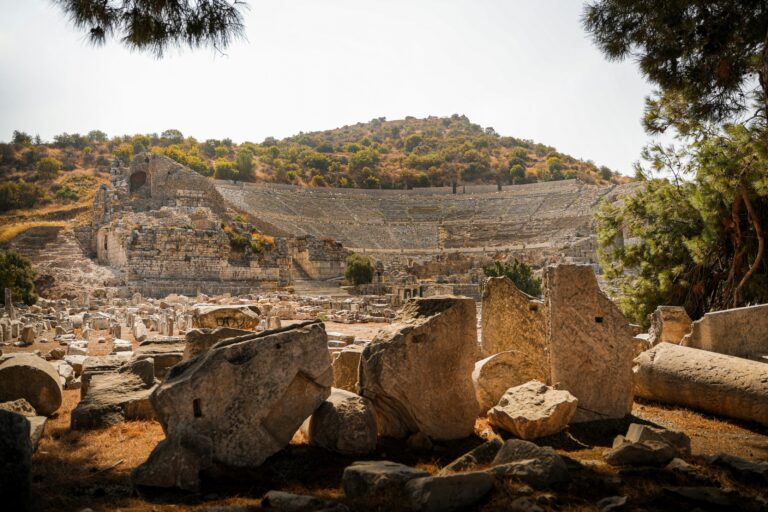
Her tomb is a question of tradition, not of archaeology. Ephesus keeps the old memory that she was buried here, and a later tradition puts her grave on the eastern slope of Pion, the hill we call Panayır Dağı today, above the Great Theater. Some say Saint Timothy and other early Christians of Ephesus were buried on the same slope. Nothing was found there till today, so we have only the tradition. I wrote about Timothy’s tomb in my article on how Timothy died.
When I walk with my guests from the theater down the Harbor Street, I like to point up at that hill and tell the story of this brave woman doctor. I hope you will hear it from me one day in Ephesus.
Frequently Asked Questions
When is the feast day of Saint Hermione of Ephesus?
September 4. The Orthodox Church and the Catholic calendar both remember her on that day as a martyr and a healer of Ephesus who died around the year 117, in the time of Emperor Hadrian.
Was Hermione of Ephesus the daughter of Philip?
By tradition, yes. She is counted as one of the four daughters of Philip the deacon, the virgins who prophesied in Caesarea (Acts 21:8-9). The Bible does not give their names, so the name Hermione comes from later church tradition.