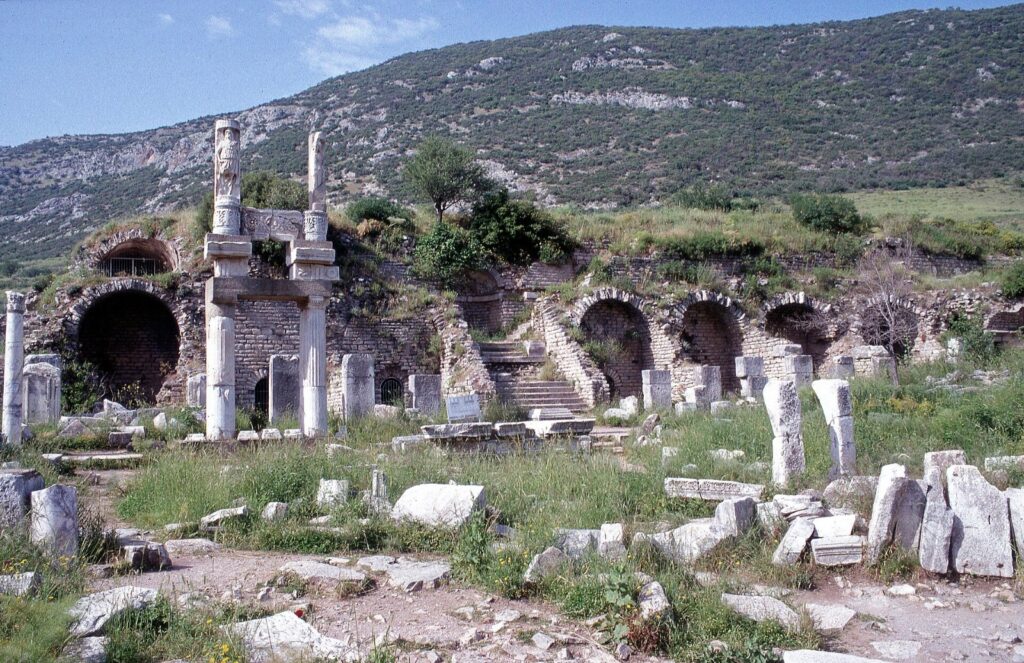
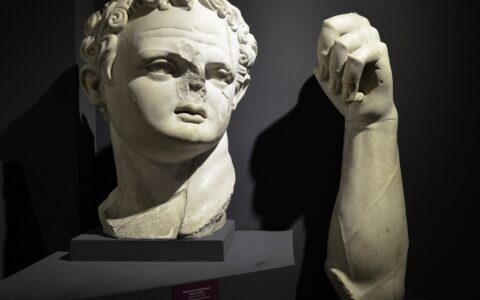
The Temple of Domitian in Ephesus, known from an ancient inscription as the Temple of the Sebastoi, was the temple of the Roman emperors of the Flavian family. It was dedicated in AD 89/90 on a high terrace built over vaults, and it made Ephesus neokoros, the official temple warden of the emperors. The colossal head of its statue is in the Ephesus Museum in Selçuk.
Ephesus Ancient City hosts a big variety of temples, but one of them hides in plain sight. As you walk through the upper part of the city, you come to a wide open square with a huge raised terrace above it, built on rows of vaulted arches. Most of visitors take a photo of the arches and move on, because nobody told them what stood up there.
It was one of the proudest monuments of the city. This temple gave Ephesus a title which it advertised all over the Roman world: neokoros, the temple warden of the emperors. It is a story of a giant statue, of flattery to Rome and of a murdered emperor whose name was chiseled off the stones.
In this article, I would like to explain in detail the architectural features of the Temple of Domitian, its religious significance, the life of Emperor Domitian. Also, I want to explore the possible effects of the temple of Domitian on Christianity. Let’s take a closer look at Domitian Temple Of Ephesus.
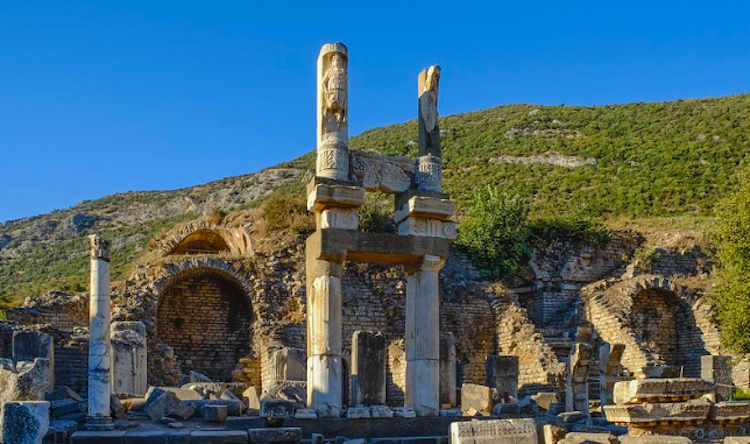
Location of the Temple of Domitian in Ephesus
The terrace of the Temple of Domitian in Ephesus rises over Domitian Square, in the upper city nearby the State Agora. Just below it, Curetes Street begins at the Hercules Gate and runs down the hill to the Library of Celsus.
Most tours of Ephesus start at the Upper Gate, also called the Magnesian Gate, and walk down to the Lower Gate. This makes the temple terrace one of the first big stops of the day. I explain the two entrances in my article on Ephesus Upper Gate or Lower Gate.
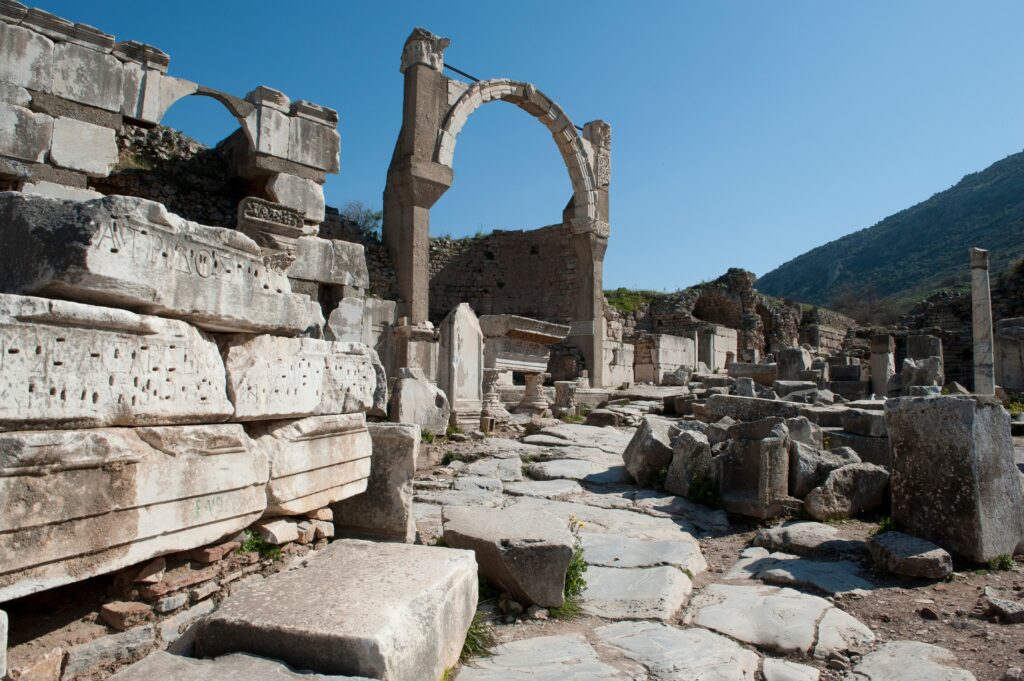
Architectural and Archaeological Interpretation of the Temple of Domitian
The Temple of Domitian stands out both for its archaeological features and for reflecting the religious and political dynamics of the Roman Empire on the first century. It is one of the few buildings in Ephesus dedicated to the cult of emperors, who were generally deified during the Roman period of Asia Minor. The other buildings dedicated to Roman emperors in Ephesus are the Temple of Hadrian and the Fountain of Trajan.
The Temple of Domitian was built between 81 and 96 AD. The first excavations of the temple were carried out in the early 20th century, mainly by the Austrian Archaeological Institute. These excavations uncovered the foundations of the temple, fragments of columns, sculptural remains and decorative elements.
The ongoing excavation and restoration work has led to a wider understanding of the temple. The original dimensions of the temple are approximately 50 × 100 meters. The basic plan of the building consists of a room with a columned entrance hall in front and a statue of the god inside.
The temple stood on a massive artificial terrace. Its vaulted substructure lifted the sacred area high above the square, so that people could see it and admire it from far away. It was political architecture as much as religious architecture, with purpose of binding Ephesus to Rome and showing everybody where the loyalty of the city lay.
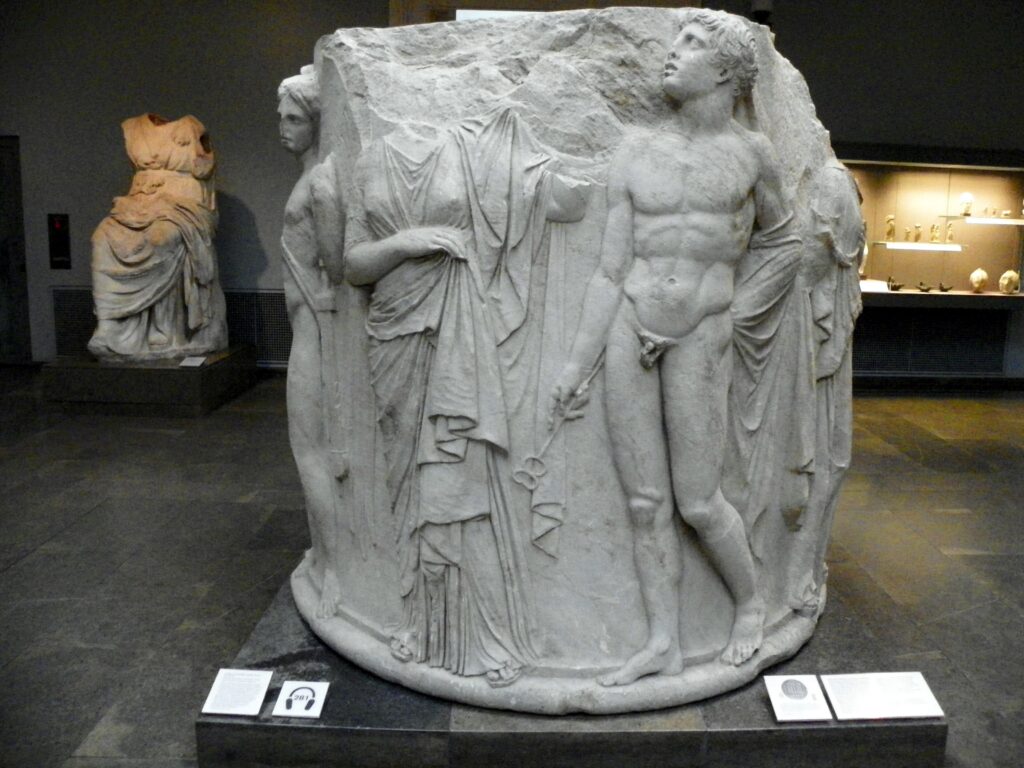
What you see today is mostly this terrace: the brick and stone vaults and, in front of them, two tall pillars with carved figures standing on the square.
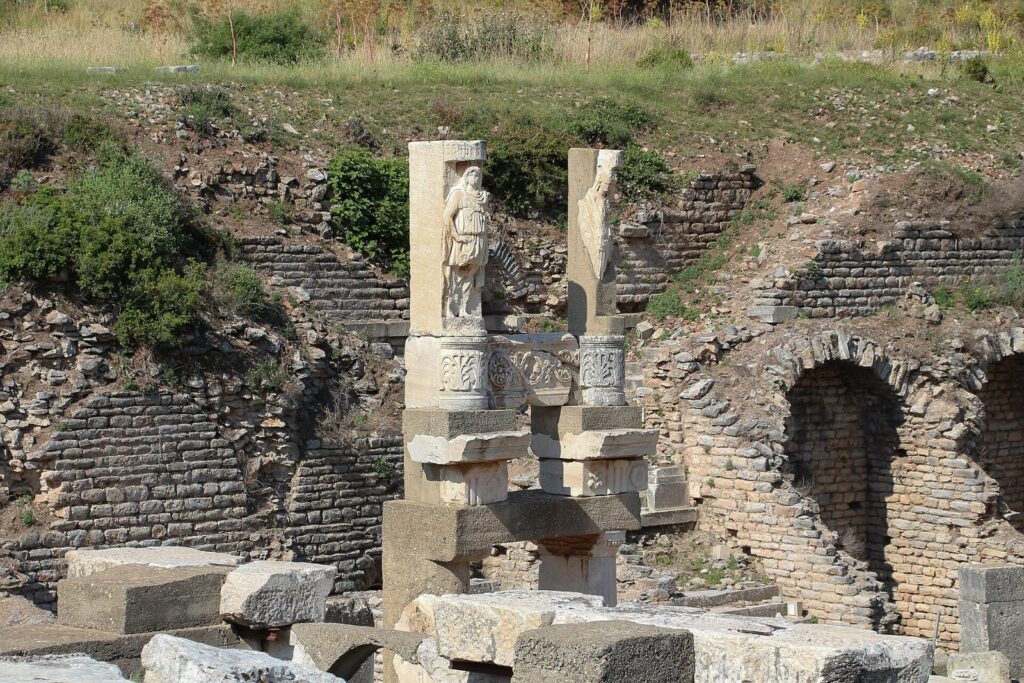
Fragments of a colossal statue dedicated to Domitian were also found in the temple area, and today the head of the statue is on display at the Ephesus Archaeological Museum. Since the remains of the Domitian temple of Ephesus are limited, it is difficult to determine its original architectural features.
The Temple of Domitian and the Cult of the Emperor
The temple was built to recognize Domitian as divine and to worship him. Emperor Domitian aimed to gain a divine identity by deifying himself. In the Roman Empire, giving emperors the status of gods was a means of strengthening the obedience and loyalty of both the people and the elite class to the emperor.
During the Roman period, emperors often received divine titles and various gods were worshiped in temples dedicated to them. Domitian identified himself with Jupiter, and therefore it is likely that the temple was dedicated to Jupiter. However, the temple may also have been used to worship the Roman state gods, Rome and Augustus.
An inscription found next to the temple gives its ancient name: the Temple of the Sebastoi. Sebastos is the Greek word for the Roman title Augustus, so the Sebastoi are the revered ones, the emperors of Domitian’s family. Today many scholars use this name for the building.
The temple was dedicated in AD 89/90, under Domitian. It was not only a project of Ephesus. Cities of the province of Asia set up inscribed stones to honor its opening, and thirteen of these dedications are known today. One of them came from Aphrodisias.
What Does Neokoros Mean
Neokoros is a Greek word. It probably comes from neos, temple, and a verb meaning to sweep, so a neokoros was first the keeper of a temple, a kind of sacristan. In the Roman period, the word became a title for whole cities.
A city became neokoros when the Roman Senate, with the emperor’s consent, recognized its temple of the emperors as a temple for the whole province. This was a great honor, and the rich cities of Asia competed hard for it. Thanks to the Temple of Domitian, Ephesus became the first city with this title for an imperial temple.
Ephesus did not always win this race. In AD 26, it lost a contest for a temple of Emperor Tiberius. The Roman historian Tacitus writes that the senators passed it over because the city was already entirely given to the worship of Artemis (Annals 4.55). Smyrna won, and Pergamon already had its temple of Augustus.
This does not mean that Artemis and the emperors were rivals. Long before the Temple of Domitian in Ephesus, the emperors were worshipped inside her sanctuary too. In 5 BC Emperor Augustus had a wall built around the Temple of Artemis and around the Augusteum, a shrine for the emperor in the same sacred area, and he paid for it from the income of the goddess herself.
The inscription of this work, in Latin and Greek, was found built into the sanctuary wall in 1869, and today it is in the British Museum. So the pilgrims who came to pray to Artemis also walked past the emperor. The goddess and Rome stood side by side, nobody had to choose.
Rivalry of Ephesus, Pergamon and Smyrna
Ephesus, Pergamon and Smyrna, the three leading cities of the Roman province of Asia, competed for about two centuries for the title “first of Asia”, the first place among the cities of the province. Ephesus proudly called itself “the first and greatest metropolis of Asia”.
Titles were a serious matter, and every city watched the titles of the others very carefully. Around AD 145 Emperor Antoninus Pius had to write to Ephesus about it. He had asked the people of Pergamon to use the titles he gave to Ephesus, and he believed that Smyrna left them out of a decree about a common sacrifice only by mistake.
The Ephesians carved his letter in stone. Coins with the word homonoia, concord, of the three cities show that people tried to make peace, but in the early 3rd century Ephesus won one more point. Emperor Caracalla ruled that new governor of Asia must come by sea and set foot first in Ephesus, before the other big cities. Ephesus celebrated this on its coins too.
Neokoros Title on the Coins of Ephesus
Second title came under Emperor Hadrian, for another temple of the emperor, and Ephesus became twice neokoros. More titles followed in the 3rd century. In the end the city called itself four times neokoros, a record that no other city reached.
The Ephesians were very proud of this, and they put it everywhere, especially on their coins. In a world without newspapers, coins told to the empire who a city was. One bronze coin of Ephesus even says that the Ephesians were the only ones of all to be four times neokoros.
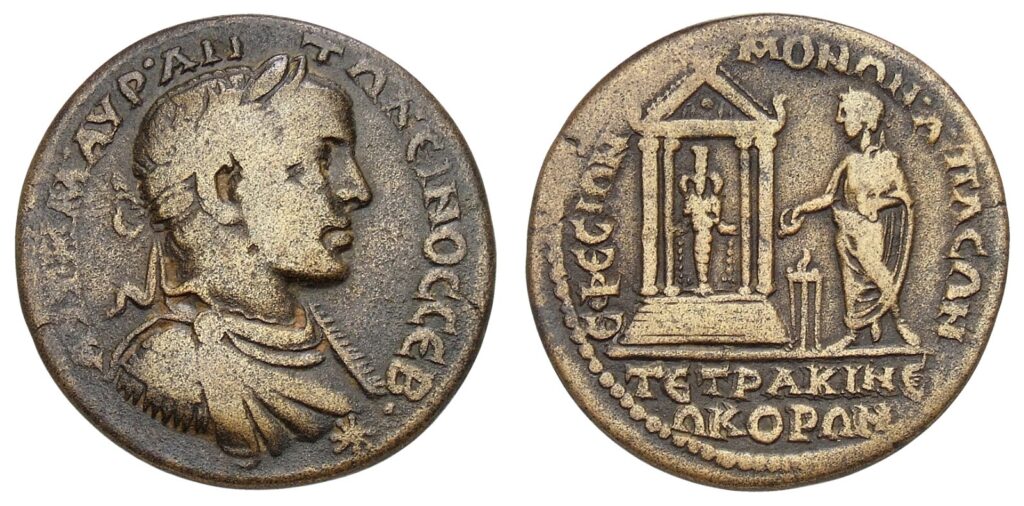
I wrote more about the money of the city in my article on the chronological order of the Ephesian coins.
Colossal Statue from the Temple of Domitian
A colossal statue of the emperor was set up for this cult, a marble figure on a superhuman scale. Only pieces of it survive, but they are enough to take your breath away: the enormous head and a forearm with a clenched hand.
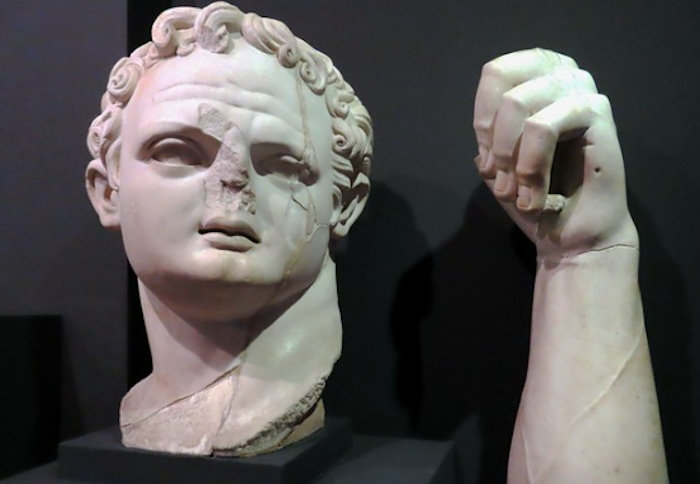
Both pieces are displayed in the Ephesus Archeological Museum in Selçuk, in the hall of the emperor cults. Standing next to that vast head, you understand what kind of impression these emperors wished to make on their subjects.
I always recommend my guests to pair the ruins with the museum. Selçuk is a short drive from the site, and the carved pieces there bring the empty terrace back to life. Once you have seen the head, the temple on its arches is not a pile of stones anymore. It is the home of a giant.
About Emperor Domitian
Domitian was the last emperor of the Flavius Dynasty. Emperor Domitian ruled the Roman Empire between 81-96 AD. He is known for his harsh style of rule and strict authoritarian practices. One of Domitian’s most remarkable characteristics is that he wanted to establish himself as a god. Domitian’s attribution of a divine status to himself led to his lifelong damnation (damnatio memoriae) by the Roman Senate, and his name and statues were destroyed in many places.

Domitian made many reforms in the Roman Empire, achieved military successes and accomplished great architectural projects. However, he was known as an unpopular emperor due to his harsh rule and conflicts with the senate. In 96, he was murdered in his palace.
What Happened to the Temple After Domitian Was Murdered
Now comes the twist that I always enjoy telling. After the murder, Rome did its best to erase Domitian, and his statues and inscriptions came down. This left Ephesus with an awkward problem, it had a magnificent new temple and a proud title tied to an emperor whom Rome now wanted to forget.
The solution was very practical. On the dedication stones of the cities of Asia, stonecutters chiseled away the name of Domitian and recut the words, so that the stones honored his deified father Vespasian, the founder of the dynasty. The temple went on as a temple of the Flavian family, and Ephesus also kept its title too.
The building survived by changing whose name it carried. I think it is a perfect lesson in how Rome rewrote its own history when it suited. The new emperor was Nerva, and you can read about him in my article on Nerva and the Christians after Domitian.
The Temple of Domitian and Christianity in Ancient Ephesus
The Domitian period was a challenging period for Christianity*. The gradual spread of Christian communities, especially in Asia Minor, made Domitian uneasy. Domitian saw Christians as a potential threat and forced them to adhere to the cult of the emperor. These pressures under Domitian strengthened the religious commitment of the Christian community in Ephesus and made them more resilient.
Even the Bible uses the word neokoros. When the silversmiths’ riot fills the Great Theater of Ephesus, the town clerk quiets the crowd and reminds them that their city is the “temple keeper of the great goddess Artemis” (Acts 19:35, WEB). So when Apostle Paul was in Ephesus, the city was already proud to be the keeper of its goddess. One generation later, it added the emperors.
Christian tradition places the exile of Saint John on the island of Patmos (Revelation 1:9) in the last years of Domitian, when this temple was still new. I tell his story in my article on Saint John the Evangelist, and the wider story of the city in What Happened in Ephesus in the Bible.
Temple of Domitian and the Temple of Hadrian
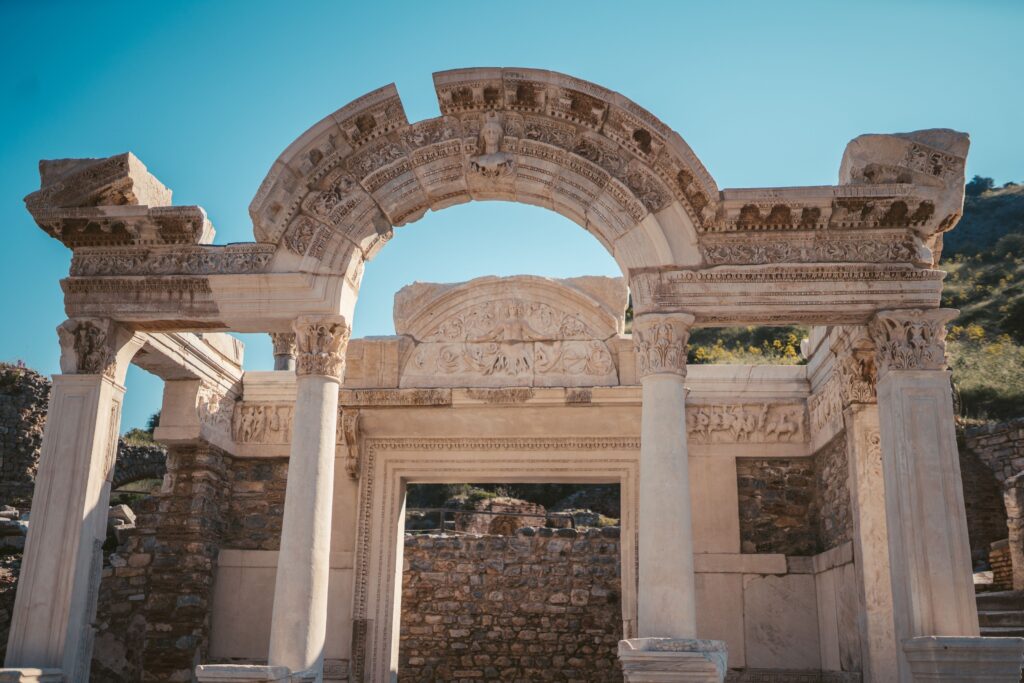
Visitors mix these two temples up all the time, so one quick clarification. The great imperial temple on its terrace is not the small and pretty Temple of Hadrian further down Curetes Street, the one with the famous carved arch. They are two different buildings.
The Temple of Hadrian is a jewel box which you admire up close. Its inscription says that a wealthy benefactor built it around AD 117 or 118, for Artemis, for Hadrian and for the Ephesian people. The Temple of Domitian was a giant statement of imperial power on a raised platform. You can read more in my Temple of Hadrian guide.
Frequently Asked Questions
Is the Temple of Domitian the same as the Temple of the Sebastoi?
Yes. Both names are used for the same imperial temple, which stood on a terrace raised on vaults in the upper part of Ephesus. Temple of the Sebastoi is the ancient name, known from an inscription, and it means the temple of the revered ones, the emperors of the Flavian family. It was dedicated in AD 89/90.
Why was Ephesus called neokoros?
Neokoros means temple warden. Ephesus received this title from Rome because it kept an official temple of the emperors for the whole province of Asia, first the Temple of Domitian and later other imperial temples. In the 3rd century its coins called the city four times neokoros.
Where is the colossal statue from the Temple of Domitian?
The giant marble head and a forearm of the statue are displayed in the Ephesus Archeological Museum in Selçuk, a short drive from Ephesus Ancient City. Seeing the ruins and the museum on the same day is well worth the time.
What is the difference between the Temple of Domitian and the Temple of Hadrian?
The Temple of Domitian was a large temple of the imperial cult for the whole province, built on a terrace in the upper city. The Temple of Hadrian is a small temple on Curetes Street with a carved arch, built by a wealthy benefactor around AD 117 or 118. They are two separate buildings.
Hire Ephesus Tour Guide
That terrace of empty arches hides one of the best stories of Ephesus: a colossal statue, a political murder and a temple that quietly changed its dedication to survive.
I am a nationally licensed Turkish tour guide. My day guiding covers Ephesus, İzmir and Pamukkale, and my national license lets me join you as your personal guide on longer journeys in Turkey. You can check my guiding rates and guiding areas, or write to me to hire me as your licensed guide for Ephesus.
I hope we will meet one day on Domitian Square and in front of that giant head in Selçuk. This little article unravels a small portion of Domitian’s story and its reflections in Ephesus. Contact me to learn more about Ephesus and to hire a professional, English-speaking tour guide for Ephesus Ancient City. See you soon, Hasan Gülday.

2 comments