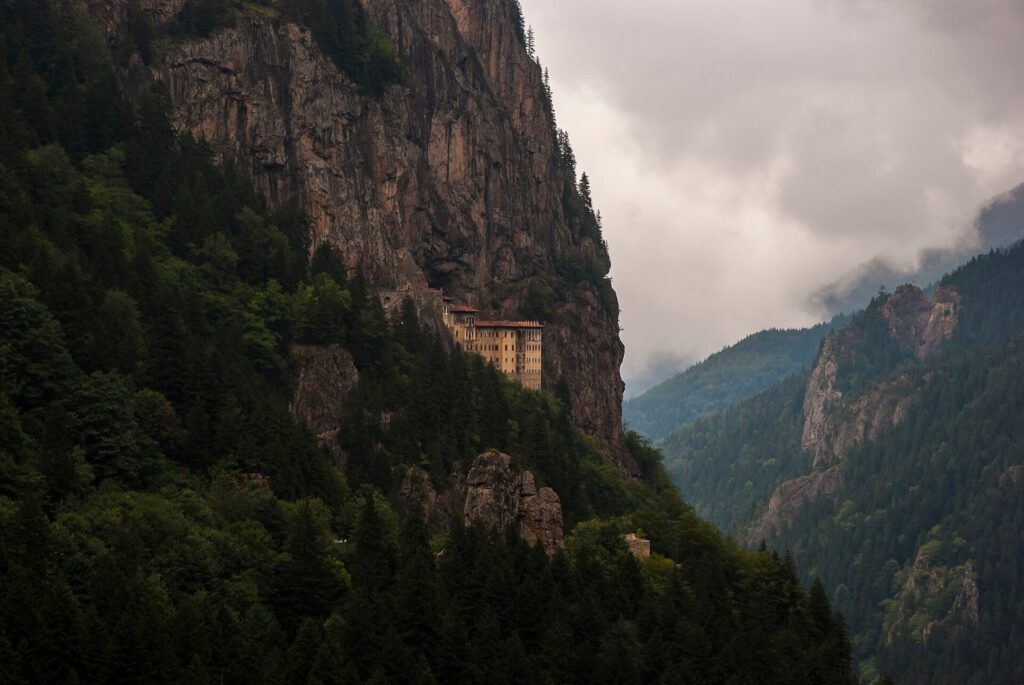
Christian monks went into the desert in Egypt, but Anatolia has no deserts like that, so its monks climbed mountains. The seven best-known holy mountains in Turkey are Uludağ above Bursa, Mount Latmos by Lake Bafa, the Black Mountain of Antioch, Mount Galesion north of Ephesus, Mount Erciyes in Cappadocia, Kayışdağı in Istanbul and the Mela mountain of Sumela Monastery.
Each mountain has its own saints, its own ruins and a very different life today. Some are ski slopes, one is a city neighborhood, and one is a monastery on a cliff that reopened in 2026. For each of them I say who lived there, what we really know and what you can see now.
Why the Monks Went Up the Mountains
Christian monasticism began in the deserts of Egypt in the 3rd and 4th centuries, with fathers such as Antony, Pachomius and Macarius. When the idea came to Asia Minor, it met a different landscape. Anatolia is full of mountains, and they gave the monks what desert gave the Egyptians: silence, hard living and distance from the cities.
Mount Athos in Greece is the most famous Orthodox holy mountain today, but its first great monastery, the Great Lavra, was founded only in 963. Monks were already living on the mountains of Anatolia before that, and Olympus in Bithynia was famous in the 8th and 9th centuries. Let’s have a look at the seven.
Most of monasteries are ruins now or are gone. Arab raids, the Turkish conquests of the 13th and 14th centuries and, in Pontus, the population exchange of 1923 scattered or ended the communities. But the mountains are still there, and in some places you can stand where the monks stood.
1. Mount Olympus of Bithynia (Uludağ)
Mount Olympus of Bithynia is today’s Uludağ, the Great Mountain, above the city of Bursa. It is not the Greek Mount Olympus of the gods, and not the Lycian Olympus on the southern coast. Uludağ reaches 2,543 meters, the highest point in western Anatolia. Bursa, at its foot, became an early capital of the Ottomans after it fell in 1326.
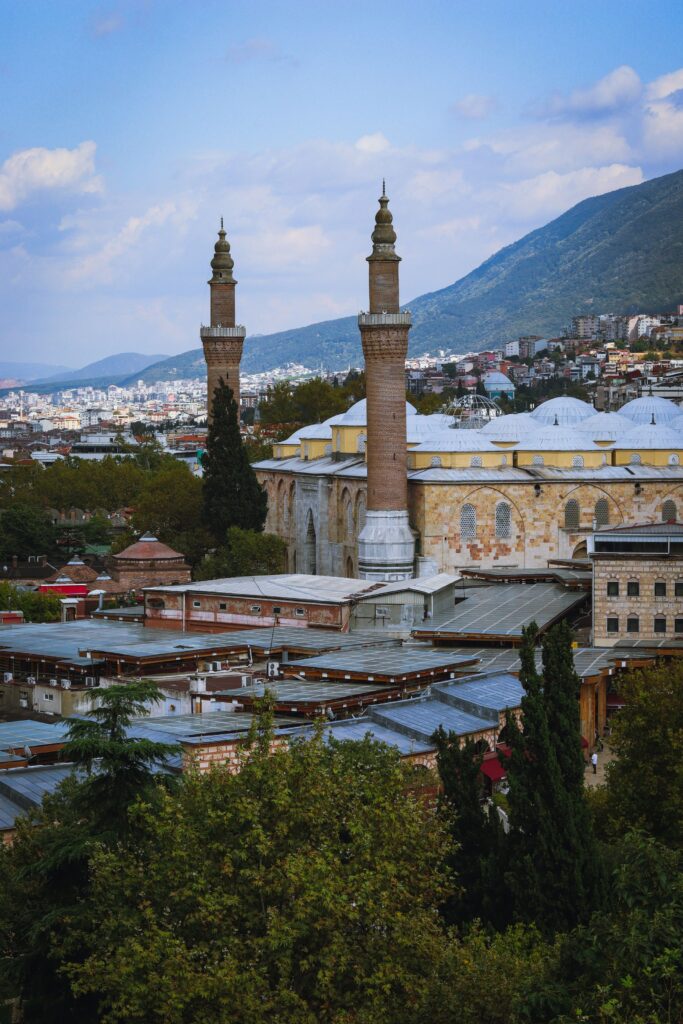
In the Middle Ages the mountain held many hermitages and monasteries. Historians link the rise of this monastic center in the 8th century, and its prestige until the 11th, to monks who resisted the iconoclast emperors, the rulers who banned the veneration of icons.
Three names stand out. Plato founded the monastery of Sakkoudion on Olympus in 783 and was its first abbot. His nephew Theodore the Studite became abbot there in 794. Joannicius the Great, a former soldier, lived as a hermit on the mountain until his death in 846, and his Lives say he foretold that icons would return.
In 797 or 798 an Arab raid on Bithynia sent Theodore’s monks back to Constantinople. Empress Irene offered him the old Stoudios Monastery there, and he made it a center of learning and prayer that shaped Byzantine monastic life.
After the Ottomans took Bursa the monastic world of Olympus slowly disappeared, today Uludağ is a national park and a popular ski center, about 22 kilometers south of the city. A gondola lift runs up from Bursa, with a stop in the alpine meadows of Kadıyayla at about 1,200 meters.
The buildings of the monks are known mostly from the Lives of the saints, but high slopes and the silence are what they knew. For the other parks of Turkey, see my list of the most visited national parks in Turkey.
2. Mount Latmos (Beşparmak)
Mount Latmos is a long ridge of many spurs above Lake Bafa, and in Turkish it is Beşparmak, the Five Fingers. The range straddles the border of Aydın and Muğla provinces, and its peaks reach about 1,300 meters. The ancient city of Herakleia under Latmos, about 25 kilometers east of Miletus, stood at its foot.
The ruins of Herakleia and the village of Kapıkırı lie at the northeast tip of the lake, in Milas District of Muğla Province. The northern part of the lake belongs to Söke District in Aydın Province. So when you plan a visit, think of Muğla for Kapıkırı and Herakleia.
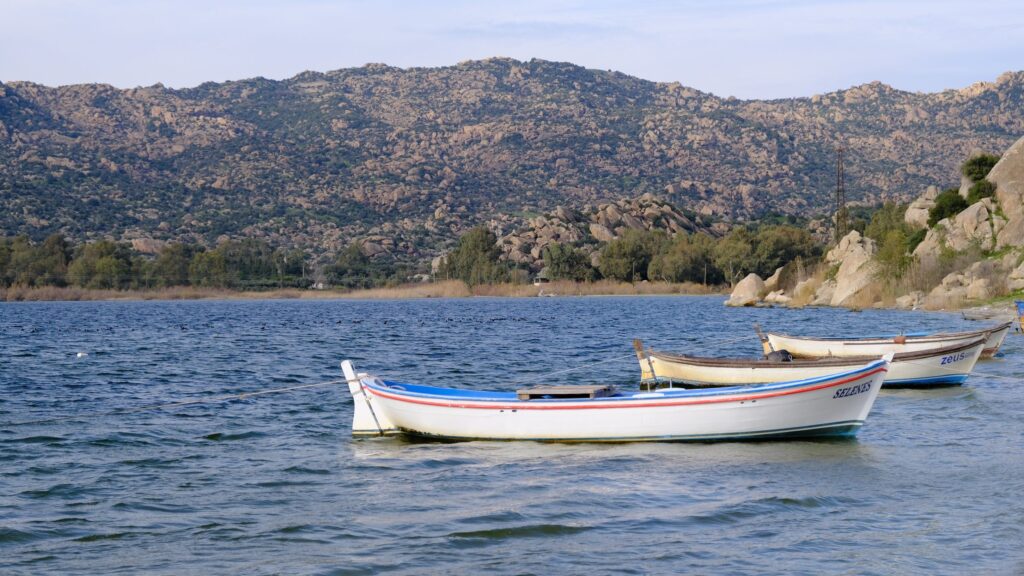
The Byzantines called the mountain Latros. Tradition says the first monastic community came from monks of Sinai who fled the Muslim conquests in the 7th century. By the early 10th century there were three monasteries on Latros, and by 1222 there were eleven.
Paul of Latros, a hermit born in Pergamon, lived on the mountain, founded a monastery there and died in 955 or 956. A text in the Philokalia says he shared his solitude and his food with wild animals.
And Saint Christodoulos, who founded the Monastery of Saint John the Theologian on Patmos in 1088, lived on Olympus in Bithynia, on Latros and on Kos before he went to the island. I describe Patmos in my article on how John wrote Revelation on Patmos.
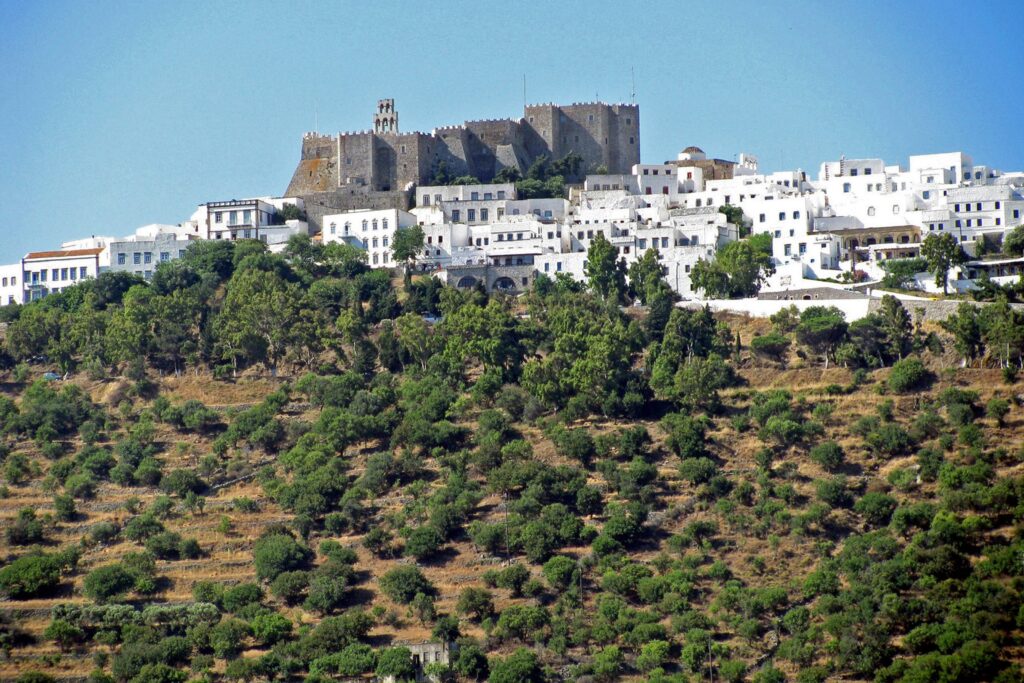
Turkish attacks grew toward the end of the 13th century, and the monastic community of Latros was gone in the 14th. The ruins of about a dozen monasteries on the slopes have never been restored, and another monastery also stands on an islet in the lake too, just across from the village.
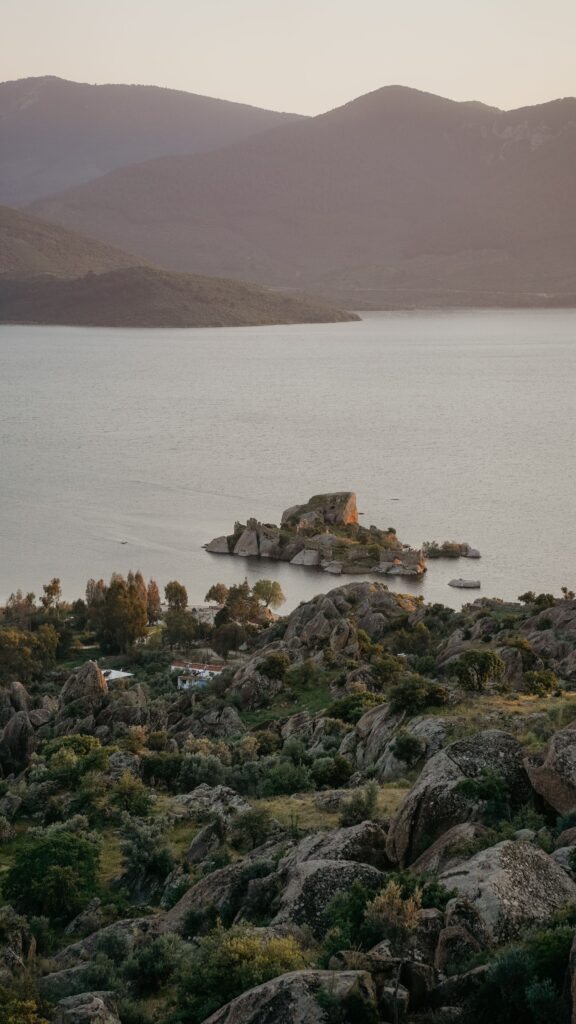
The mountain is much older than its monks. Since 1994, when the German archaeologist Anneliese Peschlow found the first ones, about 170 rock paintings in red have been discovered in shallow caves and overhangs at the foot of the mountain. Peschlow dates the earliest to about 6000 BCE.
Visit with care. In 2018 Hürriyet Daily News reported that treasure hunters had damaged Byzantine frescoes under a rock shelter on the mountain. A local environmental group said the range has no protection beyond its well-known archaeological sites. The paths are rough and the ruins are scattered, so I recommend to walk with someone who knows them, and never touch or draw on a painted wall.
In my article on Saint John the Evangelist I wrote that I sometimes take my guests to Lake Bafa for a quiet lunch after Priene and Miletus. For the apostle in that part of the Aegean, see Apostle Paul in Miletus.
3. The Black Mountain of Antioch
The Byzantines called the Amanus range above Antioch the Black Mountain. Today it is the Nur Mountains in Hatay Province, and they divide the coast of Cilicia from Antioch and inland Syria. In Middle Ages the Black Mountain held Armenian, Georgian, Greek-speaking and Syriac monasteries, and monks of different churches lived on the same mountain.
Its most famous saint is Simeon Stylites the Younger, who must not be mixed up with Simeon the Elder, the pillar saint near Aleppo in Syria. Simeon the Younger was born in Antioch in 521. His father died in an earthquake when he was six, and his mother Martha, who is also a saint, raised him.
As a boy he joined a pillar hermit named John, and he lived on pillars for 68 years, until he died in 596 or 597. His last pillar stood on a hill called the Wondrous Mountain, today Saman Dağı, about 29 kilometers southwest of Antakya and 6 kilometers east of Samandağ.
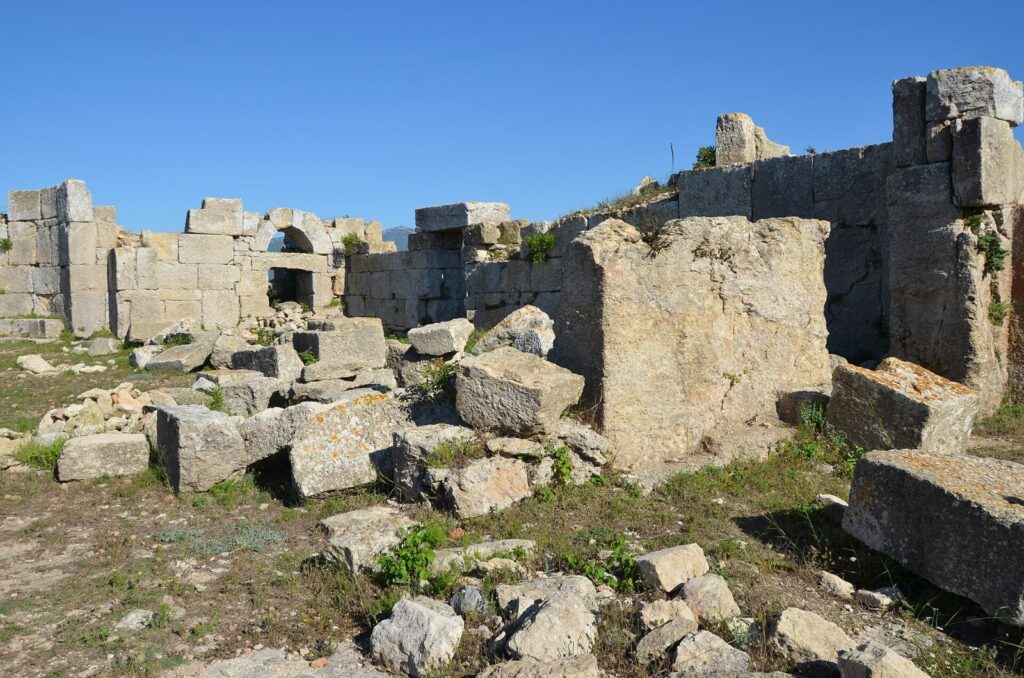
A large monastery grew around the pillar. Martha died in 551 and was buried near her son. The monastery was sacked in 1084, rebuilt after the First Crusade and destroyed for good by Sultan Baybars in 1268.
Three ruined churches are laying on the hilltop, one with pieces of mosaic, and the base of Simeon’s pillar stands inside an octagonal space. Hatay was hit hard by the earthquakes of February 2023, and I could not find a recent official note on the condition of the site. Ask the Hatay museum Directorate before you plan a visit.
4. Mount Galesion Nearby Ephesus
Mount Galesion lies north of Ephesus, on the north side of the Küçük Menderes valley, which the ancients called the Kaystros. Today the mountain is called Alamandağ. It is hill rather than an alpine peak. A castle on its summit stands at 300 to 350 meters, about 9 kilometers from the center of Selçuk.
The man who made it holy was Lazaros of Mount Galesion. He was born near Magnesia around 972, or 981 by another reckoning, and went to Attaleia to become a monk. Then he visited the Lavra of Saint Sabas in Palestine. Back home he became a stylite, a pillar saint, and he died on the mountain on 7 November 1053.
Lazaros founded three monasteries there: the Savior, the Mother of God and the Resurrection. His monks lived at separate cells, not in one common house, and they could earn their living with a handicraft.
His Life, written by his disciple Gregory the Cellarer, has few miracles and many everyday details: journeys, quarrels, thefts and visits. Richard Greenfield translated it into English in 2000. It also tells how Lazaros climbed another mountain on this list, which we meet in a moment.
The community lost much of its prestige after Lazaros died, but it rose again in the 13th century, when the nearby city of Nymphaion became a favorite winter home of the emperors of Nicaea. Three patriarchs of Constantinople had been monks of Galesion. The Turks took the area in the early 14th century, and the monastic center ended.
The only building I can name on the summit is Keçi Kalesi, the Goat Castle, a fortress of the 13th century. It is reached on foot by a hard trail, and I found no source that links it to the monasteries. It was probably built to give early warning of attacks on Ayasuluk Castle, and you can read about that hill in my article on Ayasuluk Hill nearby Ephesus.
Keçi Kalesi, also called Kızılhisar, stands on the hill above Belevi and looks over the plain of the Küçük Menderes and the old road to Sardis. It has an inner and an outer castle, and two rectangular towers guard its gate. The easiest way up is from the north, about an hour on foot, partly on a medieval road paved with limestone blocks.
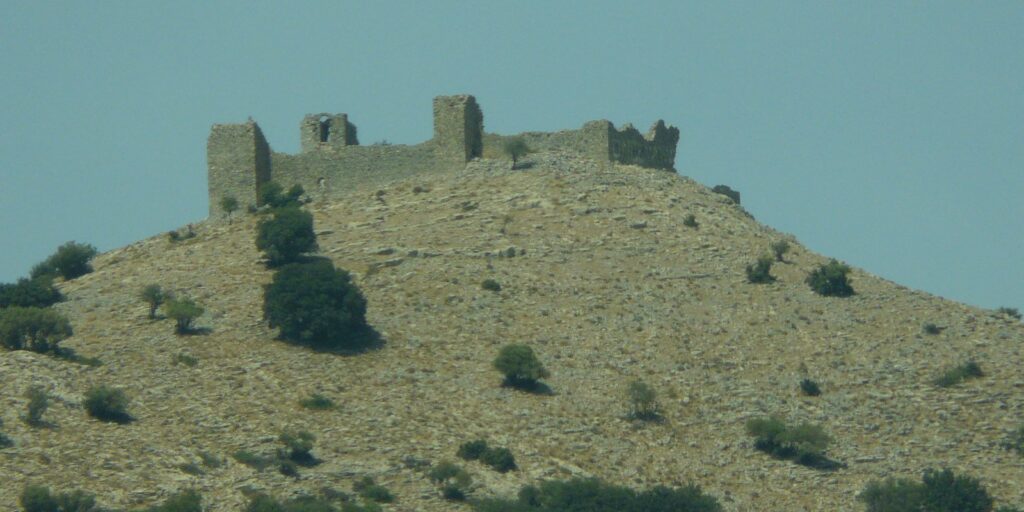
On the north and west sides, where an attacker had an easier way, a second wall protects the keep. Inside there are storerooms and cistern with a vaulted roof. It is believed that during the Turkmen raids of the 13th and early 14th centuries, the people of the valley took refuge behind these walls. The holy mountains in Turkey were not only places of prayer. In hard times they were places of defense too.
5. Mount Argaeus (Erciyes)
Mount Argaeus is today’s Erciyes Dağı, an inactive volcano in Kayseri Province. At roughly 3,900 meters it is the highest mountain of central Anatolia. Kayseri, the ancient Caesarea, lies 15 to 25 kilometers north of it. Erciyes is one of the volcanoes behind the soft rock of Cappadocia, which I mention in my 10 interesting facts about Cappadocia.
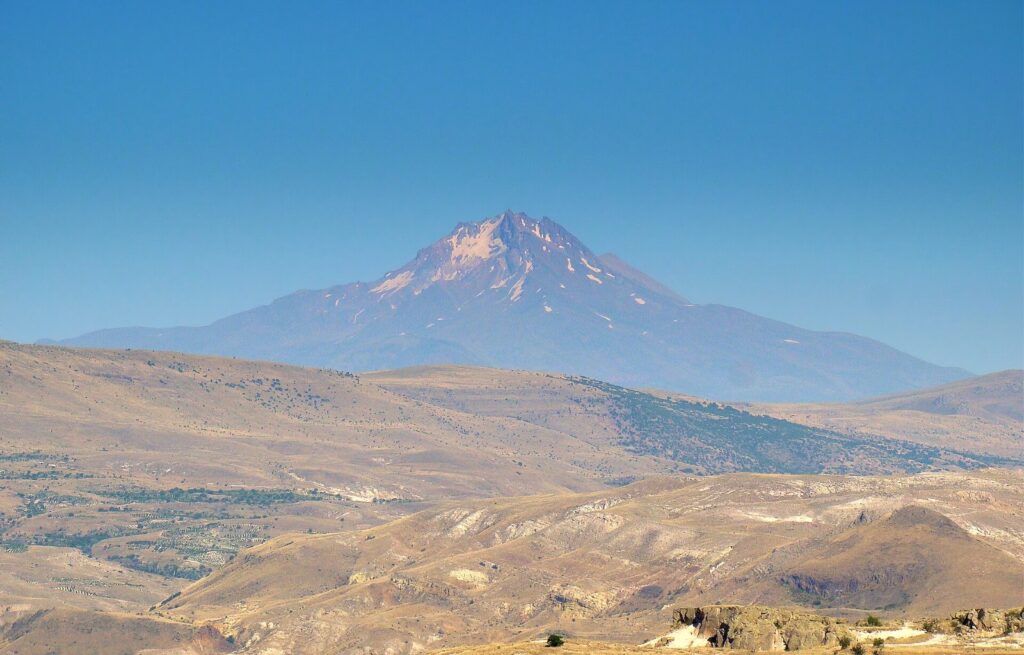
The mountain was sacred long before Christians came. The Hittites left rock carvings and even a tunnel on it. The geographer Strabo wrote that snow never leaves its summit, and that the few who climb it say they can see both the Black Sea and the Mediterranean on a clear day.
Basil the Great was born in Caesarea around 330 and became its bishop in 370. His writings on the monastic life were so respected that Benedict of Nursia told his monks to read the Rule of Basil.
Monks climbed Erciyes too. In the Life of Lazaros of Galesion, written in the 11th century, Lazaros goes up the mountain in the depths of winter, singing the Psalms. Fog closes in and he feels his way with his hands. He meets a bear on the path, and neither of them sees the other until they bump together.
At the top he finds a chapel with a barred door. He opens it, prays inside, closes the door again and walks down. So there was a church on the summit of Argaeus, and a monk who climbed to it in the snow.
Erciyes is odd one on my list. I found no source that places a large monastery on its slopes, and I will not invent one. It earns its place through Basil, through Lazaros and through the way it stands over Cappadocia. Today it is also a ski center.
6. Mount Auxentius (Kayışdağı)
Mount Auxentius is the old name of Kayışdağı, a hill of about 430 meters on the Asian side of Istanbul, in today’s Ataşehir district. The Byzantines also called it Mount Scopas. It lay not far from Chalcedon, so the capital of the empire was close.
Saint Auxentius was born in Syria around 400 and served in the guard of Emperor Theodosius II. He left the army and became a hermit, first on Mount Oxia near Constantinople and then on Mount Scopas, where people came to him for healing and advice. In 451 he attended the Council of Chalcedon. He died on the mountain around 470, or 473 in some sources.
The most famous monk of the mountain is Stephen the Younger. His parents brought him there around 731, when he was about sixteen. He became abbot after his teacher John died, and later lived as a hermit in a cave. He refused the decisions of the iconoclast Council of Hieria in 754, and Emperor Constantine V had him arrested.
Stephen was beaten to death in Constantinople in 764, or 765 in some sources. His Life, written around 806 to 809 by a deacon named Stephen, is an important source for the Iconoclast period.
Today hill is a residential district, and part of its forest holds a university campus and a municipal care home. I could not confirm that any Byzantine building survives above ground there. For this reason treat Kayışdağı as a place to understand more than a place to tour.
7. Mount Mela and Sumela Monastery
Mount Mela rises in the Pontic Mountains in Maçka District, south of Trabzon. In Greek mela means black, after the dark rock, and one theory says the name Sumela means “on Mela”.
It is not known when the monastery was really founded, but the Turkish Ministry of Culture and Tourism places it around 386, under Emperor Theodosius I. Tradition names two Athenian monks, Barnabas and Sophronios, who followed an icon of the Virgin said to be painted by Luke the Evangelist.
The monastery hangs in a cliff face at about 1,200 meters above the Altındere valley. It reached to its present form in the 13th century, under the Empire of Trebizond, and Emperor Alexios III, who ruled from 1349 to 1390, gave it the richest gifts. After Sultan Mehmed II took Trebizond in 1461, he gave the monastery his protection, and later sultans renewed its rights.
The monks left in 1923, when the population exchange ended the Greek community of Pontus. Before they went, they buried the icon, a Gospel book and a cross near the church of Saint Barbara. In 1931 a monk named Ambrosios recovered them with permission from Turkey. The icon waited in the Benaki Museum in Athens until 15 August 1952, when it was enthroned in the new Panagia Soumela monastery near Veria in Greece.
Sumela is a museum today, and its status changes, so here are the facts with dates. It closed for rockfall work on 22 September 2015 and reopened in May 2019. On 25 June 2026 the Minister of Culture and Tourism said that the first stage of maintenance and safety work was finished and the monastery was open to visitors again, Anadolu Agency reported.
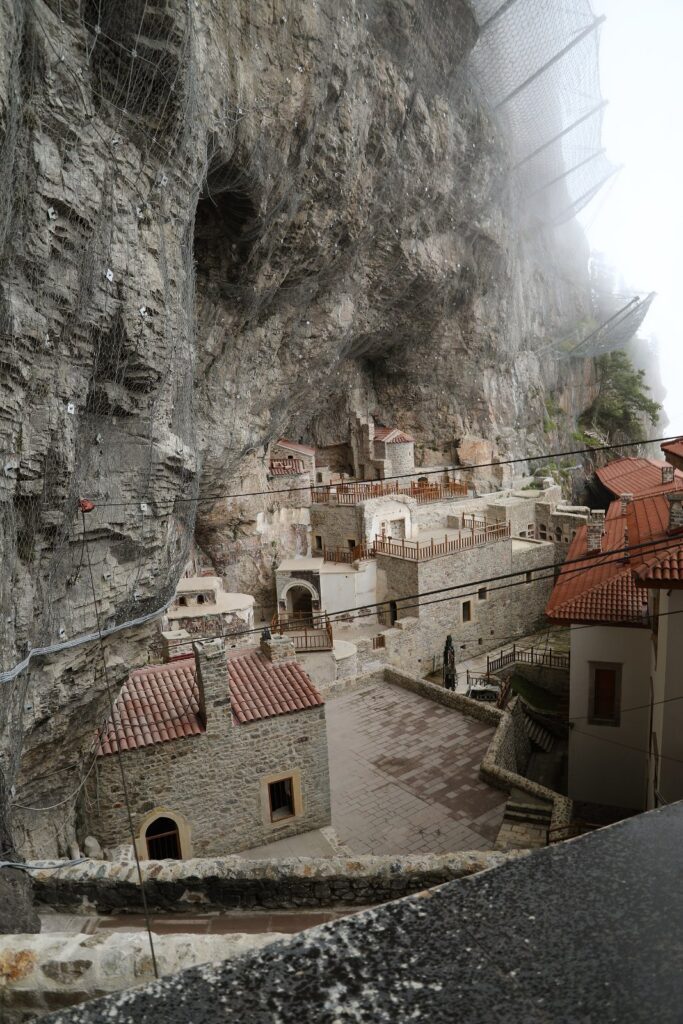
Climbers cleaned the rock faces and fitted a second layer of wire mesh over part of the inner courtyard. The wider restoration continues. As of 17 October 2026 I found no announcement of a new closure. However, Sumela has closed more than once for rockfall work, so check before you go.
The monastery is also a place of prayer once a year. A liturgy was allowed there on 15 August 2010, the feast of the Dormition of the Virgin, for the first time since 1923. In 2024 and 2025 the authorities did not give permission for 15 August itself, and the service was moved to 23 August, the leave-taking of the feast.
In 2026 it haapened again. The liturgy was held on Sunday, 23 August, and Metropolitan Barnabas of Neapolis and Stavroupolis led it for Patriarch Bartholomew, Orthodox Times reported. If you plan around the Dormition, ask for the current permission rules first.
Visiting the Holy Mountains in Turkey
Seven mountains give seven different answers. Uludağ and Erciyes are ski centers with old stories under them. Latmos and Sumela are places where you can still see what the monks saw. The Black Mountain and Galesion ask for patience and a recent word from the local museum, and Kayışdağı is a city hill that you read about more than you see.
The cities of Anatolia show where Christian life was organized and public. The mountains show where it was lived hard. For the monks the silence, the cold and the long hours of prayer were not an escape from the faith but a way to make it stronger.
For the wider picture, start with my guide to Christian Turkey for first-time visitors, and for Basil and other saints of the region read my article on important Christian people of Asia Minor.
Frequently Asked Questions
What are the holy mountains in Turkey?
The best-known Christian ones are Uludağ near Bursa, Mount Latmos by Lake Bafa, the Black Mountain near Antioch, Mount Galesion near Ephesus, Mount Erciyes in Cappadocia, Kayışdağı in Istanbul and the Mela mountain of Sumela Monastery. If you mean the mountain of Noah’s ark, see my article on Mount Ararat.
Is Sumela Monastery open?
Yes, it was open to visitors again on 25 June 2026, after the first stage of maintenance and safety work. The wider restoration continues, and the monastery has closed before for rockfall work. Check the current status shortly before you go, and ask about the rules if you plan to be there around 15 August.
Where is Mount Latmos?
Mount Latmos, or Beşparmak, lies between Aydın and Muğla provinces, above Lake Bafa and about 25 kilometers east of ancient Miletus. The ruins of Herakleia and the village of Kapıkırı are in Milas District of Muğla Province, at the northeast tip of the lake.
Is Mount Galesion near Ephesus?
Yes. It lies north of Ephesus and is called Alamandağ today. A 13th-century castle on its summit, Keçi Kalesi, is about 9 kilometers from the center of Selçuk and is reached on foot. I found no source that places the monasteries of Lazaros exactly on the ground, so it is a place for the story more than for the ruins.
Hire Biblical Tour Guide in Turkey
I’m a nationally licensed Turkish tour guide based in Kuşadası, nearby Ephesus. My day guiding is in Ephesus, İzmir and Pamukkale. Mount Galesion belongs to my own region, and I can tell you the story of Lazaros on an Ephesus day. Lake Bafa and Mount Latmos lie to the south, and I know the lake as a lunch stop after Priene and Miletus.
My license is valid all over Turkey. For Bursa and Uludağ, Antakya and Samandağ, Kayseri and Erciyes, Istanbul or Trabzon, I can join you as your personal guide on a longer journey, while you arrange your transport and hotels yourself or through a licensed travel agency. See my guiding rates and guiding areas or write to me through my contact page.
I hope we will stand together on one of the mountains that the monks knew. You can always write to me with your questions about the holy mountains in Turkey. See you soon, Hasan Gülday.