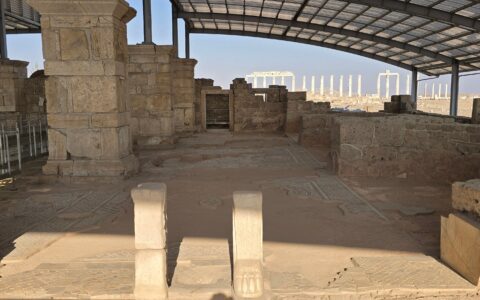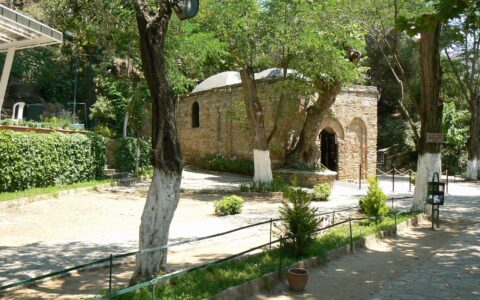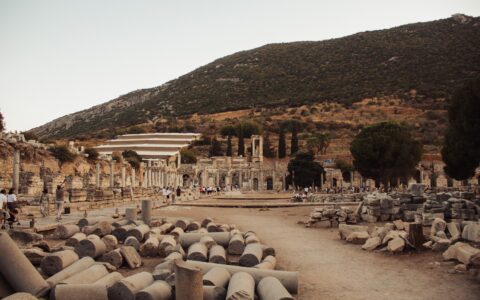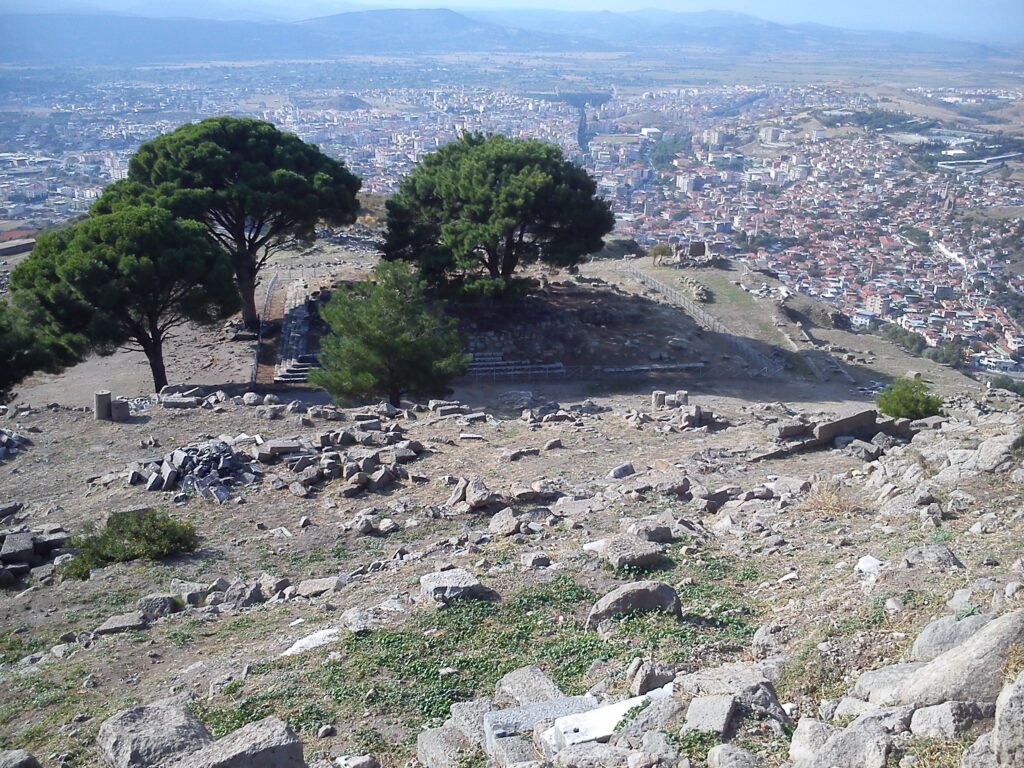
Revelation holds seven letters to real churches, and the letter to Pergamum is the third of them (Revelation 2:12–17). It was sent around 95 AD to the Christians of Pergamon, the modern town of Bergama in İzmir province. Christ praises them for keeping his name “where Satan’s seat is”, even after the death of Antipas. He warns them about the doctrine of Balaam and the Nicolaitans, and he promises the hidden manna and a white stone with a new name.
Pergamon was a royal city with a great altar of Zeus, the first imperial temple of the province of Asia, a famous library and the healing sanctuary of Asclepius. Like the letter to the church of Ephesus, this letter holds both praise and warning. Unlike the letter to Smyrna, its warning is sharp.
The King James Version says Pergamos and most modern Bibles say Pergamum, but it is the same Pergamon. For the city, its monuments and the visit, read my article on the church of Pergamum. Here we read the letter verse by verse in the King James Version.
The Address and the Two-Edged Sword
“And to the angel of the church in Pergamos write; These things saith he which hath the sharp sword with two edges” (Revelation 2:12, KJV).
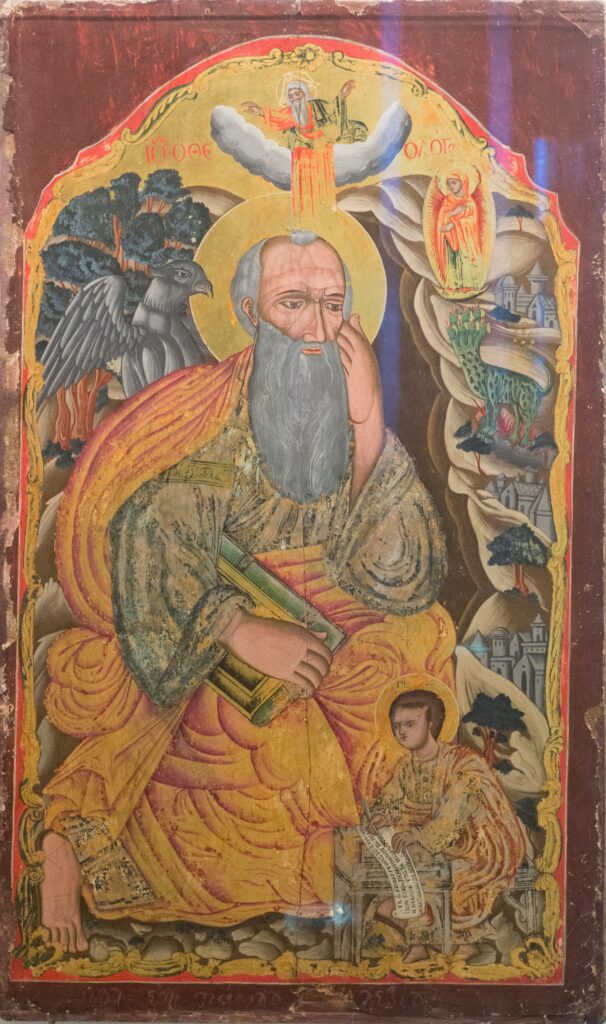
Each of the seven letters opens with a title of Christ taken from vision of the first chapter, which John received on Patmos, as I tell in how John wrote Revelation in exile on Patmos. There John saw that “out of his mouth went a sharp twoedged sword” (Revelation 1:16).
The Greek word is rhomphaia, a long and heavy sword, and the text calls it distomos, literally “two-mouthed”, sharp on both edges. But why choose this title for Pergamon? The Roman governor of Asia had the sole right to impose the death penalty, the power the Romans called ius gladii, the right of the sword.
Pergamon was the seat of a conventus, a judicial district where the governor came to hear cases. So the Christians of this city knew very well who held the sword over their lives. Letter answers this with a quiet point. Rome has a sword in Pergamon, but Christ has a sharper one, the sword of his word. Two swords in one city. The letter tells the Christians which one really decides, and the same sword returns at its end, in the threat of verse 16.
Where Satan’s Throne Is
“I know thy works, and where thou dwellest, even where Satan’s seat is” (Revelation 2:13, KJV).
Christ does not only know their works, he knows their address. And what an address it is. In Greek it is thronos, a royal throne, while the King James Version uses the plainer word “seat”. In the same verse the city is called a second time the place “where Satan dwelleth”. No other city of the seven letters is described as the home of Satan.
The verse gives no explanation, and few lines in the seven letters have produced so many interpretations. Let’s have a look at the three most popular ones, each tied to a monument the Christians of Pergamon saw every day.
The first reading points to the great Altar of Zeus, raised in the 2nd century BC on one of the acropolis terraces. With a broad staircase climbing between two colonnaded wings, the whole structure had the form of an enormous seat, and many scholars connect it with this verse. Its foundation is still on the hill, as I describe in my guide to Pergamon Ancient City.
The second reading points to the emperor cult. In 29 BC Octavian, who soon took the name Augustus, allowed the Greeks of Asia to honor him together with the goddess Roma at Pergamon. So Pergamon became the first home of the emperor cult in the province of Asia. Half a century later Emperor Tiberius still recalled that Augustus “did not forbid the founding of a temple at Pergamos to himself and to the city of Rome” (Tacitus, Annals 4.37).
For a Christian this was more dangerous neighbor. An old god could be quietly avoided, but a gesture of worship toward the emperor could turn into a public test of loyalty. A man who refused to offer incense before the emperor’s image was not just impious in the eyes of his neighbors also suspect in the eyes of Rome.
The third reading points to Asclepius, the healing god whose great sanctuary lay in the valley below the city. His symbol was the serpent, and the Book of Revelation names the devil “that old serpent, called the Devil, and Satan” (Revelation 12:9). For a Christian reader, a city that honored a serpent god for its healing could easily be the place where Satan lived.
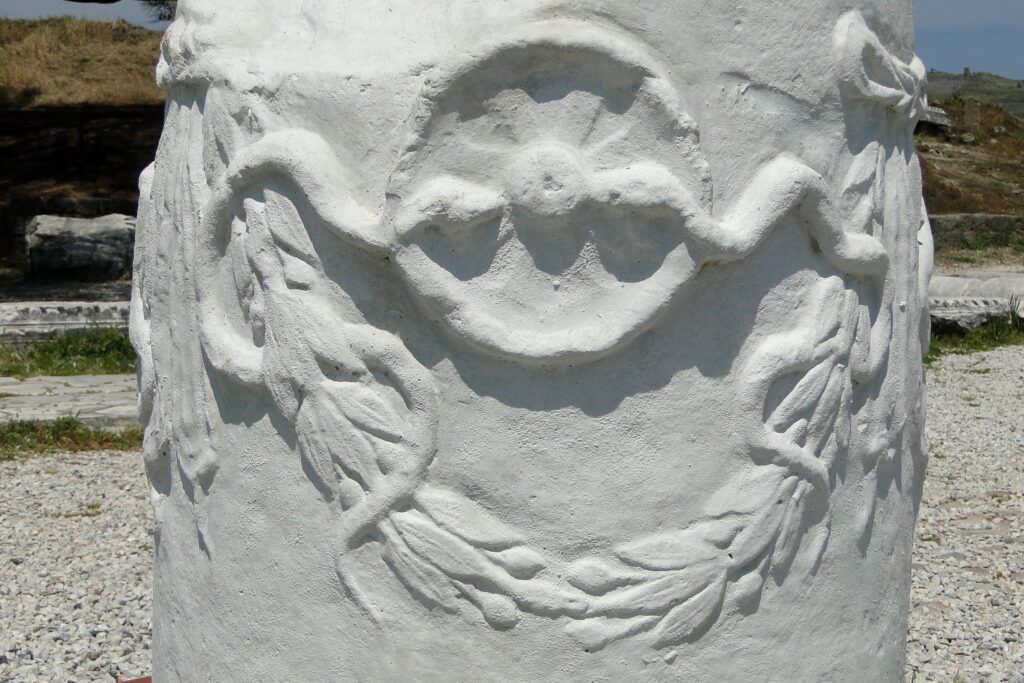
Honestly, I think all three readings are partly right. Around 95 AD Pergamon was one of the strongest centers of organized pagan religion in the province of Asia. Satan’s throne is not one building. It is the whole system: the altar on the hill, the cult of the emperor, the serpent in the valley and all the crowds who served them. The small Christian community lived in the middle of it.
Antipas, My Faithful Martyr
“And thou holdest fast my name, and hast not denied my faith, even in those days wherein Antipas was my faithful martyr, who was slain among you, where Satan dwelleth” (Revelation 2:13, KJV).
Here comes the praise. Even when one of their own was killed, the believers of Pergamon held on to the name of Christ. Antipas is the only individual martyr named in the seven letters. His death was recent enough to be fresh in everybody’s memory, and the letter says it happened “among you”, in the city itself.
The title Christ gives him is beautiful. The Greek word martys first meant a witness, and “the faithful witness” is the same title that Revelation gives to Jesus Christ in its first chapter (Revelation 1:5). So Antipas receives the title of his Lord. The later meaning of martyr, a person who dies for the faith, grew out of witnesses like him.
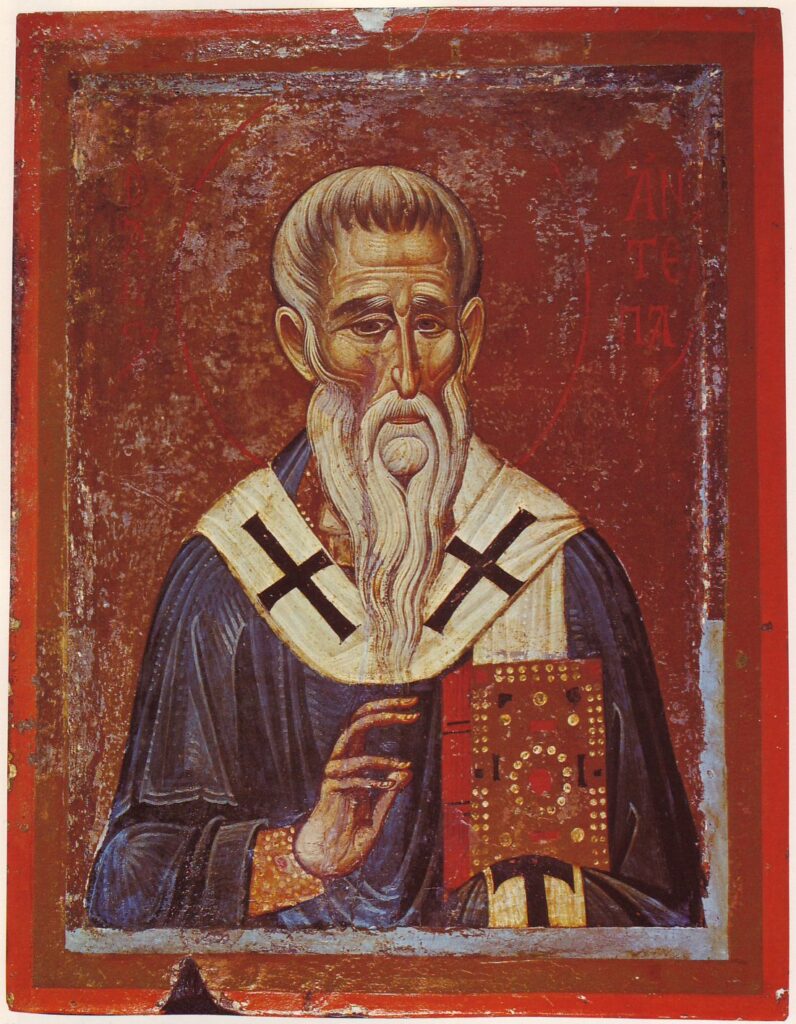
Beyond this verse we know almost nothing for him. Church tradition calls him a bishop and tells that he died in a hollow bronze bull, in the reign of Nero or of Domitian. These stories were written down centuries later. You can read more about him in my article on the martyrs and important figures of the Seven Churches.
I find this small detail very moving. In a city of kings and emperors, of famous physicians and 200,000 library volumes, Christ remembers the name of one ordinary man who was killed. Around 197 AD Tertullian wrote a line that people usually quote as “the blood of the martyrs is the seed of the Church”. His own Latin is shorter: the blood of Christians is seed.
The Doctrine of Balaam
“But I have a few things against thee, because thou hast there them that hold the doctrine of Balaam, who taught Balac to cast a stumblingblock before the children of Israel, to eat things sacrificed unto idols, and to commit fornication” (Revelation 2:14, KJV).
Now comes the warning. Inside this brave community there was a group teaching what Christ calls the doctrine of Balaam. To understand the name, we have to go back to the Book of Numbers, to the last year of Israel’s forty years in the desert, when the tribes camped on the plains of Moab.
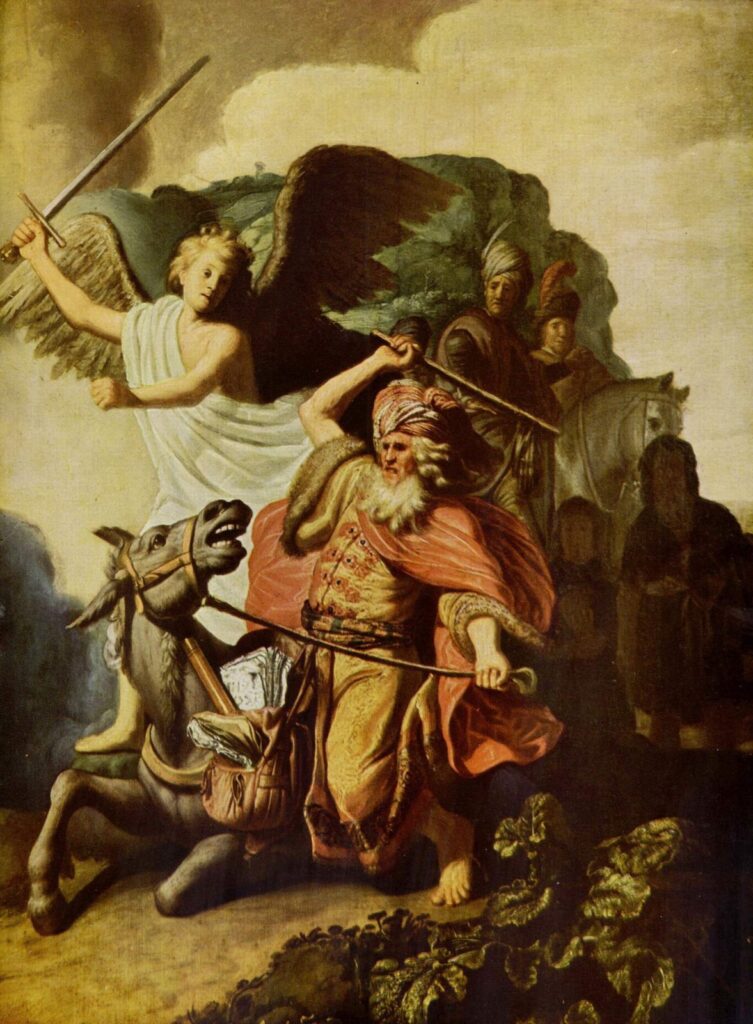
Balak, the king of Moab, hired the prophet Balaam to curse Israel (Numbers 22–24). Balaam tried but each time he opened his mouth a blessing came out. On the road an angel even stood against him “with his sword drawn in his hand” (Numbers 22:31). Later Israel fell into the worship of Baal of Peor with the women of Moab, and 24,000 people died in the plague that followed (Numbers 25).
Moses says that it happened “through the counsel of Balaam” (Numbers 31:16). So Balaam, who could not curse Israel with words, found another way to harm it: not by force, but by a friendly invitation to the feasts of a foreign god. This is exactly the danger the letter sees in Pergamon.
The teachers in Pergamon taught that a Christian could join to the banquets of the pagan city, eat the meat that came from the altar and share the loose morals that came with the feasts. Some of them may have used Paul’s own words, that “an idol is nothing in the world” (1 Corinthians 8:4), and asked why anyone should refuse a good dinner.
In the daily life this was not a small question. City festivals, family celebrations and the meetings of the trade guilds usually began with a sacrifice, and what was served at the table had first been offered to a god. A Christian who stayed away risked his friendships, his customers and his place in society. Apostle Paul had already answered to the question for Corinth (1 Corinthians 8 and 10).
The same two things appear in the decision of the apostles in Jerusalem, who asked the Gentile believers to abstain “from meats offered to idols” and “from fornication” (Acts 15:29). The letter to Thyatira fights the same teaching under the name of Jezebel (Revelation 2:20), as I explain in my article on Thyatira and its long letter.
The Nicolaitans in Pergamum
“So hast thou also them that hold the doctrine of the Nicolaitanes, which thing I hate” (Revelation 2:15, KJV).
Next to the followers of Balaam stand the Nicolaitans. Ephesus had been praised for hating their deeds (Revelation 2:6). In Pergamum, however, some Christians held their teaching, and the church let them stay. What Ephesus kept outside the door, Pergamum allowed to sit at the table.
Were they a second group, or the same group under another name? The small word “so” can mean “in the same way”. Some interpreters also noticed that the Greek name Nicolaus, “conqueror of the people”, is close to one old explanation of the Hebrew name Balaam. Others, like the commentator Albert Barnes, answered that verse 15 clearly separates the two groups.
Irenaeus in the 2nd century linked them with Nicolas, the convert from Antioch who was among the seven men chosen in Acts 6, but the early writers do not agree with each other. I collected what we know in my article on Nicolaitans and Nicolaitanism. For Pergamon important point is simpler: two kinds of compromise were living inside one small church.
The Warning of the Sword
“Repent; or else I will come unto thee quickly, and will fight against them with the sword of my mouth” (Revelation 2:16, KJV).
The threat is direct, but read it carefully. Christ will come “unto thee”, to the church, yet he will fight “against them”, against the false teachers. The whole community is called to repent, because it tolerated the problem. The punishment itself, however, is aimed at the teaching and at the people who spread it.
So the church has a chance to settle the matter by itself. If it does not, Christ will do it with the sword of his word, the same sword of verse 12. The letter opens and closes with this weapon, and in a city where Rome held the sword of the Governor, that frame is no accident.
I take this as a small comfort, in a strange way. Even when a church has corruption inside, Christ does not destroy the whole congregation. He removes the false teaching like a surgeon, a fitting picture in the hometown of Galen. The faithful believers of Pergamon are still called faithful, while their community carries a problem in its own house.
The Hidden Manna
“He that hath an ear, let him hear what the Spirit saith unto the churches; To him that overcometh will I give to eat of the hidden manna” (Revelation 2:17, KJV).
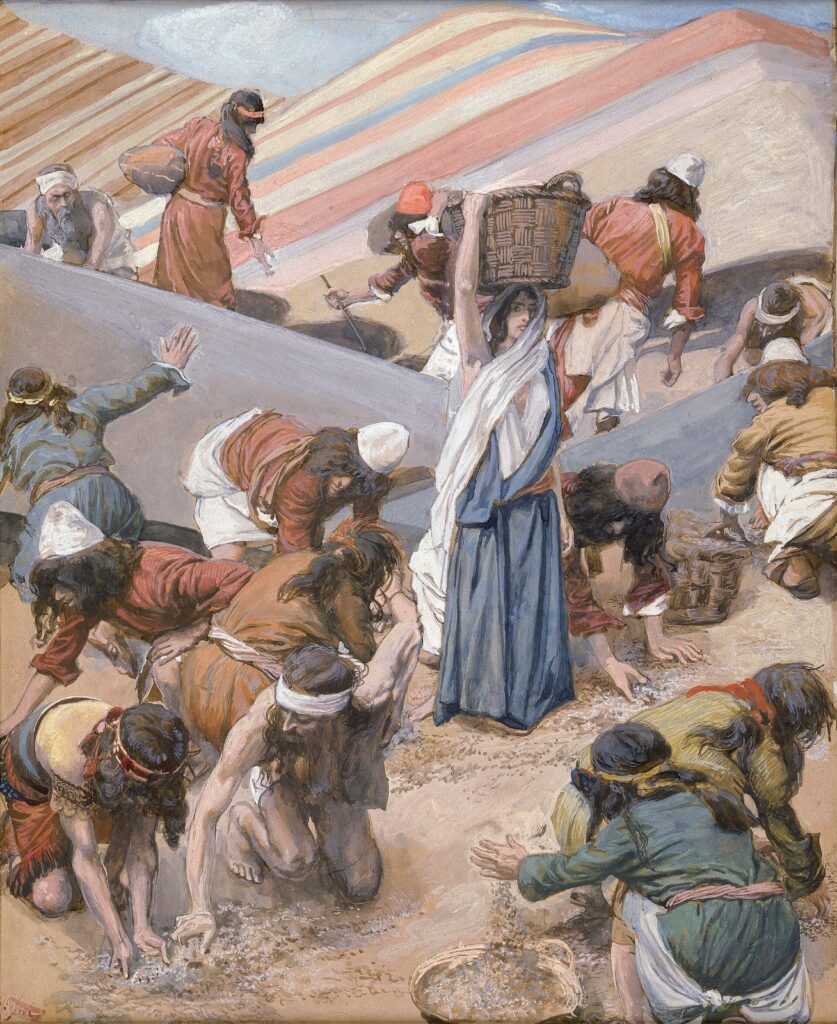
The promise has two parts, a food and a stone. The food takes us back to Exodus. When God fed Israel in the desert with manna, Moses told Aaron to keep a pot of it “before the LORD” for the generations to come (Exodus 16:33). The Epistle to the Hebrews places this “golden pot that had manna” inside the Ark of the Covenant (Hebrews 9:4).
Then the Ark disappeared. The Second Book of Maccabees tells that the prophet Jeremiah hid it in a cave on the mountain of Moses, until God gathers his people again (2 Maccabees 2:4–8). A Jewish book written after 70 AD, known as 2 Baruch, expects that “the treasury of manna shall again descend from on high” at the end of time (2 Baruch 29:8).
So the hidden manna is the bread of the age to come, kept by God for his people. For the Christians of Pergamon contrast was clear. Some of them were tempted by the meat of the temple banquets, and Christ offers them a far better meal. Jesus had already said, “I am the bread of life” (John 6:35).
The White Stone and the New Name
“And will give him a white stone, and in the stone a new name written, which no man knoweth saving he that receiveth it” (Revelation 2:17, KJV).
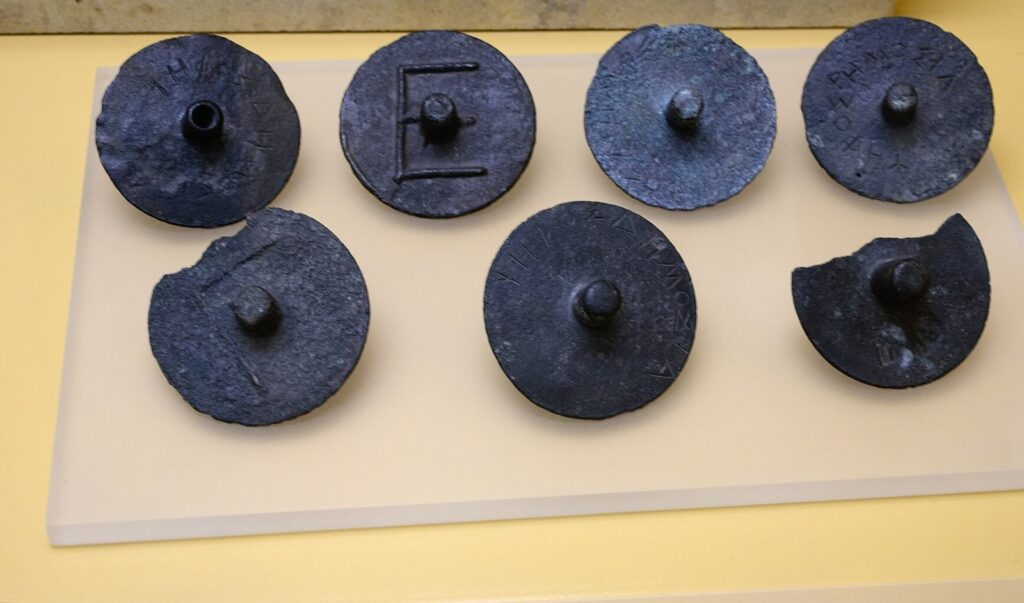
The white stone is the most mysterious image of the letter. The Greek word is psephos, a small pebble, the same word the Greeks used for a voting stone. The Roman poet Ovid describes “an ancient custom” of voting with white and black pebbles: the black ones condemned the accused, and the white ones set them free (Metamorphoses 15.41–42).
In Athens the jurors voted with bronze ballots instead, one solid and one pierced, and Aristotle explains that the solid ballot was the vote for the defendant (Athenian Constitution 68–69). The idea is the same. If the white stone is a vote of acquittal, then the Christian whom his city condemned receives “not guilty” from the court of heaven.
Other explanations exist, and none of them is certain. The new name, however, points clearly to the prophets. Isaiah promised that God’s people “shall be called by a new name, which the mouth of the LORD shall name” (Isaiah 62:2). Revelation repeats the promise of a new name to the faithful in the letter to Philadelphia (Revelation 3:12).
Names also matter in these letters too. Antipas is named, and in the letter to Sardis Christ knows “a few names” who stayed faithful (Revelation 3:4). In Pergamon the believer who keeps the name of Christ receives a name of his own, written on a stone that nobody else can read.
What the Letter to Pergamum Means
The letter describes a church with two faces. On one side there is courage: they kept the name of Christ when Antipas died, in the city of the altar, the emperor and the serpent. On the other side there is compromise: in the small daily choices about which dinner to attend, some of them gave in.
The pressure came in two shapes, the sword of the governor and the invitation to dinner. The first one made martyrs; the second was quieter and more dangerous. Where do you draw the line? In this letter the answer is sharp. Those who refuse the altar table receive a different banquet, a different verdict and a name that belongs only to them.
One Last Thought
I will leave you with one quiet picture instead of a summary. Imagine the Christians of Pergamon around 95 AD, in a house somewhere in the lower city, listening to this letter as it was read aloud for the first time. The praise for their courage when Antipas died. The warning about teachers from their own community. The hidden manna and the white stone.
Imagine them in the next weeks, deciding what to do about the false teachers in their own house. The difficult conversations, the arguements, the slow work of reform. We do not know the details. We only know that the church of Pergamum survived for many centuries after this letter, with its bishops and its martyrs.
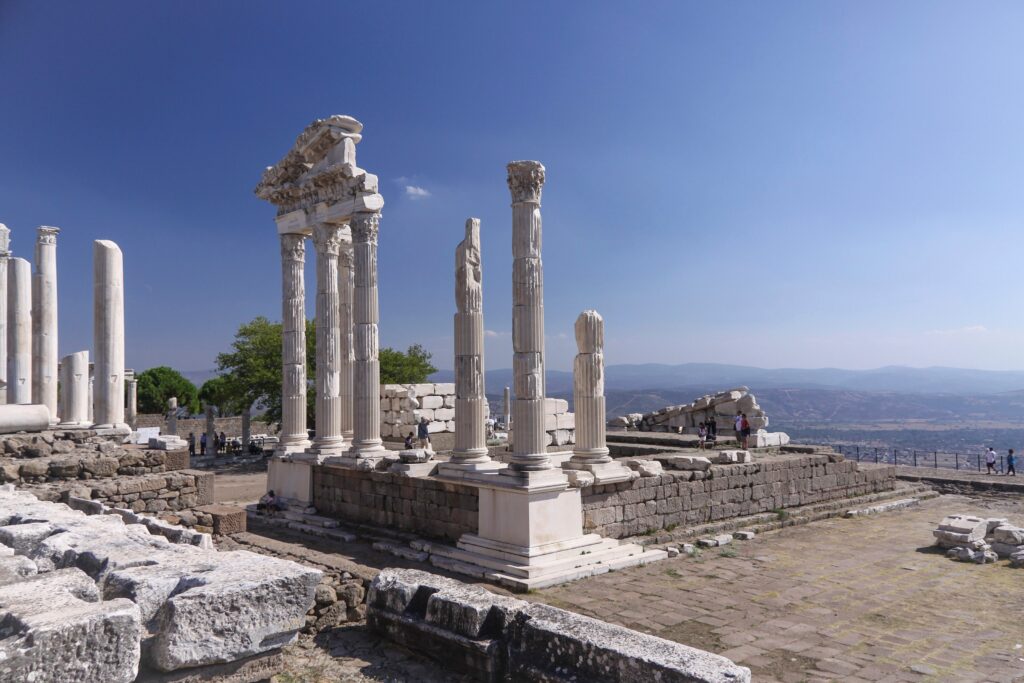
When I read this letter with my guests on the upper terrace of the acropolis, I always look at the white columns of the Trajaneum, bright in the afternoon sun. That temple of an emperor was begun about twenty years after the letter, and its stones are laying on the hill today. Its emperor is long gone, and the letter to the small church that refused to bow is still read all over the world. That is the letter to Pergamum.
Frequently Asked Questions
What does the letter to Pergamum mean?
The letter to Pergamum (Revelation 2:12–17) praises a church that kept its faith in a city full of pagan and imperial worship, even after the martyr Antipas was killed. It warns against teachers who allowed idol feasts and immorality, the doctrine of Balaam and the Nicolaitans, and it promises the faithful the hidden manna and a white stone with a new name.
What is Satan’s throne in Revelation 2:13?
The verse does not explain it. Commentators usually name three candidates: the huge Altar of Zeus on the acropolis hill, the emperor cult, which received its first temple in the province of Asia at Pergamon in 29 BC, and Asclepius, the healing god whose sign was a serpent. Many readers understand the phrase as the whole pagan power of Pergamon.
What is the doctrine of Balaam?
In Revelation 2:14 the doctrine of Balaam is the teaching that Christians could eat food sacrificed to idols and join the immorality of pagan feasts. The name comes from the prophet Balaam, whose counsel led Israel into the worship of Baal of Peor in the Book of Numbers (Numbers 25 and 31:16).
What is the white stone in Revelation 2:17?
The Greek word psephos means a small pebble used for voting. In the ancient world a white pebble could mean acquittal, so many readers see the white stone as Christ’s verdict of “not guilty”. The new name written on it, which only its receiver knows, echoes Isaiah’s promise of a new name for God’s people (Isaiah 62:2).
Hire Biblical Tour Guide in Turkey
Reading these letters where they were first heard is a different experience from reading them at home. I am a Turkish tour guide with a national license, living in Kuşadası, nearby Ephesus. I guide day visits in Ephesus, İzmir and Pamukkale, and on longer journeys through the Seven Churches of Revelation I can travel with you as your personal guide, Bergama included.
For prices and the places I cover, have a look at my guiding rates and guiding areas. To ask about your dates, send me a message from my contact page.
I hope we will open Revelation together one day on the acropolis of Pergamon and read the third letter aloud. Write to me if you need to learn more about the seven letters, the hidden manna or the white stone. See you soon, Hasan Gülday.