After almost twenty years of guiding people through Ephesus, I have heard our city’s name pronounced in maybe fifty different ways. Some guests step off the bus and say it perfectly the first time. Others try three or four times and still finish with a question mark on their face. It happens, and it is nothing to be embarrassed about. English is not an easy language for ancient names, and Ephesus is one of those words which tricks even the most confident speaker.
So in this short article, as a professional licensed tour guide who hears this question almost every day on the field, I want to give a simple and clear answer.

How to Pronounce Ephesus in English
The correct English pronunciation is EH-feh-sus. Three syllables, with the stress on the first one, a little bit like the beginning of the word “elephant” but shorter. The “ph” is pronounced as “f”, the same as in “phone” or “philosophy”. And the final “us” is soft, almost like “iss” if you say it quickly.
So please, not “Ee-FEE-sus” with a long E in the middle. This is the most common mistake my guests are making, especially the ones who are coming from North America. It sounds like the city should rhyme with “Jesus”, but it really doesn’t. It is EH-feh-sus. Short, quick, stress at the front.
Once you hear it correctly one time, it stays in your head. I always tell my guests, just say “EH” like you are a little bit surprised, then add “feh-sus” after it. EH-feh-sus. That’s all.
What About the Turkish Name?
In Turkish we call our city Efes. Pronounced very simple, EH-fess. Two syllables, stress on the first one again. It is much easier than the English version, and you will see this name everywhere when you travel in Turkey, on the road signs, on museum brochures, and on bottles of beer.
Yes, on bottles of beer. 🙂 The most popular Turkish lager is also called Efes, named after our ancient city. After a long day of walking on the marble streets of Ephesus under the summer sun, sometimes my guests ask for “an Efes please” at lunch, and I always smile, because they have just pronounced our city’s name perfectly without even knowing it.
The Greek Origin of the Name
Like many things about Ephesus, the name itself goes back to ancient Greek. The original form was Ἔφεσος, Ephesos, with the same stress on the first syllable. The Romans later wrote it as Ephesus in Latin, keeping the spelling but changing the ending a little bit. The “ph” comes from the Greek letter phi (φ), which the Romans always transliterated as “ph”, even though it is pronounced as “f”. This is why we have words like philosophy, physics, phenomenon, Pharaoh, all of them coming from Greek and all of them using “ph” for an “f” sound.

So when you say EH-feh-sus, you are saying it almost in the same way the ancient Ephesians did 2500 years ago. Not bad for a tourist, isn’t it?
About the meaning of the word, scholars are not totally sure. Some of them connect it to the Hittite city Apasa, which was the capital of the Arzawa kingdom in the Late Bronze Age and is most likely the same place with Ephesus. Other scholars connect it to a personal name, or even to an old Anatolian word for “bee”, because the bee was the symbol of Ephesus and you can see it on many ancient coins of the city. We don’t have a clear answer, but it is a nice mystery to think about while you are walking down on the Curettes Street.
Ephesian, Not Ephesusian
One more important detail. The adjective form, the word for a person from Ephesus, is Ephesian. Pronounced eh-FEE-zhun, with the stress on the second syllable this time. Yes, the stress is moving. English is a strange language sometimes.
Saint Paul wrote his famous letter “to the Ephesians”, not “to the Ephesusians”. The early Christian writers, the Roman historians, all of them were using Ephesian. So when you read about “the Ephesians” in the Bible or in an old history book, this is referring to the people of our city.

Other Names You Will Hear in the Region
While we are on the subject of pronunciation, let me also help you with a few more names you will see and hear when you visit our region:
Selçuk is pronounced Sel-CHOOK. This is the modern town right next to ancient Ephesus, where the Basilica of Saint John, the Ephesus Archaeology Museum, and also my own home town are located. The “ç” in Turkish is always “ch”, like in the word “church”.
Kuşadası is pronounced Koo-SHA-da-suh. This is the cruise port and a popular holiday town only twenty minutes by car from Ephesus. The “ş” in Turkish is “sh”, and the “ı” without a dot on top is a softer sound, almost like the “uh” at the end of the word “sofa”.
Şirince is pronounced Shi-RIN-jeh. A beautiful old Greek village in the mountains above Selçuk, famous for its fruit wines and stone houses. The “c” in Turkish, the one without a hat on top, is always “j” like in the word “jam”.


You don’t have to memorize all of this before you come. When you are on tour with me, I will repeat these names so many times during the day that by the evening they will feel completely natural in your mouth.
Come and Pronounce It with Me in Person
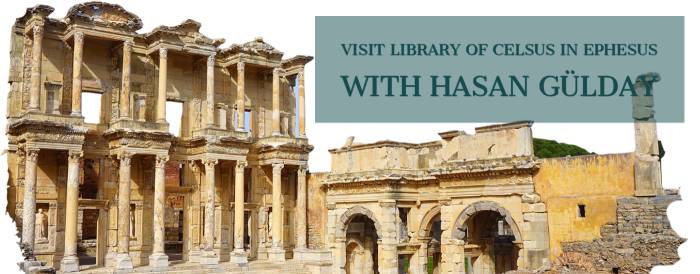
Of course, the best way to learn how to pronounce Ephesus is to come to Ephesus. Stand on the Curettes Street, look up at the Library of Celsus, take a deep breath, and say the name out loud. It feels very different when you are saying it in the place itself.
If you want to discover this magnificent city with a local, professional, licensed tour guide who will not only show you the ruins but also teach you a few Turkish words on the way, you can contact me through theephesus.com or toursaroundturkey.com. Come and unravel the mysteries, and the pronunciations, of Ephesus with me. See you soon, Hasan Gülday.