The fifth of the seven letters is sent to Sardis, the once-glorious capital of Lydia, the city of king Croesus and the river of gold. As I told you in the article on the city, Sardis was a place living off its past, with a famous historical reputation for falling asleep on its watch and being captured by surprise. Almost every line of this letter is going to play on these two themes — lost glory, and failed watchfulness of Sardis, which is modern Sart.

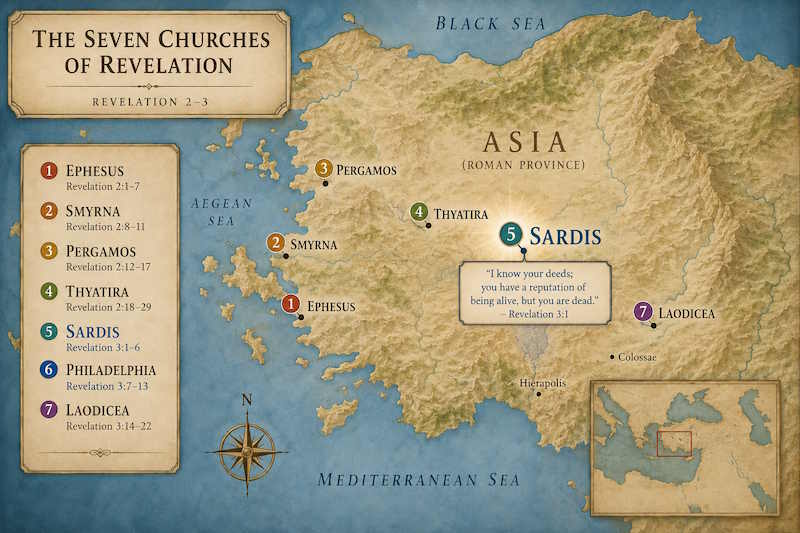
The letter is in chapter 3, verses 1 to 6. It is the second-shortest of the seven, after the letter to Smyrna. And the brevity itself carries meaning. Christ does not need many words for a community which is dying.
The Address
And unto the angel of the church in Sardis write: These things saith he that hath the seven Spirits of God, and the seven stars.
The opening of this letter is unique among the all seven letters. Christ identifies himself as the One who has the seven Spirits of God and the seven stars. The seven stars, as we have already seen in the letter to Ephesus, are the angels of the seven churches. The seven Spirits of God is a phrase used several times in the Apocalypse, and it most probably refers to the fullness of the Holy Spirit, expressed in seven aspects. The phrase echoes the prophet Isaiah, chapter 11, where the Spirit of the Lord is described in a sevenfold way which are wisdom, understanding, counsel, might, knowledge, fear of the Lord, and the Spirit of the Lord himself.
For a church that was spiritually dying, this is the most relevant possible self-identification of Christ. He is the One who possesses the fullness of the Holy Spirit. He is the One who can pour life back into a dead community. The diagnosis which is coming next will be brutal, but the very opening of the letter is already containing the hope of the cure.


No Praise — Only Diagnosis
I know thy works, that thou hast a name that thou livest, and art dead.
Notice what is missing from this letter. There is no praise. There is no I know thy charity, thy service, thy patience. There is no opening commendation. The letter goes directly from the address to the diagnosis. And the diagnosis is the harshest sentence in any of the seven letters. Thou hast a name that thou livest, and art dead.
What does this mean? The Christians of Sardis had a name — that is to say, a reputation — of being alive. Their neighbouring churches probably looked at them with respect. The community was perhaps numerous. The members were probably wealthy and well-established. They were not visibly persecuted, like the Smyrnaeans. They were not visibly tempted by Jezebel, like the Thyatirans. From the outside, everything looked fine.


But Christ, who looks at the heart, says: you are dead. You have the form of religion without the life of religion. You have the worship without the worshippers. You have the structure without the spirit. You are walking, but you are walking like a corpse.
This is, in some ways, the most frightening of all the diagnoses. Because it is the diagnosis which can be missed by everyone, including by the Sardian Christians themselves. A persecuted church knows it is suffering. A compromised church knows, deep inside, that it is compromising. But a dead church may not even know that it is dead.
The Call to Wake Up
Be watchful, and strengthen the things which remain, that are ready to die: for I have not found thy works perfect before God.
The first command is be watchful. In the Greek, gregōrōn ginou, “become a watcher”. This is the most pointed possible command for a city which had been famous for almost a thousand years for falling asleep on its watch. Twice in its long history, as I told you in the article about the city, Sardis had been captured by enemies who climbed the cliff of the acropolis at night while the defenders slept. The Lydians thought they were safe. The Sardian Christians, in 95 AD, also thought they were safe. They were wrong in exactly the same way.
The second command is strengthen the things which remain. There is still something alive in Sardis. The fire is not completely extinguished. There are still embers. The whole letter is not a death certificate. It is a wake-up call. There is something to save, but only if the watchfulness returns immediately.


There is an old Anatolian saying. Geç olsun, güç olmasın. “Let it be late, but let it not be impossible.” The cure of Sardis is exactly this. Late, but not impossible. The watchman has fallen asleep, the enemies have entered, the city is in trouble — but the trouble can still be reversed if the watchman wakes up now. Now, not in five minutes.
Remember and Repent
Remember therefore how thou hast received and heard, and hold fast, and repent.
The next command echoes the call to Ephesus. Remember. The Sardian Christians, like the Ephesians, are being called back to the moment of their first reception of the Gospel. Whatever the original generation of Sardian believers had received from the apostles, perhaps from disciples of Paul or of John himself, that original deposit is still preserved somewhere in the community. They need to find it again, hold on to it, and repent.
The word repent in Greek, metanoia, literally means to change your mind, or in a deeper sense, to turn your direction. Christ is not asking for a small adjustment. He is asking for a full turning back to the original direction.


The Warning of the Thief
If therefore thou shalt not watch, I will come on thee as a thief, and thou shalt not know what hour I will come upon thee.
If they do not wake up, Christ himself will come like a thief, and thou shalt not know what hour I will come. This image is again very specifically chosen for Sardis. The Persian soldier Hyroeades who climbed the cliff and took the city in 547 BC came exactly like a thief at night. The Cretan soldier Lagoras, who repeated the same trick in 218 BC, also came at night, undetected, by the same path. Christ is using the most painful image in the entire civic memory of Sardis. You did not learn from your own history. So I will come like the same thief who has come before, and you will not see me.
The image of Christ coming like a thief is found also in other parts of the New Testament, including in the first letter of Paul to the Thessalonians and in the second letter of Peter. It is one of the great recurring images of the second coming. But here, in the letter to Sardis, it carries an especially local and especially sharp meaning.


The Few Faithful
Thou hast a few names even in Sardis which have not defiled their garments; and they shall walk with me in white: for they are worthy.
After the harsh diagnosis comes a softer note. Even in this almost-dead church, there are a few names who have not defiled their garments. The image of clean garments versus soiled garments was very important in the textile industry of Sardis, where dyers and clothing merchants were a significant part of the local economy. To soil a garment was to make it unsellable. To keep it clean was to preserve its value.


In a spiritual sense, soiling the garments meant participating in the false worship of the city, in the imperial cult, in the social compromises which surrounded the small Christian community. The few who had not soiled their garments were those who had quietly, without public attention, kept themselves separate from these compromises. And they shall walk with me in white, that is to say, in the clothing of victory and of holiness.
I want to underline a small detail here. A few names. In a dying church, the rescue is not collective. Christ is not saving the institution. He is saving the individuals. A few. This is one of the small comforts of the letter. Even when the wider community is dying, the faithful individual is still seen. The few are known. By name.
The Promise of the Book
He that overcometh, the same shall be clothed in white raiment; and I will not blot out his name out of the book of life, but I will confess his name before my Father, and before his angels.
The promise has three parts.
White raiment. The clean garment, which we have already seen, the clothing of victory and holiness.
Not blot out his name out of the book of life. The book of life, in Jewish apocalyptic tradition, is the book in which the names of those who belong to God are written. The image is of a citizen list, kept in the heavenly archive. The promise here is that the name of the faithful overcomer will not be erased. There is a possibility of erasure — the verse implies this. But the faithful are protected from it.


I will confess his name before my Father, and before his angels. This is one of the most personal promises in the seven letters. Christ himself, by name, will speak the name of the faithful believer in front of the Father. Recognition. In a dead church where almost no one is being noticed, the few faithful are being deeply noticed. By the highest possible voice.


One Closing Thought
I can not give the standard pitch for this letter. I always see the letter to Sardis as my favourite one and the one which makes me to understand the connection between Christ and the early Christian communities of Asia Minor.

Instead of a standard pitch, I want to leave you with one quiet observation. When I read this letter in the modern ruins of Sardis, in front of the unfinished temple of Artemis, with the wind moving through the dry grass and the cliffs of the ancient Sardis acropolis rising behind, I always notice something. The Sardian church is no longer there. The community died. The lamp was, eventually, removed. The warning of the letter was real, and the warning was, in the end, fulfilled.
But the few names — the few who had not defiled their garments — they are not in the visible ruins. They are not on the inscriptions. They are not on the tourist plaques. They are somewhere else. In the book of life. In the recognition of Christ. Confessed before the Father and the angels.
The dying institution is forgotten. The faithful individual is remembered. This is the deep theology of the letter to Sardis. And it is, I think, a very useful theology for any of us who have watched a religious community decline. The community may not survive. The faithful individual is not lost.
That is how I see and how I interpret the letter to Sardis.
Thanks for reading.