Ephesus vs Constantinople compares two great cities whose best years came centuries apart. Ephesus was the harbor city and capital of the Roman province of Asia, at its peak in the 1st and 2nd centuries AD. Constantinople, old Byzantium, was the capital of the whole Eastern Roman Empire, at its peak from Constantine’s dedication in AD 330 to Emperor Justinian in the 6th century.
Add Tours Around Turkey as a preferred source on Google
My guests often ask me about Istanbul while we walk down Curetes Street in Ephesus. Many visit both cities on same trip to Turkey and want to know which one was greater. The fair answer is that each was the greatest in its own time. Let’s have a look at both cities at their peaks.

Ephesus vs Constantinople at a Glance
Here are the two cities side by side.
| Topic | Ephesus | Constantinople |
|---|---|---|
| Peak era | 1st and 2nd centuries AD | AD 330 to the 6th century |
| Founder in legend | Androclos, son of an Athenian king | Byzas of Megara |
| Refounded by | Lysimachus, about 290 BC | Constantine, AD 330 |
| Rank | Capital of the province of Asia | Capital of the Eastern Roman Empire |
| Setting | River harbor near the Aegean | Golden Horn on the Bosphorus |
| Great building | Temple of Artemis | Hagia Sophia, AD 537 |
| Ecumenical councils | 431 | 381, 553 and 680-681 |
| UNESCO list | Since 2015 | Since 1985 |
Byzantium, Constantinople and Istanbul
The city on the Bosphorus has had three names. Byzantium was a Greek colony founded by settlers from Megara in the 7th century BC, by tradition under a leader called Byzas. Emperor Constantine dedicated it as his new capital on 11 May 330, and it became New Rome and Constantinople. It became the Ottoman capital in 1453 and is Istanbul today. The whole story is in my article on the historical names of Istanbul.
Setting, Harbors and Walls
Constantinople sits on a peninsula between the Sea of Marmara and the Golden Horn, where the Bosphorus joins the Black Sea to the Mediterranean world. The Golden Horn is a deep, sheltered harbor, and it never closed. Ships from two seas met under walls of the city. By the way, we call the Golden Horn Haliç in Turkish.
Ephesus stood near the mouth of the Cayster River, and the river kept filling its harbor with silt. The Ephesians dredged it many times, the sea still moved away slowly. Today the ruins stand several kilometers inland, and the old Harbor Street ends in green fields.

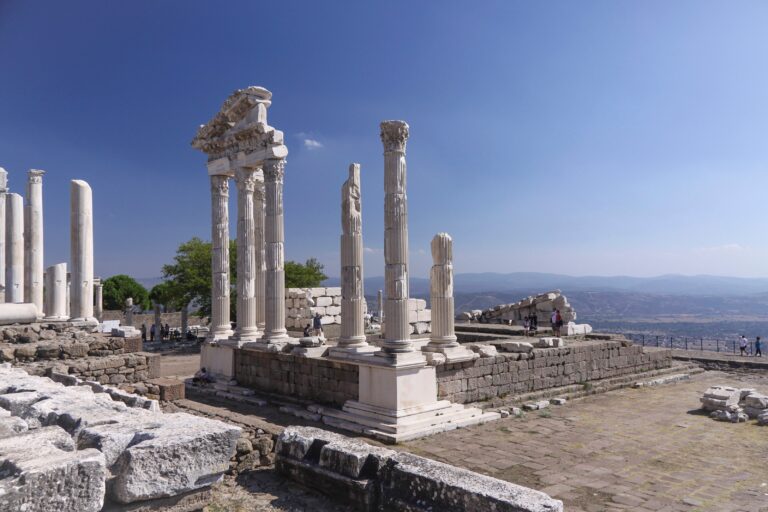
Ephesus had the Hellenistic walls of Lysimachus, which climbed over the two hills of the city, Panayır Dağı and Bülbül Dağı. Constantinople got the Theodosian land walls, finished in their first phase in 413 under Emperor Theodosius II. They run for about 5.7 km (3.5 miles) from the Sea of Marmara to the Golden Horn.
Great Buildings, Streets and Learning
Each city had one building that the whole world talked about. In Ephesus it was the Temple of Artemis, one of the Seven Wonders of the Ancient World. Its marble columns are believed to have been about 18 meters (60 feet) tall. Today one rebuilt column stands in a marshy field in Selçuk.
In Constantinople it was Hagia Sophia, built by Emperor Justinian between 532 and 537. Its dome rises about 55 meters above the floor and is about 31 meters wide. Today it is the Hagia Sophia Grand Mosque, and visitors can go inside.

Both cities loved a show. Ephesus had the Great Theater, believed to have held about 24,000 people, and a stadium. Constantinople had the Hippodrome for chariot races, believed to have held around 100,000. Today it is a square in Sultanahmet with the Obelisk of Theodosius in the middle.

Water was also a matter of pride too. Ephesus brought water from the hills by aqueducts and shared it through marble fountains, such as the Fountain of Trajan. Constantinople had the Aqueduct of Valens, finished in 368, and huge cisterns. The Basilica Cistern, built in 532, has 336 marble columns.
The main street of Constantinople was the Mese, the Middle Street, a colonnaded road that was a market every day in Justinian’s time. Ephesus had Curetes Street, Marble Street and Harbor Street, all paved with marble. Emperor Arcadius, who ruled from Constantinople, rebuilt Harbor Street around AD 400, so we also call it the Arcadiane.

I like to stop my guests on the top of Harbor Street, beside the Great Theater, and show them the straight line of columns running toward the lost harbor. The Library of Celsus nearby is believed to have held about 12,000 scrolls. Constantinople gave the world Justinian’s Code, great collection of Roman law made between 529 and 534.
Here are the peak eras side by side.
| At the peak | Ephesus | Constantinople |
|---|---|---|
| Harbor | River harbor, slowly silting | Golden Horn, never closed |
| Walls | Lysimachus, over two hills | Theodosian, about 5.7 km |
| Great building | Temple of Artemis | Hagia Sophia |
| Show place | Great Theater and stadium | Hippodrome |
| Water | Aqueducts and fountains | Aqueduct of Valens, cisterns |
| Main street | Curetes, Marble and Harbor streets | The Mese |
| Learning and law | Library of Celsus | Justinian’s Code |
How Ephesus and Constantinople Are Linked
Emperors and stone tie the two cities together. Justinian, the builder of Hagia Sophia, also built the great Basilica of Saint John on Ayasuluk Hill nearby Ephesus. Work began by 548 and was finished by 565. Its plan is believed to follow the Church of the Holy Apostles in Constantinople. My article on the Basilica of Saint John shows what is left of it.

An old story says that some columns of Hagia Sophia came from the Temple of Artemis. I like to tell it when we stand beside last column of the temple. In 431 Emperor Theodosius II called the Council of Ephesus, with Nestorius of Constantinople, the patriarch of the capital, at its center and Cyril of Alexandria leading the meeting.
Ephesus and Constantinople in the Bible
Ephesus is a Bible city. Paul taught there for about three years (Acts 20:31), and Acts 19 tells of his work and of the riot in the theater. He wrote the Letter to the Ephesians, Timothy stayed in the city (1 Timothy 1:3), and the first of the seven letters of Revelation goes to the church of Ephesus (Revelation 2:1-7).
Constantinople is not in the Bible. The New Testament was written in the 1st century, and Constantine dedicated his city about three centuries later. Old Byzantium was already there, but no book of the Bible names it. If you like these comparisons, my article on Corinth vs Ephesus looks at two cities of Paul.
In church history the balance turns. Constantinople hosted three of the seven ecumenical councils, in 381, 553 and 680-681. Ephesus hosted one, the council of 431, in the Church of Mary. My article on the seven ecumenical councils shows where all of them met.

Visiting Ephesus and Istanbul Today
Both cities are on the UNESCO World Heritage List: the Historic Areas of Istanbul since 1985 and Ephesus since 2015. In Istanbul most Byzantine sights are in Sultanahmet: Hagia Sophia, the Hippodrome square, the Basilica Cistern and, a little farther, the land walls.
At Ephesus most visits start at the Upper Gate and walk downhill along Curetes Street to the Library of Celsus and the Great Theater. The Temple of Artemis site and the Basilica of Saint John are in Selçuk. My article on the Upper Gate or Lower Gate explains the two entrances.

| Visiting today | Ephesus | Istanbul |
|---|---|---|
| Base | Selçuk or Kuşadası | Sultanahmet, the old city |
| Top sight | Library of Celsus | Hagia Sophia |
| Show place | Great Theater | Hippodrome square |
| Water | Fountains on Curetes Street | Basilica Cistern |
| Walls | Lysimachus walls on the hills | Theodosian land walls |
| Church history | Church of Mary, Basilica of Saint John | Hagia Irene, Hagia Sophia |
| Getting there | Short flight to İzmir, then about an hour by road | Short flight from İzmir |
Ephesus is about 369 km from Istanbul in a straight line. Most of my guests take the short flight from Istanbul to İzmir and then drive about an hour to Ephesus. With a few days for each city, you can see both on one trip to Turkey. I hope you will give Ephesus at least one full day.
Frequently Asked Questions
Is Ephesus older than Constantinople?
Yes. Ephesus was an Ionian Greek city by about the 10th century BC, and Byzantium was founded in the 7th century BC. The name Constantinople came only in AD 330, when Constantine dedicated the city as his capital.
How far is Ephesus from Istanbul?
About 369 km (229 miles) in a straight line. Most visitors take a short flight from Istanbul to İzmir and then drive about an hour to Ephesus.
Is Constantinople in the Bible?
No. Constantinople was dedicated in AD 330, long after the New Testament was written. Ephesus is named in Acts, 1 Corinthians, Ephesians, 1 and 2 Timothy and Revelation.
Hire Ephesus Tour Guide

I am a nationally licensed Turkish tour guide based in Kuşadası, nearby Ephesus. My day guiding is in Ephesus, İzmir and Pamukkale, and on a longer journey my national license lets me join you as your personal guide in Istanbul and other regions of Turkey.
You can see my guiding rates and guiding areas, or write to me through my contact page to ask about my availability.
I hope we will walk down Curetes Street together one day and talk about Constantinople under the same columns. Write to me with your questions about Ephesus and its long story. See you soon, Hasan Gülday.